

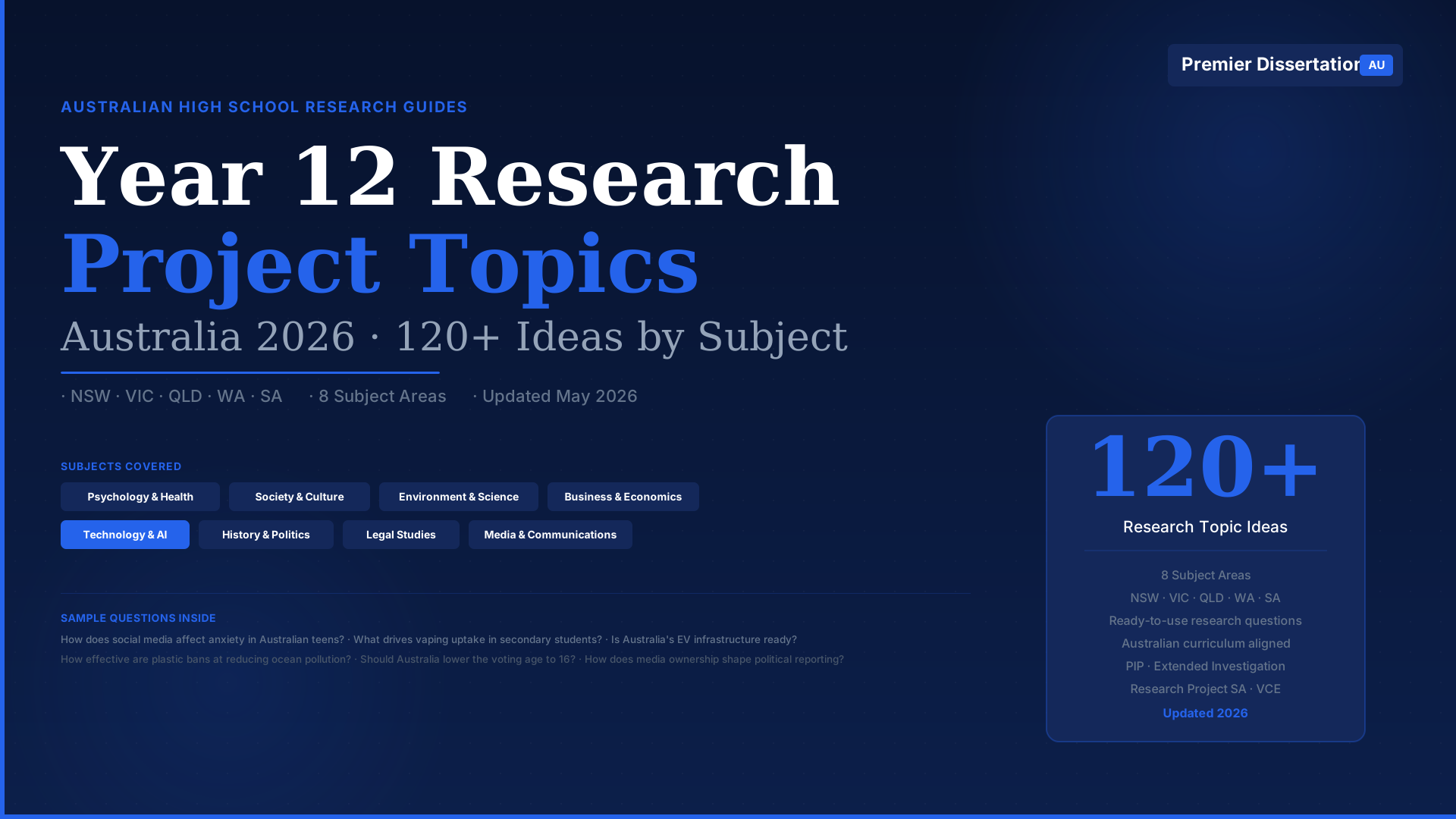
Year 12 Research Project Topics Australia (2026) — 120+ Ideas by Subject
May 16, 2026
How to See Your Turnitin AI Score Before Submitting: A Student’s Guide (2026)
May 18, 2026
Updated: May 2026 · For Academic Year 2026-2027
If you are conducting qualitative research, interview transcription is not just a technical step; it is the foundation of your analysis. A well-transcribed interview allows you to identify patterns and themes, support your arguments with evidence, and ensure accuracy in your findings.
Poor transcription, on the other hand, can distort meaning, weaken your analysis, and cost you marks. This guide explains exactly how to transcribe interviews for a dissertation, with clear steps, examples, tools, and academic best practices.
Reviewed by UK Academic Editor · Premier Dissertations
📘 Explore This Page
Jump directly to key sections of this guide:
- What Does "Transcribing Interviews" Mean?
- Types of Interview Transcription
- Top 7 Key Steps to Transcribe Interviews
- Manual vs Automated Transcription
- Step-by-Step Transcription Process
- Best Tools for Transcribing Interviews
- Common Mistakes to Avoid
- Ethical Considerations
- Expert Tips for Faster Transcription
- Conclusion & Final Notes
- FAQs Students Ask
Want more chapter guides? Explore our Dissertation Examples Library or get free dissertation help.
What Does "Transcribing Interviews" Mean in Research?
Transcribing interviews means converting recorded audio or video into written text. In a dissertation, this is essential because you need written data for analysis, examiners cannot review raw audio, and it ensures transparency and reliability throughout your research.
Most students include full transcripts in the appendix and analyse key extracts in Chapter 4. If you are still working on data collection, you may find our guide on structuring your research methodology useful before beginning transcription.
Types of Interview Transcription
Before you start, you must choose the right transcription style. The method you use should align with your research methodology and analytical approach.
Captures every word, filler (um, uh), pause, and repetition exactly as spoken.
Example:
"Um… I think the course was, uh, quite useful… especially the practical parts."
Best for: Linguistic analysis, discourse analysis, and psychology research.
Removes fillers, repetitions, and irrelevant sounds while preserving the full meaning.
Example:
"I think the course was quite useful, especially the practical parts."
Best for: Most dissertations, thematic analysis, business and management research.
Improves grammar and readability for clarity. Use with caution; over-editing can alter meaning.
Best for: Highly readable summaries, policy-facing reports, executive-level research outputs.
Top 7 Key Steps to Transcribe Interviews (Editors' Choice 2026)
Shortlisted by Premier Dissertations editors for 2026. Use these steps to keep your transcription process accurate, ethical, and examiner-ready.
- Prepare your audio files → label each recording clearly and listen through once before typing.
- Choose your transcription style → verbatim or intelligent verbatim based on your research method.
- Set up a consistent format → use speaker labels, timestamps, and paragraph breaks throughout.
- Transcribe in short segments → play 5–10 seconds at a time; pause and type before continuing.
- Add timestamps and non-verbal cues → include [pause], [laughs], or [00:02:15] where relevant.
- Proofread carefully → check for missing words, formatting errors, and inaccuracies before analysis.
- Anonymise participants → replace all names with "Participant 1" etc. to meet ethical requirements.
Reviewed November 2025 · Premier Dissertations Academic Editorial Team
Turnitin-safe · GDPR compliant · 100% confidential · UK-qualified editors
Manual vs Automated Transcription: Which Is Better?
Both approaches have their place in dissertation research. The table below helps you decide which method suits your needs.
- Highly accurate and context-aware
- Captures nuance and non-verbal cues well
- Time-consuming (4–6 hours per hour of audio)
- Better suited for academic and linguistic analysis
Best for: All dissertation types, especially where precision is critical.
- Fast and convenient for long recordings
- Tools include Otter.ai, Microsoft Word, and Happy Scribe
- Errors are common and always require manual review
- Struggles with accents, overlapping speech, and background noise
Best approach: Use AI tools first, then manually proofread and correct.
Step-by-Step: How to Transcribe Interviews for a Dissertation
Follow these steps to produce an accurate, well-formatted transcript that meets academic standards.
Step 1: Prepare Your Audio
Use clear, properly labelled recordings. Listen through once before you begin typing to familiarise yourself with the speaker's style and content.
Step 2: Choose Your Transcription Style
Decide between verbatim or intelligent verbatim based on your research method. If you are unsure, dissertation methodology guidance can help you decide.
Step 3: Create a Consistent Format
Use a clear, repeatable structure throughout all transcripts:
Participant: [response]
[00:02:15] [pause] [laughs]
Step 4: Transcribe in Short Segments
Play 5–10 seconds of audio, pause, and type before continuing. Use 0.75x slow playback for difficult sections to improve accuracy.
Step 5: Add Timestamps
Timestamps such as [00:02:15] are highly recommended. They allow you to quickly locate and reference specific responses during the analysis phase.
Step 6: Include Non-Verbal Cues
Add cues such as [pause], [laughs], or [hesitation] only where they add analytical meaning. Avoid over-annotating.
Step 7: Proofread and Edit
Check carefully for accuracy, missing words, and formatting consistency. Many students skip this step — and it shows in their analysis quality.
Real Example of a Dissertation Interview Transcript
Here is a simplified example of what a correctly formatted transcript looks like. This is the level of clarity examiners expect.
Interviewer: How do you manage your study schedule?
Participant: I usually study in the evening, around 7 pm.
[Pause]
Participant: Sometimes I get distracted, especially with social media.
Interviewer: What helps you stay focused?
Participant: Turning off notifications helps a lot.
For complete dissertation transcript samples, visit our Dissertation Examples Library (PDFs curated for UK standards).
Best Tools for Transcribing Interviews
These are the most commonly used transcription tools among UK dissertation students. Always proofread any automated output before using it in your work.
- Otter.ai → fast AI transcription with speaker identification; good for longer interviews.
- Microsoft Word → built-in transcription feature; convenient for Office 365 users.
- Trint → advanced editing tools with timestamping and collaborative features.
- Happy Scribe → multilingual support; useful for non-English interviews.
- oTranscribe → free browser-based tool designed specifically for manual transcription.
Where to Include Transcripts in Your Dissertation
Structuring your transcript placement correctly is important for both clarity and examiner expectations.
- Full transcripts → place in the Appendix section at the end of your dissertation.
- Key quotes and extracts → present and analyse in Chapter 4 (Results/Findings).
- Example in-text reference: As one participant stated, "Time management is the biggest challenge" (Participant 3, line 47).
If you need help structuring your results, our dissertation results and discussion chapter guides can be useful.
Ethical Considerations in Interview Transcription
Ethics is a key marking criterion in qualitative research. Your transcription process must comply with your university's ethical guidelines.
- Anonymise all participants → replace real names with codes such as "Participant 1", "Participant 2".
- Remove sensitive data → redact any identifiable details (employer names, locations, personal references).
- Store recordings securely → use password-protected files and delete raw audio after the required retention period.
- Obtain informed consent → confirm participants agreed to their words being transcribed and used in your research.
Common Mistakes in Interview Transcription
Even well-planned dissertations lose marks due to avoidable transcription errors. Watch out for these.
- Wrong transcription style → not matching your method to verbatim or intelligent verbatim.
- Skipping timestamps → makes it harder to reference and verify data during analysis.
- Ignoring non-verbal cues → losing analytical meaning embedded in pauses and hesitations.
- Poor formatting → inconsistent speaker labels and structure reduce academic credibility.
- Copying AI output without editing → automated tools produce errors that undermine accuracy.
- Failing to anonymise → a serious ethical breach that can result in your submission being rejected.
Expert Tips to Transcribe Interviews Faster and Better
These are the practical strategies experienced researchers use to improve both speed and accuracy.
- Use headphones → improves clarity and reduces fatigue during long sessions.
- Use keyboard shortcuts → most transcription tools support play/pause shortcuts to keep hands on the keyboard.
- Work in short sessions → 45–60 minute blocks with breaks, maintain focus and accuracy.
- Slow the playback speed → 0.75x playback helps with accents, mumbling, or fast speech.
- Use AI tools + manual editing → the hybrid approach saves time while preserving quality.
- Transcribe promptly → transcribe soon after each interview while the context is still fresh.
Reviewed November 2025 · Premier Dissertations Academic Editorial Team
Conclusion
Transcribing interviews is one of the most time-consuming parts of a dissertation, but it is also one of the most important. A clear, accurate transcript allows you to analyse data effectively, support your arguments, and produce high-quality research.
By choosing the right transcription method, using appropriate tools, and following a structured process, you can turn raw interview data into meaningful academic insight that strengthens your findings chapter.
Quick reminder: Transcription is the bridge between raw data and analysis. Choose your method carefully, proofread thoroughly, anonymise all participants, and place full transcripts in the appendix with key quotes in Chapter 4.
Reviewed November 2025 · Premier Dissertations Academic Editorial Team
Related Guides and Further Reading
Explore more helpful resources to support your qualitative research and ensure every chapter meets UK academic standards.
Each of these guides provides real examples and step-by-step tips to make your dissertation more effective and examiner-ready.
Reviewed November 2025 · Premier Dissertations Academic Editorial Team
FAQs Students Ask
Short, practical answers to the questions students search for most about transcribing interviews for a dissertation.
How do you transcribe interviews for a dissertation step by step?
Prepare your audio files, choose a transcription style (verbatim or intelligent), create a consistent format, convert the audio into text in short segments, add timestamps and non-verbal cues, then proofread carefully for accuracy before using in your analysis.
Should I use verbatim or intelligent transcription in a dissertation?
It depends on your research method. Verbatim is ideal for linguistic or discourse analysis. Intelligent verbatim is more suitable for most business, management, and social science dissertations where readability matters more than every filler word.
Can I use AI tools to transcribe dissertation interviews?
Yes. AI tools like Otter.ai can significantly speed up the process. However, you must always review and manually correct the output before using it, as automated tools frequently miss nuance, misinterpret accents, and produce formatting errors.
Where should interview transcripts be included in a dissertation?
Full transcripts belong in the Appendix. Key quotes and relevant extracts are then presented and analysed in Chapter 4 (Results/Findings) to support your research conclusions directly.
How long does it take to transcribe an interview for a dissertation?
On average, one hour of interview audio takes 4–6 hours to transcribe manually. The time varies depending on audio quality, number of speakers, accent clarity, and your typing speed.
What is the best format for a dissertation interview transcript?
Use clear speaker labels (Interviewer/Participant), paragraph breaks after each turn, optional timestamps, and consistent notation for non-verbal cues. Maintain the same format across all transcripts for academic consistency.
Do I need to include timestamps in interview transcripts?
Timestamps are not mandatory but are strongly recommended. They make it easier to locate specific responses during thematic coding and demonstrate rigour to your examiner.
What are the common mistakes in interview transcription for dissertations?
The most common errors include not proofreading transcripts, inconsistent formatting, failing to anonymise participants, over-editing responses to change meaning, and relying on automated tools without manual correction.
Do I need ethical approval before transcribing interviews?
Yes. You must have informed consent from participants before transcribing or using their words. Your university's ethics committee approval should be obtained before data collection begins.
When should I transcribe interviews in the dissertation process?
Transcribe after data collection is complete but before analysis begins. Transcription is the essential bridge between raw audio and your findings — do not attempt to code themes before transcripts are finalised.
Trusted by 10,000+ UK students
What Students Say About Us
Verified reviews from students who used our dissertation editing, topic refinement, and proposal guidance services.













Last reviewed: November 2025 · Reviewed by UK Academic Editor
Get a Free Dissertation Review
Upload one chapter for a brief structural and academic-integrity check (Turnitin/AI safe). Response within 24 hours.
Ethical academic support · Turnitin-safe · GDPR compliant · No ghostwriting
Free Student Study Tools
Improve quality and maintain integrity with our UK-trusted tools.
- Free Turnitin Plagiarism Checker
- Data Analysis Support
- How to Write Data Analysis for a Dissertation
- Statistical Analysis Services
24/7 response · UK-qualified support · 100% confidential
⭐ Trusted by UK students · Since 2010 · Reviewed by UK Academic Editors
Request Free Review
Get a quick check of your interview transcripts (formatting, anonymisation, ethical compliance, layout).
Turnitin-safe · GDPR compliant · Ethical academic editing only. Need a fast reply? Chat on WhatsApp