

WAM vs GPA: Understanding Australian University Grading (2026)
May 11, 2026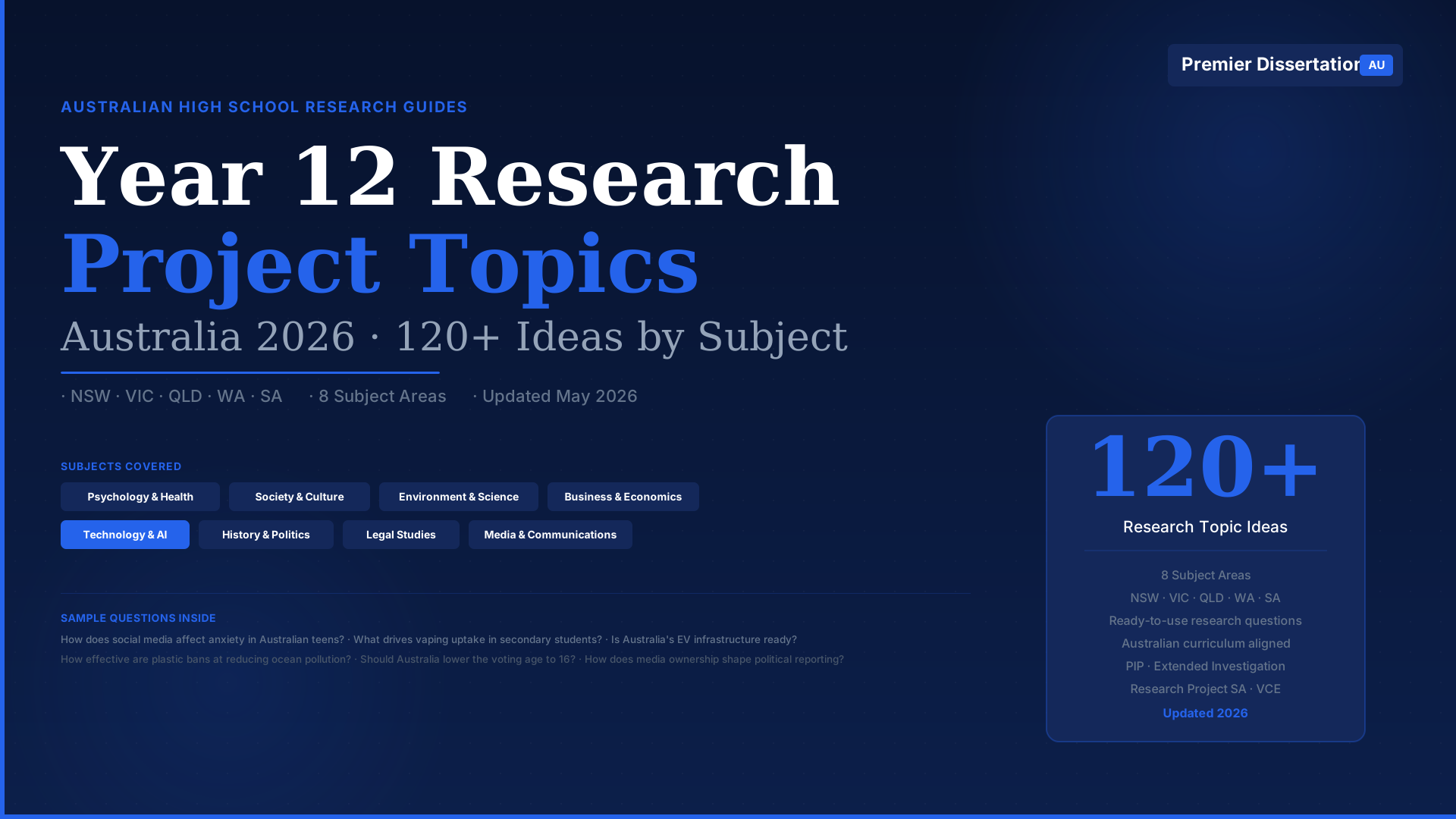
Year 12 Research Project Topics Australia (2026) — 120+ Ideas by Subject
May 16, 2026
Updated: May 2026 · For Academic Year 2026–2027
Designing a dissertation questionnaire is not just a technical step; it is the foundation of your entire research. Many students focus heavily on writing and analysis, but overlook how the data is collected in the first place. If your questionnaire is unclear, biased, or poorly structured, even the most advanced analysis will not produce reliable results.
A well-designed questionnaire ensures your data is accurate, relevant, and easy to interpret. It also improves response rates and reduces errors during analysis. This guide walks you through the process in a practical, step-by-step way, using real examples, templates, and examiner-focused insights.
Reviewed by UK Academic Editor · Premier Dissertations
📘 Explore This Page
Jump directly to key sections of this guide;
- What Is a Dissertation Questionnaire?
- Top 6 Key Steps to Design a Dissertation Questionnaire
- Choosing the Right Question Types
- Bad vs Good Questionnaire Questions
- Copy-Paste Questionnaire Template
- Common Mistakes to Avoid
- Expert Tips and Pilot Testing
- Conclusion
- FAQs Students Ask
Need more support? Explore our Dissertation Examples Library or get free dissertation help.
What Is a Dissertation Questionnaire?
A dissertation questionnaire is a structured tool used to collect primary data from participants in a consistent and measurable format. It is one of the most widely used research instruments in academic study, precisely because it allows you to gather comparable data from a large group within a limited timeframe.
Questionnaires are commonly used in undergraduate dissertations, Master's research projects, PhD-level studies, and both quantitative and mixed-method research designs. They are particularly effective when you need to measure attitudes, behaviours, or opinions across a defined population.
The key distinction between a questionnaire and an interview is structure. A questionnaire presents every participant with the same questions in the same order, which makes the data easier to compare and analyse. For guidance on where this fits into your overall research design, see our guide on dissertation methodology structure.
Top 6 Key Steps to Design a Dissertation Questionnaire (Editors' Choice 2026)
Shortlisted by Premier Dissertations editors for 2026. Follow these steps in order to build a questionnaire that is clear, valid, and examiner-ready.
- Define clear research objectives → every question must directly serve your research aim. If it doesn't, remove it.
- Identify your target respondents → tailor language, length, and complexity to your specific audience.
- Choose the right question types → mix closed-ended, Likert scale, and open-ended questions for depth and measurability.
- Write clear, unbiased questions → avoid leading, double-barrelled, or ambiguous wording.
- Structure the questionnaire professionally → use sections (demographics, core questions, open feedback) with a logical flow.
- Pilot test before distribution → test with 5–10 participants, measure completion time, and revise based on feedback.
Reviewed May 2026 · Premier Dissertations Academic Editorial Team
Turnitin-safe · GDPR compliant · 100% confidential · UK-qualified editors
Step-by-Step Guide: How to Design a Dissertation Questionnaire
Step 1: Define Clear Research Objectives
Before writing a single question, be absolutely clear about your research aim, your research questions, and the type of data you need. Every question must serve a purpose. A simple rule: if a question does not directly help answer your research question, remove it. Students who struggle at this stage often benefit from structured dissertation help to align their research design properly.
Step 2: Identify Your Target Respondents
Your questionnaire should be tailored to your audience. Consider who your participants are, what their level of understanding is, and how much time they can realistically spend. A questionnaire designed for professionals will look very different from one designed for undergraduate students, in language, length, and level of assumed knowledge.
Step 3: Choose the Right Question Types
Using the right mix of question types improves both data quality and analysis. See the section below for a full breakdown of closed-ended, Likert-scale, and open-ended questions.
Step 4: Keep Your Questionnaire Focused
One of the biggest mistakes students make is adding too many questions. Best practice is 10–20 questions with clear wording, no repetition, and a logical flow. A shorter questionnaire almost always results in better completion rates and cleaner data.
Step 5: Structure Your Questionnaire Professionally
A strong structure improves clarity and participant engagement. Use the four-section format below: an introduction explaining the purpose and confidentiality, a demographic section, your main research questions, and an optional open feedback section at the end.
Step 6: Align Questions with Research Variables
Each question should map directly to a research objective, a variable, and a hypothesis where applicable. This alignment makes your analysis considerably stronger and easier to justify in Chapter 4. It is one of the clearest markers that separates average dissertations from high-scoring ones.
Choosing the Right Question Types
A well-balanced questionnaire uses a combination of three question types. Each serves a different purpose in your data collection.
- Yes / No, multiple choice, ranking
- Easy to analyse and code
- Suitable for large datasets
- Best for measuring frequency or preference
Example: "How often do you use online learning platforms? Daily / Weekly / Monthly / Rarely"
- Strongly Agree → Strongly Disagree (5 or 7 points)
- Ideal for measuring attitudes and opinions
- Standard in dissertation research
- Produces ordinal data suitable for SPSS
Example: "Rate your satisfaction with online learning: 1 (Very Low) – 5 (Very High)"
- Allow participants to explain their views
- Provide deeper, qualitative insights
- Useful for mixed-method research
- Best used sparingly — 1 or 2 per questionnaire
Example: "What challenges do you face in online learning?" (free text)
Bad vs Good Questionnaire Questions
This is where many dissertations lose marks. Poorly worded questions produce unreliable data that cannot be properly analysed. Use the comparison below to check your own questions before distribution.
Leading question:
"Do not you agree that social media improves academic performance?"
Problem: pushes the respondent toward a specific answer.
Double-barrelled question:
"Do you find online learning easy and effective?"
Problem: asks two things at once — respondent may agree with one but not the other.
Neutral wording:
"What is your opinion on the impact of social media on academic performance?"
Why it works: no implied answer; respondent decides.
Split into two questions:
"How easy do you find online learning?" and "How effective do you find online learning?"
Why it works: Each question captures one clear variable.
Real Dissertation Questionnaire Example
Below is a sample questionnaire structure for a study on online learning. Use it as a reference when building your own sections.
Section A: Demographics
- Age: ___
- Gender: ___
- Education Level: ___
Section B: Core Questions
- How often do you use online learning platforms? Daily / Weekly / Monthly / Rarely
- Rate your satisfaction with online learning: 1 (Very Low) – 5 (Very High)
- How effective do you find online learning compared to traditional learning? (Much less effective → Much more effective)
- What challenges do you face in online learning? (Open-ended)
Copy-Paste Dissertation Questionnaire Template
Use this template as a starting framework. Replace the placeholder text with your own research questions and adjust the sections to match your methodology.
Title: Academic Research Questionnaire
Introduction: This questionnaire is conducted for academic research purposes. All responses will remain strictly confidential and will be used only for this study.
Section A: Demographics
- Age: ___
- Gender: ___
- Occupation: ___
Section B: Main Research Questions
- Q1: ___
- Q2: ___
- Q3: ___
Section C: Additional Comments
Please share any additional feedback: ___________
Reviewed May 2026 · Premier Dissertations Academic Editorial Team
Common Mistakes in Questionnaire Design (From an Examiner's Perspective)
Examiners regularly deduct marks for avoidable questionnaire errors. Another major issue is collecting data that cannot be properly analysed, which is why many students later require statistical analysis support to fix problems that started at the design stage.
- Irrelevant questions → every item must directly serve a research objective. If it doesn't, remove it.
- Leading or biased wording → questions that suggest a "correct" answer produce unreliable data.
- Double-barrelled questions → asking two things at once makes responses impossible to interpret cleanly.
- Too many questions → questionnaires with over 25 items see sharply reduced completion rates.
- Poor structure → jumping between unrelated topics confuses participants and increases drop-off.
- No pilot test → distributing an untested questionnaire risks wasted data that cannot be recovered.
- No link to research objectives → each section should be traceable back to your research questions.
Expert Tips: Pilot Testing and Distribution
Pilot testing is the step most students skip — and it is also one of the most valuable. Distributing an untested questionnaire risks collecting data that is impossible to analyse properly. If you need support with primary data collection at this stage, our dissertation data collection help service covers survey design, distribution, and analysis preparation.
- Test with 5–10 participants → choose people similar to your target respondents but not in your final sample.
- Measure completion time → if it takes more than 10–12 minutes, shorten it.
- Check for confusing wording → ask testers to flag anything unclear or ambiguous.
- Adjust before distribution → revise based on feedback before sending to your full sample.
- Choose the right distribution channel → Google Forms, email surveys, social media groups, and university portals all reach different audiences. Match the channel to your respondents.
- Align every question with a variable → before finalising, map each question to a specific research objective, variable, or hypothesis.
Reviewed May 2026 · Premier Dissertations Academic Editorial Team
Conclusion
A dissertation questionnaire is not just a list of questions — it is a carefully designed research tool that shapes your entire study. When done correctly, it improves data quality, simplifies analysis, and strengthens your overall research findings.
Focusing on clarity, structure, and relevance will help you create a questionnaire that not only collects data but supports strong academic conclusions. The steps, examples, and templates in this guide give you everything you need to build one that is both examiner-ready and genuinely fit for purpose.
Quick reminder: Every question must link back to a specific research objective. If you cannot explain why a question is in your questionnaire, it should not be there.
Reviewed May 2026 · Premier Dissertations Academic Editorial Team
Related Guides and Further Reading
Explore more resources to strengthen your dissertation methodology and research design.
Each guide provides step-by-step support to help you move from research design through to final submission with confidence.
Reviewed May 2026 · Premier Dissertations Academic Editorial Team
FAQs Students Ask
Short, practical answers to the questions students search for most about dissertation questionnaire design.
What is a dissertation questionnaire, and why is it important?
A dissertation questionnaire is a structured set of questions used to collect primary data for academic research. It is important because it directly affects the accuracy, reliability, and validity of your findings — poor questionnaire design cannot be fixed after data collection.
How do you design a questionnaire for a dissertation?
Define your research objectives first, then identify your target audience, choose appropriate question types, write clear and unbiased questions, structure the questionnaire logically, and pilot test before final distribution.
How many questions should a dissertation questionnaire include?
Typically 10–20 questions. Enough to collect meaningful data across your research objectives, but short enough to maintain participant engagement and completion rates.
What types of questions should be included?
A good dissertation questionnaire uses a mix of closed-ended questions (multiple choice, yes/no), Likert scale questions (for measuring opinions and attitudes), and open-ended questions (for qualitative insights). This combination supports both quantitative and mixed-method analysis.
What are the most common mistakes in questionnaire design?
Using leading or biased questions, making the questionnaire too long, asking double-barrelled questions, using complex language, failing to pilot test, and including questions that don't link to any research objective.
Can I use Google Forms for my dissertation questionnaire?
Yes. Google Forms is widely used for dissertation questionnaires at undergraduate and master's level. It is free, easy to use, and exports data directly into formats compatible with Excel and SPSS.
How do you ensure a questionnaire is valid and reliable?
Align all questions with your research objectives, use clear and neutral wording, conduct pilot testing with a small sample, and revise based on feedback. Consistency in question structure across all participants strengthens reliability.
When should you use a questionnaire in a dissertation?
A questionnaire is ideal when you need data from a large number of participants, your research is quantitative or mixed-method, and you need measurable, comparable responses across your sample.
What is the difference between a questionnaire and an interview?
A questionnaire presents every participant with the same questions in the same order — producing comparable, quantifiable data. An interview is more flexible and conversational, producing deeper qualitative insights but data that is harder to compare across participants.
How do I analyse questionnaire data after collection?
Common tools include Excel for basic analysis and SPSS for advanced work. Typical methods include descriptive statistics, cross-tabulation, correlation, and regression analysis. For complex datasets, our statistical analysis service provides full SPSS support with written interpretation.
Trusted by 10,000+ UK students
What Students Say About Us
Verified reviews from students who used our dissertation editing, data analysis, and methodology support services.













Last reviewed: May 2026 · Reviewed by UK Academic Editor
Get a Free Dissertation Review
Upload one chapter for a brief structural and academic-integrity check (Turnitin/AI safe). Response within 24 hours.
Ethical academic support · Turnitin-safe · GDPR compliant · No ghostwriting
Free Student Study Tools
Improve quality and maintain integrity with our UK-trusted tools.
- Free Turnitin Plagiarism Checker
- Statistical Analysis Services
- Data Collection Help
- Dissertation Examples (PDF)
24/7 response · UK-qualified support · 100% confidential
⭐ Trusted by UK students · Since 2010 · Reviewed by UK Academic Editors
Request Free Review
Get a quick check of your questionnaire design — clarity, structure, bias, and alignment with your research objectives.
Turnitin-safe · GDPR compliant · Ethical academic editing only. Need a fast reply? Chat on WhatsApp