

Dissertation Timeline (Free Template + Examples): Step-by-Step Guide for Master’s and PhD Students
March 15, 2026
How to Publish a Research Paper in UK
March 18, 2026
Updated: March 2026
Reviewed by: UK Academic Editor
Publishing a paper can feel difficult when the process is not clearly explained. Many students and early-career researchers complete strong work but still struggle with journal selection, formatting rules, submission steps, and reviewer expectations. In most cases, the problem is not the quality of the idea. It is the lack of a clear publishing strategy.
This guide explains how to publish your research paper in a practical and realistic way for UK students, graduates, and researchers. It covers what publication means, how to choose the right journal, how peer review works, and what you should check before submission. If you are still refining your draft, our how to publish a research paper guide can help you understand the full process in more detail.
Before submitting to any journal, it is also important to check whether your paper matches the journal's aims, follows academic conventions, and is free from avoidable errors. Choosing the best journal to publish research paper can improve your chances of acceptance and reduce the risk of immediate rejection.
Whether you are preparing your first article or trying to move your dissertation work towards publication, the sections below will help you take the next step with more confidence and less confusion.


Explore This Page
Jump directly to each stage of publishing your research paper:
- What Does It Mean to Publish a Research Paper
- Who Can Publish a Research Paper in the UK
- Types of Journals You Can Publish In
- How to Choose the Right Journal
- Step-by-Step Process to Publish Your Research Paper
- Understanding the Peer Review Process
- How Long It Takes to Publish a Paper
- Common Reasons Research Papers Get Rejected
- How to Improve Your Chances of Acceptance
- Open Access vs Traditional Publishing
- Ethical Guidelines and Plagiarism Rules
- Cost of Publishing a Research Paper
- Final Checklist Before Submission
- Conclusion: From Research to Publication
Need help before submission? Explore our research paper writing guide.
What Does It Mean to Publish a Research Paper
Publishing a research paper means submitting your work to an academic journal where it is reviewed, evaluated, and accepted for public sharing. Once published, your research becomes part of the academic record and can be read, cited, and used by other researchers, students, and professionals.
In simple terms, publication is not just about writing a paper. It is about meeting academic standards, following journal requirements, and passing the peer review process. This is why many strong papers still get rejected. The issue is often not the idea, but how the research is presented and aligned with journal expectations.
Most journals follow a structured process. You submit your paper, editors check whether it fits the journal scope, and then reviewers evaluate its quality, originality, and clarity. Only after passing these stages does the paper get accepted for publication.
Before reaching this stage, your paper must be properly written, structured, and formatted. If you are still developing your draft, reviewing a complete research paper writing guide can help you strengthen your content before submission.
It is also important to ensure your work is original and meets ethical standards. Journals often reject submissions that have high similarity or unclear referencing. Using a reliable free plagiarism checker UK before submission can help you identify and fix these issues early.
Understanding what publication really involves allows you to approach the process with realistic expectations. It helps you avoid common mistakes and increases your chances of getting accepted by the right journal.
Who Can Publish a Research Paper in the UK
One of the most common misconceptions is that only experienced academics or university professors can publish research papers. In reality, anyone who produces original, well-structured research can submit their work to a journal. This includes undergraduate students, postgraduate students, PhD researchers, and independent scholars.
In the UK, many students begin their publishing journey by converting dissertation work into a research paper. If your research has a clear objective, strong methodology, and meaningful findings, it can often be refined and submitted for publication. Journals are primarily interested in quality, relevance, and originality, not your academic title.
However, first-time authors often face challenges because they are unfamiliar with journal expectations. Academic writing style, referencing standards, and submission formats must align with journal guidelines. Reviewing a clear dissertation structure can help you understand how to organise your work in a way that meets academic standards.
Supervisors and academic mentors can also play an important role in guiding new researchers. In some cases, students publish papers with co-authors such as lecturers or research advisors. This can improve credibility and increase the chances of acceptance, especially for early submissions.
Before submitting, it is important to refine your work carefully. Even strong research can be rejected due to clarity issues, formatting mistakes, or weak presentation. Using professional dissertation proofreading services can help improve language, structure, and overall quality before submission.
In short, publishing is not limited to experts. It is open to anyone who understands the process, follows academic standards, and presents their research clearly. With the right preparation, even your first paper can be successfully published.


Types of Journals You Can Publish In
Not every journal serves the same purpose, and choosing the wrong type of journal can delay publication before the review process even begins. Some journals focus on original empirical studies, while others publish review papers, case studies, theoretical discussions, methodological papers, or short communications. Before submitting your paper, you need to understand what kind of contribution your work actually makes.
Broadly speaking, most researchers submit to one of four common categories. The first is the standard peer-reviewed academic journal, which is usually the strongest option for serious research publication. The second is an open access journal, where accepted papers are made freely available online. The third is a specialist journal focused on a narrow subject area. The fourth is an interdisciplinary journal, which may be suitable if your research crosses more than one field.
Students often make the mistake of targeting journals based only on name recognition. A better approach is to study the journal’s aims, scope, audience, and the type of articles it has published recently. If you are unsure where your work fits, reviewing the best journal to publish research paper can help you compare suitable options more carefully.
You should also look at practical details such as word count, citation style, review speed, publication fees, and whether the journal accepts student-led work. Some journals are highly selective and usually expect a polished manuscript that already reads like a publishable article. Others are more open to first-time authors, provided the work is original and clearly presented.
In simple terms, the right journal type depends on your discipline, your research aim, and the audience you want to reach. Once you understand that, the next step becomes much easier.
How to Choose the Right Journal
Choosing the right journal is one of the most important decisions in the publication process. A strong paper sent to the wrong journal is often rejected quickly, sometimes without external review. This is known as a desk rejection, and it usually happens because the topic does not match the journal’s scope, the paper type is unsuitable, or the submission does not follow the journal’s priorities.
Start by identifying journals that regularly publish work similar to yours. Read their aims and scope carefully, and then compare your paper with recently published articles. Ask yourself whether your research question, method, and findings would make sense to that journal’s readership. If the answer feels forced, the fit may not be strong enough.
It is also important to review practical submission requirements. Pay attention to formatting rules, maximum word count, referencing style, abstract structure, and whether the journal expects tables, appendices, or supplementary files in a specific format. If your manuscript still needs refinement, the full how to publish a research paper guide can help you understand how these pieces fit together before submission.
Another useful filter is relevance rather than prestige. New authors often aim too high too early, which leads to avoidable rejection. A realistic journal with the right audience is often a better choice than a famous journal that is only loosely connected to your topic. Your goal should not be to submit anywhere. Your goal should be to submit where your work genuinely belongs.
If your paper is adapted from a larger academic project, refining the structure before journal selection can also help. A clear argument, tighter section flow, and a better presentation of findings often improve journal fit. For this reason, many students review their draft against a solid dissertation structure before converting it into article format.
Step-by-Step Process to Publish Your Research Paper
The publication process becomes much easier when you break it into clear stages. Many authors feel overwhelmed because they treat publication as one large task, when in reality it is a sequence of smaller decisions. Once you understand the order, the process feels more manageable.
Step 1: Refine the paper. Your manuscript should be clear, focused, and written for journal readers rather than for classroom assessment. If your work began as a dissertation chapter or full thesis, you may need to shorten it, sharpen the argument, and remove unnecessary background sections. Reviewing a focused research paper writing guide can help you tighten the draft before submission.
Step 2: Match the paper to a journal. Study the journal’s scope, formatting rules, and recently published articles. Make sure the journal publishes work in your area and accepts the type of manuscript you are submitting.
Step 3: Prepare the submission package. This usually includes the manuscript, title page, abstract, keywords, references, and in some cases a cover letter, ethical approval note, or declaration of originality. Some journals also ask for suggested reviewers or funding information.
Step 4: Submit through the journal portal. Most journals use an online submission system. You will be asked to upload files separately, enter author details, confirm ethical compliance, and approve the final version before submission.
Step 5: Wait for editorial screening. The editor first checks whether the paper fits the journal. At this stage, many papers are rejected because of poor fit, weak structure, or failure to follow instructions.
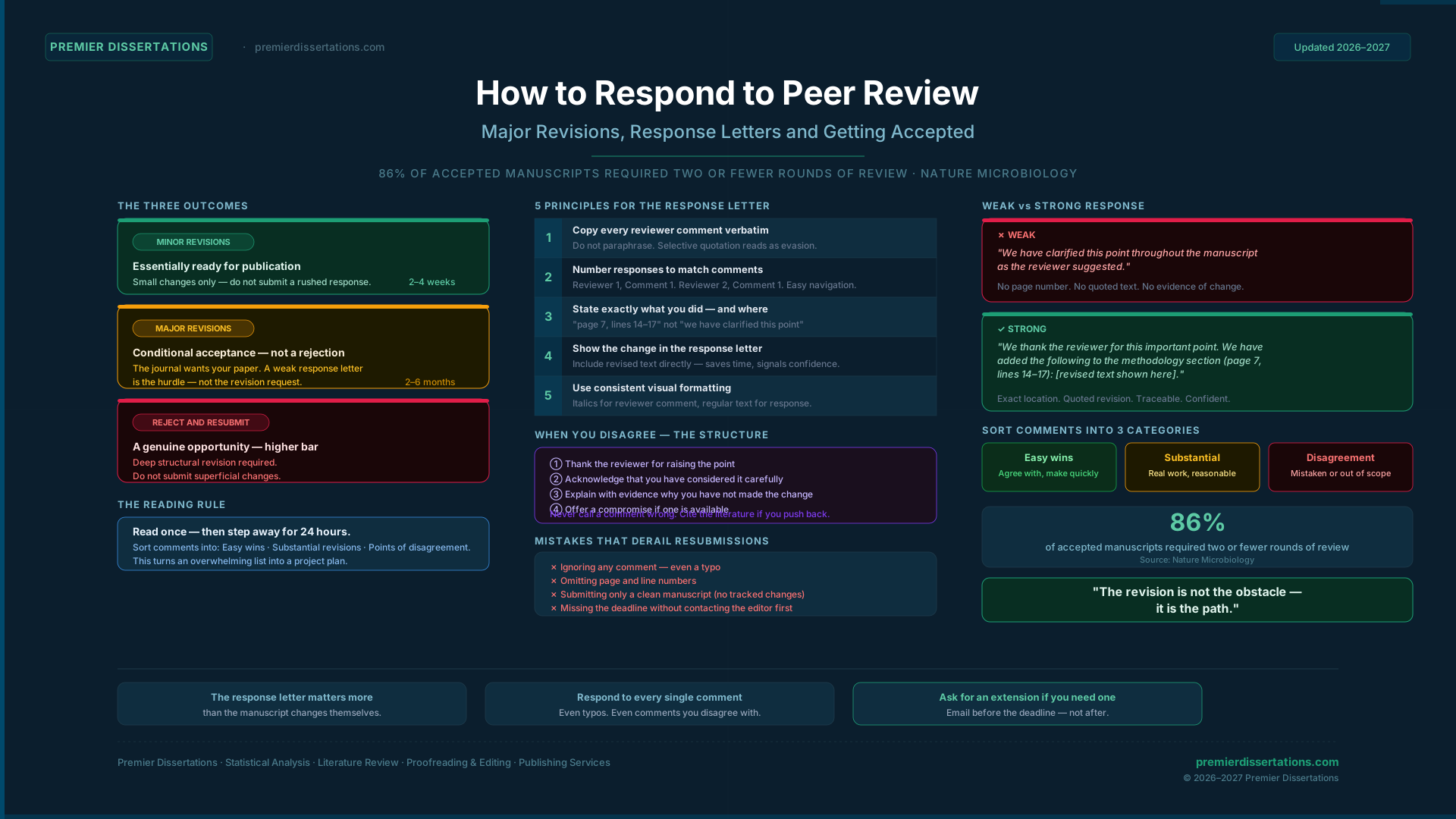
Step 6: Respond to peer review. If the editor sends your paper for review, you may receive comments asking for revisions. These can be minor or major. A calm, structured response often makes a real difference to the outcome.
Step 7: Complete final revisions and proof checks. Once accepted, your paper may still go through copy-editing and proof approval. This is the stage where small errors in grammar, consistency, and formatting should be corrected carefully. Many researchers use dissertation proofreading services at this stage to improve clarity before or after submission.
Understanding the Peer Review Process
Peer review is the stage where other experts in the field evaluate your paper before publication. Its purpose is to check whether the work is original, methodologically sound, clearly written, and suitable for the journal. For many first-time authors, this is the most unfamiliar part of the process, yet it is also one of the most important.
After editorial screening, the manuscript is usually sent to two or more reviewers. They assess the quality of the research question, the method, the interpretation of findings, and the overall contribution of the paper. They may also comment on structure, language, referencing, and whether the conclusions are supported by the evidence presented.
There are different review models, including single-blind, double-blind, and open review. In a double-blind review, both the author and reviewer identities are concealed. This is common in many disciplines because it aims to reduce bias during evaluation.
The outcome is rarely a simple yes or no at first stage. Most authors receive one of four common decisions: accept, accept with minor revisions, revise and resubmit, or reject. A revise and resubmit decision is not a failure. In many cases, it is a positive sign that the journal sees potential in the paper.
Responding to reviewers requires patience and precision. You should answer each comment clearly, revise the manuscript carefully, and explain what changes were made. If a reviewer misunderstands a point, that usually means the paper needs clearer wording. Strong presentation matters as much as strong ideas, especially in peer-reviewed publication.
How Long It Takes to Publish a Paper
One of the biggest surprises for first-time authors is how long academic publishing can take. Even when a paper is strong, the timeline is rarely quick. From first submission to final publication, the process may take several months, and in some cases much longer.
The first stage is editorial screening, which may take a few days or several weeks depending on the journal. If the paper passes this stage, it then moves into peer review. Reviewers need time to read the manuscript, evaluate its quality, and prepare detailed comments. This stage is often the longest part of the process.
After reviews are returned, the editor makes a decision. If revisions are requested, the timeline depends partly on you. Some authors complete revisions within days, while others need several weeks to respond properly. Once the revised paper is submitted again, it may return to reviewers for another round or go straight to the editor for a final decision.
Even after acceptance, the paper may still go through copy-editing, proof approval, and scheduling for online or print release. For this reason, publication should be approached as a staged process rather than a quick outcome. If your research needs clearer presentation before submission, strengthening the method and findings sections through a dedicated research methodology and data analysis guide can reduce unnecessary delays later.
The key point is simple: publication takes time, but delay does not always mean something is wrong. Academic publishing moves slowly because journals are trying to protect quality and credibility.
Common Reasons Research Papers Get Rejected
Many papers are rejected for reasons that could have been addressed before submission. In some cases, the research itself is not weak. The problem lies in positioning, clarity, or journal fit. Understanding the most common causes of rejection can help you avoid losing time on preventable mistakes.
One frequent reason is poor journal matching. A paper may be well written, but if it does not suit the journal’s audience, scope, or article type, it is unlikely to move forward. Another common problem is a weak abstract. Editors often form an early impression from the title, abstract, and keywords, so these sections need to be precise and convincing.
Methodological weakness is another major issue. If the method is unclear, poorly justified, or not explained in enough detail, reviewers may question the credibility of the findings. This is especially important when adapting dissertation work into article form. Many students benefit from reviewing strong research proposal examples and methodological guidance before final submission.
Other common reasons include poor structure, unsupported conclusions, inconsistent referencing, language errors, and failure to follow submission guidelines. Some papers are also rejected because they offer too little originality or repeat ideas already well covered in the literature.
In short, rejection is often not random. It usually reflects a mismatch between the paper, the journal, and the way the research is presented. When you understand that, you can improve the parts that matter most before submitting.
How to Improve Your Chances of Acceptance
Improving your chances of acceptance starts long before you click submit. The strongest authors do not rely on luck. They improve fit, sharpen the argument, and remove weaknesses that would give editors a reason to reject the paper early.
First, make sure your paper has a clear purpose. The research question should be easy to identify, and every section of the paper should support it. A common problem in rejected papers is that the discussion becomes too broad or disconnected from the original aim. Reviewers are more likely to respond positively when the paper feels focused from start to finish.
Second, give proper attention to structure and language. Clear section flow, consistent terminology, and concise paragraphs make the paper easier to review. If your writing still feels too close to a dissertation chapter, it may help to tighten the draft using a strong dissertation editing service before submission.
Third, strengthen the technical details. Make sure references are complete, tables are labelled correctly, and all claims are supported by evidence. This is also a good stage to review originality and remove any wording that may trigger similarity concerns. If you use AI tools during drafting, it is wise to review the final text through an AI content detector tool and then edit the language so it reads naturally and consistently.
Finally, take reviewer expectations seriously before they even arrive. Ask yourself what questions a critical reader would raise. If your paper answers those questions clearly from the start, your chances of acceptance become much stronger.
Open Access vs Traditional Publishing
When choosing a journal, you will often need to decide between open access and traditional publishing. Both models can be valid, but they work differently and each has practical implications for visibility, cost, and access.
Open access publishing makes your paper freely available online for anyone to read. This can increase reach, especially if you want your work to be accessible to students, practitioners, policymakers, or researchers without institutional subscriptions. In many cases, however, open access journals charge an article processing fee after acceptance.
Traditional publishing usually means the journal controls access through subscriptions. Readers often need university access or institutional credentials to view the full paper. These journals may not charge the same type of publication fee, although this varies from one publisher to another.
The right choice depends on your goals, your field, and your funding situation. If broad visibility matters most, open access may be more attractive. If budget is limited and the journal is a strong fit, traditional publication may still be the better route. The important point is not to choose based only on labels. You should compare journal reputation, audience, cost, review standards, and long-term value.
Ethical Guidelines and Plagiarism Rules
Ethics play a central role in academic publishing. Journals expect authors to submit original work, acknowledge sources properly, report findings honestly, and follow accepted research standards. If ethical concerns appear at any stage, a paper can be rejected immediately, even if the topic itself is strong.
Plagiarism is one of the most serious issues. This includes direct copying, close paraphrasing without citation, recycled text from previous work, and submitting the same material to more than one journal at the same time. Many authors assume plagiarism only means copying full paragraphs, but journals also look for unoriginal phrasing, weak attribution, and unattributed reuse of their own earlier writing.
Before submission, it is wise to review your manuscript for citation accuracy, paraphrasing quality, and reference consistency. Running the final draft through a reliable free plagiarism checker for students can help identify similarity problems before a journal does.
Ethical publishing also includes transparency in authorship, funding, data use, and approval procedures. If your research involved human participants, interviews, surveys, or sensitive data, journals may ask whether ethical approval was obtained. Your paper should be ready to answer that clearly.
In simple terms, good ethics protect both your work and your reputation. A publishable paper is not only well written. It is also honest, properly referenced, and responsibly presented.
Cost of Publishing a Research Paper
The cost of publishing a research paper depends on the journal you choose. Some journals do not charge authors at the point of submission or acceptance, while others require publication fees, open access charges, or additional costs for optional services. Because of this variation, it is important to check the journal website carefully before submitting.
Open access journals are more likely to charge article processing fees, especially when the paper will be made freely available to all readers. Traditional journals may have lower direct author costs, but this is not always guaranteed. In some cases, journals also charge for colour figures, extra pages, or post-acceptance changes.
You should also consider indirect costs. These include proofreading, editing, formatting support, plagiarism checking, or revision help after peer review. While these are not journal fees, they can still affect the overall cost of getting a paper publication-ready. Some authors see these as optional, but for first-time submissions they can make a meaningful difference to quality and acceptance potential.
The key is to balance cost with credibility. A low-fee journal is not always the best option, and a high-fee journal is not automatically better. What matters most is legitimacy, academic fit, and the quality of the review process.
Final Checklist Before Submission
Before you submit your paper, take time to review it with a practical final checklist. This stage often determines whether the submission moves smoothly into review or gets delayed by avoidable problems.
- Confirm that the journal’s aims and scope clearly match your topic.
- Check that your title, abstract, and keywords reflect the real focus of the paper.
- Make sure the paper follows the required word count, structure, and referencing style.
- Review tables, figures, headings, and appendices for consistency and accuracy.
- Check that all sources are cited correctly in the text and listed in the references.
- Confirm originality and remove any high-similarity wording before submission.
- Prepare any additional documents requested by the journal, including cover letter or declarations.
- Proofread the final version carefully for grammar, clarity, and formatting issues.
If your paper still feels uneven at final stage, it may help to get one more expert review before submission. Many authors choose a free dissertation review or editorial check to identify issues they can no longer see in their own work.
A careful final check does not guarantee acceptance, but it greatly reduces the risk of rejection for avoidable reasons. That alone makes it worth doing properly.
Conclusion: From Research to Publication
Publishing a research paper is not only about finishing a manuscript. It is about preparing that manuscript for the standards, expectations, and realities of academic publication. From journal selection to peer review, every stage requires careful judgement rather than rushed submission.
The strongest papers are usually not the ones submitted first. They are the ones refined with more care, matched to the right journal, and checked properly before entering review. If you understand how journals work, follow ethical standards, and present your research clearly, publication becomes far more achievable.
For many students and early researchers, the journey begins by turning coursework, dissertation research, or an early study into a stronger article. That process takes editing, patience, and a realistic strategy, but it is entirely possible. If you want to improve your paper before submission, reviewing the how to publish a research paper guide and exploring the best journal to publish research paper can help you move forward with more confidence.
The goal is simple: do not submit in a hurry. Submit when your paper is ready, your journal choice is sensible, and your research is presented in the clearest possible way.
Frequently Asked Questions (FAQs)
Get 3+ Free Dissertation Topics within 24 hours.