

Open Access vs Subscription Journals: Which Should You Choose? (2026-2027)
November 24, 2025
Gig Economy & Platform Economy Dissertation Topics 2026-27
November 26, 2025
Publishing your dissertation in the right journal can be the difference between your research being widely cited or barely noticed. With hundreds of journals available, picking the right one can feel overwhelming. Choose poorly, and months of research may go unnoticed. Choose well, and your work reaches the right audience, earns citations, and strengthens your academic profile.
This guide walks through how to identify the best journal for your dissertation, step by step, so you can maximise reach, credibility, and long-term impact.
Updated August 2026, for the 2026 to 2027 publishing cycle. Written by Katherine Alexander, PhD, UK Academic Editor at Premier Dissertations.
Quick take
- Define your audience: who should read and cite your research?
- Check journal metrics: impact factor, h-index, SJR score.
- Review scope and past issues: make sure your topic genuinely fits.
- Verify credibility: peer review, editorial board, and indexing.
- Consider access model: open access vs subscription.
- Confirm funding: can you cover APCs if the journal is open access?
📋 Before You Submit to Any Journal
Journals desk reject papers for plagiarism and AI generated content before they even reach peer review. Check your manuscript is clean before you submit.
Free Plagiarism Check Free AI Detector📘 Explore This Page
- What Makes a Journal the "Best" for Your Dissertation?
- Key Factors to Consider
- Open Access vs Subscription Journals
- Should You Split Your Dissertation Into Multiple Papers?
- Step-by-Step Process
- Gold vs Green Open Access
- Embargo Policies and Avoiding Fraudulent Agents
- Tools and Resources
- Best Journals by Discipline
- Final Tips
- FAQs
What Makes a Journal the "Best" for Your Dissertation?
Not all journals are equal, but "best" isn't the same thing as "highest impact factor." A journal earns that title when it publishes research in your subject area and methodology, gives your work a realistic chance of being seen and cited, and puts it through genuine peer review with recognised indexing.
In other words, the best journal is the one where your work fits, is taken seriously, and reaches the audience that actually matters for your career, not necessarily the most prestigious name available.
Key Factors to Consider
1. Scope and Relevance
Start with fit. Read the journal's aims and scope section carefully, and review a few recent issues to confirm your dissertation topic genuinely aligns with what they publish, not just adjacent to it.
2. Impact Factor and Indexing
Journals indexed in Scopus, Web of Science, or PubMed typically carry more weight academically. Check the impact factor, h-index, and SJR score where relevant, but only after confirming the journal is genuinely a fit for your field. See our full journal impact factor guide for how to interpret these numbers properly.
3. Peer Review Quality
Rigorous peer review protects you from predatory publishers and ensures your work is respected. Examine the editorial board for recognised experts, and check how clearly the peer review process is described in the submission guidelines.
4. Audience and Visibility
Consider who actually reads the journal, academics, practitioners, policymakers, or a mixed audience. Wider visibility usually means more citations and more real-world influence.
5. Publication Speed and Acceptance Rate
For early-career researchers, publication speed can matter for job applications and funding deadlines. Tools like Elsevier Journal Finder often show indicative decision and publication times.
Open Access vs Subscription Journals
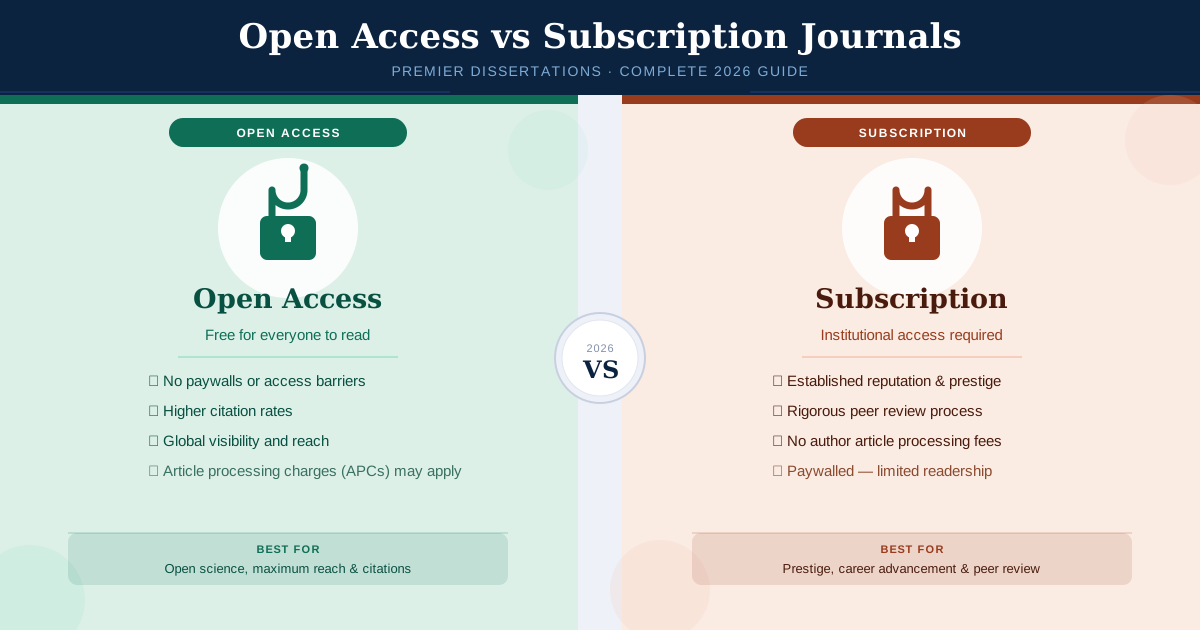
Understanding the difference between open access and subscription journals helps you balance visibility, cost, and prestige. For the full picture, see our dedicated open access vs subscription journals guide.
| Feature | Open Access Journals | Subscription Journals |
|---|---|---|
| Accessibility | Free for everyone to read. | Requires subscription or institutional access. |
| Cost for authors | Usually requires APCs (Article Processing Charges). | Often no APCs, funded by subscriptions. |
| Visibility | High, easily shareable across networks. | Limited to subscribers and affiliated institutions. |
| Prestige and impact | Variable, some OA journals are top-tier, others are newer or niche. | Often established with higher impact factors, field-dependent. |
| Speed | Often faster publication workflows. | Can be slower due to rigorous, multi-stage peer review. |
Pro tip: combine open access journals for visibility with subscription journals for credibility and impact where appropriate.
Should You Split Your Dissertation Into Multiple Papers?
Often, yes, and this is one of the most overlooked decisions students make. A 150 to 200 page dissertation typically doesn't fit into a single journal article. It usually yields 2 to 4 genuinely focused papers, each built around one clear question, and the right journal often differs for a methods-focused chapter, an empirical results chapter, and a literature review chapter.
A few practical ways to work out your target journals:
- Mine your own bibliography. The journals you cite most often for a given chapter are natural candidates for that chapter's article.
- Ask your supervisor or committee. They often know exactly where similar work in your field gets published, and can point you toward journals you might not find alone.
- Check where recent graduates from your program published. If your department has produced dissertation-derived articles before, that's a useful, realistic benchmark.
One important caution if you do split your work: each resulting paper needs a genuinely distinct framing and needs to be fully rewritten, not recycled from chapter to chapter. Publishing near-identical content across multiple journals as separate papers is self-plagiarism, and it's taken seriously by journals and universities alike.
Step-by-Step Process to Choose the Best Journal
- Define your audience. Who benefits most from this research, academics, practitioners, policymakers, or a niche group? Focus on journals your peers and examiners are likely to read.
- Evaluate metrics. Check impact factor, h-index, and SJR score using the official Scopus Source List and Web of Science Master Journal List, not third-party estimates.
- Review the journal's scope and recent issues. Ask honestly: does my topic and methodology look like what this journal normally publishes?
- Verify peer review and credibility. Check the editorial board and indexing status. Avoid journals absent from reputable databases, since that's a real predatory-journal warning sign. Use Think.Check.Submit as a quick reference.
- Consider publication speed. Fast publication can matter for early-career milestones. Tools such as Elsevier Journal Finder or Springer Journal Suggester give indicative timelines.
- Check funding and APCs. For open-access journals, confirm whether your institution, supervisor, or grant can cover the fee before you commit.
- Read a few similar articles closely. Use one from your target journal as a structural model, since dissertations and journal articles are written for very different audiences.
If you'd rather get a personalised starting point instead of doing all of this manually, our free journal matcher asks a few quick questions and gives you a realistic tier and publisher shortlist.
Gold vs Green Open Access for Dissertation Publication
When planning how your dissertation-based article will be accessed, you will often see Gold OA and Green OA options:
| Type | Description | Accessibility |
|---|---|---|
| Gold OA | The final article is immediately free on the journal website, usually supported by APCs. | Instant visibility and global access from day one. |
| Green OA | Authors self-archive a version of the article in a repository, often after an embargo period. | Free access later, ensuring long-term discoverability. |
Pro tip: Gold OA gives immediate exposure and rapid sharing, while Green OA ensures long-term accessibility, especially combined with a reputable subscription journal.
Embargo Policies and Avoiding Fraudulent Agents
Most journals don't treat a dissertation sitting in a university repository as prior publication, but this varies, so confirm the specific journal's policy and disclose your thesis in the cover letter regardless. If publication is genuinely important to you, it's also worth checking your university's embargo options. Many institutions allow you to delay public release of the full thesis for 6 to 24 months, which keeps your later journal submission cleaner.
Separately, be alert to fraudulent submitting agents and manuscript editing services. Taylor & Francis's own author guidance explicitly warns authors to watch for fake acceptance letters and unauthorised third parties claiming to guarantee placement. If a service promises guaranteed acceptance for a fee, that's not a shortcut, it's a red flag. See our guide on guaranteed journal publication scams for more detail.
Tools and Resources for Selecting Journals
- Premier Dissertations Journal Matcher, a free, publisher-agnostic starting point based on your field and priorities
- Elsevier Journal Finder, matches your abstract to suitable Elsevier journals
- Springer Journal Suggester, the same idea for Springer titles
- Scopus Source List, explore indexed journals by discipline with real metrics
- Web of Science Master Journal List, verify indexing and subject categories
- DOAJ, discover verified open-access journals
Cross-check journal fit using more than one of these tools, then confirm the details directly on the journal's own official website before submitting.
Best Journals by Discipline
Different fields have different leading journals, and the best choice for your dissertation will depend on your subject area, methodology, and career goals. Below is a curated list of reputable, widely recognised journals across major disciplines. These are journals we regularly help students target, based on their research fit and acceptance realities.
⚙️ Engineering & Technology
- IEEE Access
- Engineering Science and Technology (Elsevier)
- Computer Methods in Applied Mechanics and Engineering
- International Journal of Advanced Computer Science and Applications (IJACSA)
💼 Business, Management & Finance
- Journal of Business Research (Elsevier)
- International Journal of Finance & Economics (Wiley)
- Academy of Management Journal
- Journal of Accounting Research
📚 Social Sciences & Humanities
- PLOS ONE
- SAGE Open
- Social Science Research
- Journal of Education and Human Development
🏥 Medical & Health Sciences
- BMJ Open
- BMC Public Health
- Journal of Medical Internet Research (JMIR)
- The Lancet Regional Series
💻 Computer Science & Data Science
- ACM Transactions
- Journal of Machine Learning Research (JMLR)
- Pattern Recognition Letters
- Information Sciences (Elsevier)
🌍 Multidisciplinary
- Nature Communications
- Scientific Reports
- Heliyon
- PeerJ
Need help deciding which of these journals fits your specific dissertation? Use our free journal matcher tool or send us your research area on WhatsApp for personalised recommendations.
Final Tips for Students and Researchers
- Always verify journal credibility and indexing in trusted databases directly, not from the journal's own marketing.
- Balance visibility (OA) against prestige (subscription or high-ranked OA) based on your career goals.
- Avoid predatory journals by checking editorial boards, peer review detail, and indexing status carefully.
If you need help preparing your manuscript for your target journal, our Scopus manuscript preparation service can help ensure your paper meets the formatting and quality standards reputable journals expect.
Choosing the right journal is a strategic decision, not just a final step. Take the time to get the fit right, and it pays off in reach, credibility, and citations for years to come.
Need Help Preparing Your Manuscript?
Most journal rejections happen at desk review, not peer review. Poor formatting, a weak abstract, or language issues get you rejected before anyone reads your research.
WhatsApp Us for Manuscript Support →Or visit: Scopus Publication Support → · Find Your Journal →
Tell Us Where You Want to Publish. We Handle Everything Else.
You don't need to become an expert in journal selection. That's what our team is here for.
Journal selection →
We match your dissertation to a genuinely suitable journal, not just the biggest name.
Thesis-to-journal conversion →
Condensing and reformatting your dissertation into a submission-ready manuscript.
Pre-submission review →
A second, expert pair of eyes before you submit.
Plagiarism and AI screening →
A full integrity report before submission, from £2.99.
Submission support →
Cover letters, portal formatting, and tracking through to a decision.
Journal acceptance can never be guaranteed by any service. The decision belongs to the journal's editors and reviewers.
Trusted by 15,000+ UK and international students
What Students Say About Our Journal Selection Support
Verified feedback from students who used our journal guidance and manuscript preparation services.













Last reviewed: August 2026 · Reviewed by UK Academic Editor, PhD
Get a Free Journal Shortlist and Suitability Check
Share your dissertation topic and draft article for a brief review of journal fit, credibility, and access model. Response within 24 to 48 hours.
Ethical support · Turnitin-safe · COPE-aligned · No ghostwriting
Frequently Asked Questions
⭐ Trusted by UK students · Since 2010 · Reviewed by UK Academic Editors
Request Free Review
Get a quick check of your appendices (labels, cross-references, anonymisation, layout).
Turnitin-safe · GDPR compliant · Ethical academic editing only. Need a fast reply? Chat on WhatsApp