If you have ever asked whether it is easy to publish a research paper, you are not alone. It is one of the most common questions among UK students and early-career researchers.
The honest answer? It depends far more on preparation, persistence, and strategy than most people realise. Publishing is not impossible — but it is rarely as simple as writing something and sending it off.
At the most prestigious journals, rejection rates exceed 90 per cent. Even at mid-tier publications, competition is fierce and standards are high. That said, thousands of students and independent researchers successfully publish their work every year — including undergraduates. The difference between those who succeed and those who do not usually comes down to understanding the process before they begin.
This guide gives you a complete, honest picture of what publishing a research paper actually involves — the stages, the challenges, the timelines, and the practical steps you can take to improve your chances.
Need a strong dissertation before you can publish? Premier Dissertations helps UK students build research that is actually publishable — 100% human-written, AI-free, with Turnitin report included.
Publishing a research paper means formally presenting your original research findings to the academic community through a recognised outlet — most commonly a peer-reviewed journal. Once published, your work becomes part of the permanent academic record, accessible to researchers, academics, and students across the world.
At its core, a published research paper makes a specific, evidence-based contribution to a field. It is not simply an essay or a summary of existing literature — it presents new findings, new analysis, or a new perspective that adds genuine value to ongoing academic conversations. This distinction is important, because it is also what makes publishing genuinely challenging for first-time authors.
There are several formats through which research can be published:
✓
Journal Articles — The most widely recognised form of academic publication, assessed through peer review. Journal articles carry the most academic credibility and are the gold standard for researchers at every level.
✓
Conference Papers — Presented at academic conferences and often published in proceedings. A good entry point for early-career researchers, as the bar for acceptance can be slightly lower than top-tier journals.
✓
Preprints — Versions of your paper shared publicly before formal peer review, typically through platforms such as arXiv or SSRN. They allow researchers to share findings quickly, though they do not carry the same weight as a formally peer-reviewed publication.
✓
Open Access Publications — Freely available online to all readers. Open access can significantly increase the reach and impact of your research, though it sometimes involves an Article Processing Charge (APC) paid by the author.
Key insight: Publishing is not just about writing a good paper — it is about writing the right paper, for the right journal, at the right standard.
The Short Answer: Is It Easy to Publish a Research Paper?
No — publishing a research paper is not easy. But it is absolutely achievable with the right preparation, the right journal choice, and a clear understanding of what the process involves. The difficulty is not a reason to be discouraged — it is simply a reason to go in with realistic expectations and a solid plan.
The reality is that academic publishing is one of the most competitive environments in the world of education and research. At the most prestigious journals — such as Nature, The Lancet, or the Economic Journal — rejection rates regularly exceed 90 per cent. Even papers from experienced academics with strong institutional backing are turned away.
However, the picture is more encouraging when you look beyond the elite tier. There are thousands of reputable, peer-reviewed journals across every academic discipline — many of which actively welcome submissions from early-career researchers and students. The key is matching your work to the right publication rather than aiming too high too soon.
What makes publishing difficult for most students? Most students find publishing challenging for three core reasons:
Originality requirementsYour paper must contribute something new to your field. Summarising existing research is not enough — you need a clear, original argument supported by credible evidence.
The peer review processIndependent experts will scrutinise your methodology, your findings, and your writing in detail. Their feedback is rigorous, and revisions are almost always required.
Time and persistenceFrom initial submission to final publication, the process can take anywhere from six months to two years. Rejection from one journal does not mean failure — it means you regroup, revise, and try again.
The honest verdict: Publishing a research paper is challenging, time-consuming, and competitive — but it is far from out of reach. Students who succeed are not necessarily the most naturally gifted writers. They are the ones who understand the process, choose their journal wisely, produce rigorous work, and refuse to give up after the first rejection.
Key Stages of the Research Paper Publication Process
Understanding the publication process from start to finish is one of the most valuable things you can do before you begin. Many students assume that writing the paper is the hard part — and while it is certainly demanding, the journey from completed manuscript to published article involves several distinct stages.
1
Selecting Your Target JournalBefore you write a single word, identify the journal you are aiming for. Every journal has a specific scope, audience, formatting style, and word count. Writing with a particular journal in mind allows you to tailor your argument to what that publication is actually looking for. Submitting to the wrong journal almost always results in a swift rejection without peer review.
2
Writing and Structuring Your ManuscriptOnce you know your target journal, begin drafting your paper in line with its guidelines. A standard research paper includes an abstract, introduction, literature review, methodology, results, discussion, conclusion, and reference list. Clarity, precision, and logical flow are non-negotiable.
3
Pre-Submission ChecksCheck your formatting against the journal's author guidelines, verify that all citations are accurate, and confirm that your paper is entirely original. Running a plagiarism check before submission is a straightforward step that every author should take.
4
Submitting Your ManuscriptMost journals now use an online submission system. You will upload your manuscript, provide an abstract, suggest keywords, and in most cases write a cover letter explaining why your research fits the journal. A well-written, targeted cover letter can meaningfully improve your chances of passing initial editorial screening.
5
Editorial ScreeningThe journal editor conducts an initial review of your paper, assessing whether your work falls within the journal's scope, meets basic quality standards, and is suitable for peer review. This typically takes a few days to four weeks.
6
Peer ReviewIf your paper passes editorial screening, it is sent to two or three independent experts. They assess the originality, methodology, clarity, and contribution of your work. Peer review is thorough and can take three to twelve months. At the end, you receive one of four decisions: accepted, minor revisions, major revisions, or rejected.
7
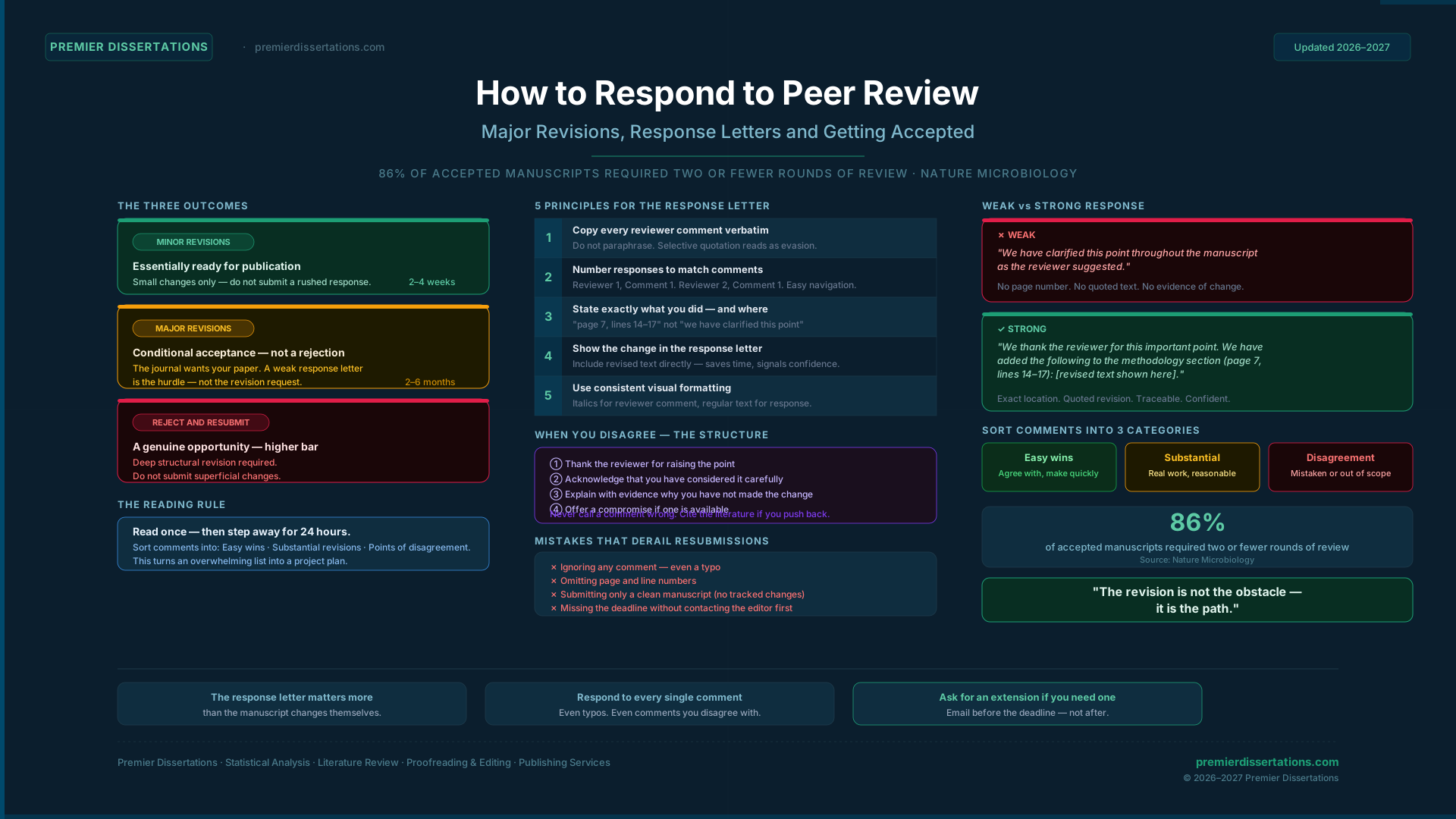
Revisions and ResubmissionIt is extremely rare for a paper to be accepted without revisions. Responding to reviewer comments thoroughly and professionally is critical. Authors who engage constructively with feedback are far more likely to reach acceptance.
8
Acceptance and ProductionOnce your revised manuscript is approved, the journal sends formal acceptance. Your paper enters production — copyediting, typesetting, and proofreading. This stage typically takes two weeks to three months.
9
PublicationYour paper is published — either online first or as part of a scheduled issue. Most journals assign a Digital Object Identifier (DOI), making your paper easily citable and discoverable worldwide.
What is a desk rejection? A desk rejection happens when the editor decides your paper is not suitable for peer review — usually because it is outside the journal's scope, does not meet formatting requirements, or lacks sufficient originality. Desk rejections are common and do not necessarily reflect the quality of your research. Simply resubmit to a more appropriate journal.
Key insight: The publication process is long and requires patience. Most successful authors plan for six to twelve months from submission to publication — often longer.
Publishing a research paper for the first time is rarely smooth. Even students with strong academic records encounter significant obstacles. Being aware of these challenges before you begin puts you in a much stronger position to handle them.
Finding the Right JournalWith thousands of academic journals, narrowing down your options requires careful research. Submitting to a journal whose scope does not match your topic almost always results in a desk rejection.
Meeting Originality RequirementsYour paper cannot simply summarise existing research — it must present new findings or a genuinely fresh perspective. For students used to writing essays, this can be a significant adjustment.
Navigating Peer ReviewPeer review is rigorous, detailed, and often humbling — even for experienced academics. Reviewers will scrutinise every aspect of your work, and their feedback can be extensive.
Handling RejectionRejection is inevitable in academic publishing — even the most accomplished researchers face it regularly. Every rejection, especially with detailed feedback, is an opportunity to improve your manuscript.
Publication CostsPublishing in an open access journal often requires an Article Processing Charge (APC) ranging from several hundred to several thousand pounds. Check whether your university has agreements with publishers that cover these costs.
Formatting RequirementsEvery journal has specific formatting requirements — referencing style, word count, figure resolution, section headings. Failing to follow these precisely is one of the most common reasons for desk rejection.
Key insight: Every challenge in the publishing process has a solution. The students who ultimately get published are those who anticipate obstacles, prepare for them, and keep moving forward.
How Long Does It Take to Publish a Research Paper?
This is one of the questions students ask most frequently — and one that rarely gets a straight answer. The honest answer is that it varies considerably depending on the journal, the discipline, the quality of the manuscript, and reviewer availability.
Stage
Typical Duration
Writing the manuscript
2–12 months
Editorial screening
1–4 weeks
Peer review
3–12 months
Revisions and resubmission
2 weeks – 6 months
Acceptance to production
2 weeks – 3 months
Total from first submission
6 months to 2 years
Students adapting an existing dissertation will find the writing phase considerably shorter, provided the original research was rigorous. Peer review is almost always the longest part — reviewers are academics with busy schedules, and finding suitable reviewers who are available can take weeks. Following peer review, minor revisions might take two to six weeks, while major revisions can take three to six months or more.
Key insight: Plan for the long game. Most students who successfully publish do so by starting early, staying patient, and treating delays as a normal part of the process.
Is It Easier to Publish in Some Journals Than Others?
Yes — significantly so. Not all academic journals operate at the same level of selectivity, and understanding the differences is one of the most useful things you can do as a first-time author. Choosing the right journal for your level of research is not a compromise — it is smart strategy.
✓
High-Impact Journals — Journals such as Nature, The Lancet, or the British Medical Journal have rejection rates that regularly exceed 90 per cent. For most students, targeting these journals from the outset is unlikely to be productive unless your research is genuinely groundbreaking.
✓
Mid-Tier Peer-Reviewed Journals — Academically credible, indexed in major databases, and with more accessible acceptance rates. For most students publishing for the first time, this is the most realistic and rewarding target.
✓
Undergraduate and Student Journals — Several journals exist specifically to publish research by undergraduate and postgraduate students. These are peer-reviewed, carry genuine academic credibility, and are designed for researchers at the early stages of their careers.
✓
Open Access Journals — Many are fully legitimate and rigorously peer-reviewed. However, the open access model often involves an Article Processing Charge paid by the author. Always verify the credibility of an open access journal before submitting.
Warning — Predatory Journals: Not every journal that claims to be peer-reviewed actually is. Predatory journals charge significant fees in exchange for rapid, often non-existent peer review — and publishing in one can damage your academic reputation. Before submitting to any unfamiliar journal, check whether it is indexed in Scopus or Web of Science.
Key insight: The best journal for your paper is not necessarily the most prestigious — it is the one whose scope, audience, and standards most closely match your research.
Can Undergraduate Students Publish a Research Paper?
Yes — undergraduate students can and do publish research papers. It is not common, but it is far from impossible. For students with strong research skills and a well-defined original question, it is a genuinely achievable goal.
Publishing as an undergraduate sends a powerful signal to postgraduate admissions panels and future employers. It demonstrates intellectual curiosity, academic rigour, and a level of commitment that goes well beyond the standard degree requirement.
What gives an undergraduate paper a realistic chance of publication?
✓
A clearly defined, original research question
✓
A thorough and up-to-date literature review
✓
An appropriate and well-justified methodology
✓
Clear, precise presentation of findings and conclusions
✓
Submission guidelines followed precisely — formatting errors lead to instant rejection
The role of your supervisor: Having a supportive and engaged supervisor makes an enormous difference. A good supervisor can advise you on appropriate journals, provide feedback on your manuscript before submission, and in some cases co-author the paper with you — which can significantly improve its credibility with journal editors.
Key insight: Publishing as an undergraduate is not about competing with PhD researchers. It is about producing the best possible work at your current level, targeting the right journals, and treating the experience as the first step in a longer academic journey.
Getting published is rarely a matter of luck. Researchers who succeed consistently do so because they approach the process with preparation, discipline, and a willingness to learn from setbacks.
Choose Your Journal Before WritingIdentifying your target journal before drafting allows you to tailor your manuscript — tone, structure, length, and referencing style — to exactly what that publication requires. Read several recent articles from your target journal before you write a word.
Be Rigorous With Your Research QuestionA vague or overly broad research question is one of the most common reasons papers fail at peer review. The best published papers address a specific, well-defined question and answer it convincingly within a single article.
Get Feedback Before SubmittingNever submit a manuscript that has only been reviewed by you. Ask your supervisor, a trusted academic colleague, or a professional editor to read your paper first.
Follow Submission Guidelines ExactlyJournal editors receive hundreds of submissions. Papers that do not comply with formatting requirements, exceed word limits, or fail to include required elements are frequently rejected without review.
Write a Strong Cover LetterYour cover letter is the first thing the journal editor reads. A strong cover letter introduces your research clearly, explains why it fits this specific journal, and highlights its original contribution. Keep it concise, professional, and targeted.
Respond to Reviewer Feedback ThoroughlyIf your paper is sent back for revisions, treat the reviewers' comments as a gift. Address every point raised — even those you disagree with — clearly and professionally. Explain the changes you have made and provide well-reasoned justifications where you have chosen not to change something.
Do Not Give Up After RejectionRejection is not the end. When your paper is rejected, read the feedback carefully, make improvements, identify the next most appropriate journal, reformat, and resubmit. Persistence is the defining characteristic of every researcher who has successfully published.
Check for Plagiarism Before SubmittingBefore submitting your manuscript, run it through a reliable plagiarism checker to confirm that your work is entirely your own and that all sources have been properly cited.
Key insight: The difference between a published paper and an unpublished one is rarely about raw intelligence. It is almost always about preparation, presentation, and persistence.
For many UK students, the dissertation is the most substantial piece of independent research they will ever undertake during their degree. It involves identifying an original research question, conducting a thorough literature review, designing and executing a methodology, analysing findings, and drawing evidence-based conclusions — in other words, every element that a publishable research paper requires.
This is why the dissertation is so often the most direct pathway to academic publication for students at both undergraduate and postgraduate level. Many journal articles published by early-career researchers began life as a dissertation chapter or an entire dissertation that was subsequently condensed and adapted for journal submission.
What needs to change when adapting a dissertation for publication? A dissertation is typically a long, detailed document written to demonstrate the breadth of your knowledge. A journal article is a focused, concise document written to communicate a specific finding to a specialist audience. Adapting one into the other requires several adjustments:
✓
Substantially reduce the length — most journal articles are 5,000–8,000 words, while dissertations can run to 15,000 words or more
✓
Tighten your literature review to only the most directly relevant sources
✓
Sharpen your research question to speak directly to a gap in existing literature
✓
Reframe your conclusion to clearly articulate the contribution your work makes to your field
✓
Seek feedback from your supervisor or a professional editor before submitting
Thinking of turning your dissertation into a published article? Starting with a strong, well-researched dissertation proposal is essential. Our service can help you build that foundation from the beginning — ensuring your research question is original, focused, and genuinely suitable for publication.
Key insight: Your dissertation is not just an academic exercise — it is the foundation of your research career. Students who approach it with publication in mind produce better dissertations, ask sharper research questions, and are far better placed to translate their work into something the academic world will want to read and publish.
So — is it easy to publish a research paper? No. But it is absolutely within reach for students who approach the process with the right mindset, the right preparation, and a realistic understanding of what is involved. Publishing is not a single event — it is a process, and like any process, it becomes far more manageable once you understand each stage.
The challenges are real. Rejection is common, timelines are long, peer review is rigorous, and competition is fierce — particularly at the top tier. But none of these obstacles are insurmountable. Thousands of students publish their research every year, including undergraduates. The ones who succeed are the most prepared, the most persistent, and the most willing to learn from every piece of feedback they receive.
If you are a UK student with a research question you believe in, the pathway to publication begins with your dissertation. A well-planned, rigorously researched, and professionally written dissertation is the most powerful foundation you can build — not just for your degree, but for your academic future.
No, it is challenging — but achievable with the right preparation. Most first-time authors face rejection at least once. The key is choosing an appropriate journal, following submission guidelines carefully, and persisting through feedback.
Yes, but it is harder. A supervisor can provide valuable guidance on journal selection, manuscript quality, and responding to reviewer feedback. Without one, consider using professional editing services or seeking a mentor in your field.
It depends. Many subscription-based journals charge nothing to publish. Open access journals typically charge an Article Processing Charge (APC) from £500 to several thousand pounds. Some journals offer fee waivers for students — always check before submitting.
At top-tier journals, rejection rates exceed 90 per cent. At mid-tier journals, rejection rates are still high — often 70–85 per cent. Even good papers are rejected. Do not take it personally — regroup, revise, and resubmit.
Yes — this is very common. Most dissertations need to be shortened, focused, and rewritten for a journal audience. The strongest single chapter or finding from your dissertation is usually the best starting point. Our dissertation writing service can help you build that foundation from the start.
Submit to a reputable undergraduate or student journal — their review processes are often faster than mainstream journals. Alternatively, submit to a journal that publishes short communications or research notes, which are shorter and reviewed more quickly.
Yes — thousands do every year, primarily in undergraduate-specific journals. It requires a strong, original research question and a well-executed study, but it is absolutely achievable.