


Publish Your Research Paper: Step-by-Step UK Guide for Journal Publication (2026)
March 17, 2026
Publishing a Journal Article (2026 Guide)
March 25, 2026

Updated: March 2026 · UK Academic Publishing Guide
Publishing a research paper is often seen as the final and most difficult step of academic work. Many students in the UK complete strong dissertations but struggle when it comes to turning their research into a publishable journal article. The process feels unclear, competitive, and in many cases, frustrating.
One of the main reasons for this difficulty is that academic publishing follows a completely different structure from dissertation writing. Journals expect concise arguments, clear contribution to knowledge, and strict formatting standards. Without understanding these expectations, even high-quality research can be rejected at an early stage.
This guide explains how to publish a journal article in the UK step by step, including how to choose the right journal, prepare your manuscript, navigate peer review, and avoid common rejection mistakes. Whether you are a Master’s or PhD student, the aim is to help you move from completed research to a successfully published paper.
By the end of this guide, you will understand not only the process but also the practical decisions that increase your chances of acceptance in academic journals.


Explore This Page
- Can High School Students Publish Research Papers?
- What Publishing Means at High School Level
- Why Publishing Early Matters
- What Level of Research Is Good Enough?
- Types of Research High School Students Can Publish
- Where to Publish a Research Paper as a High School Student
- How to Choose the Right Journal
- Step-by-Step Process to Publish a Research Paper
- Do You Need a Teacher or Supervisor?
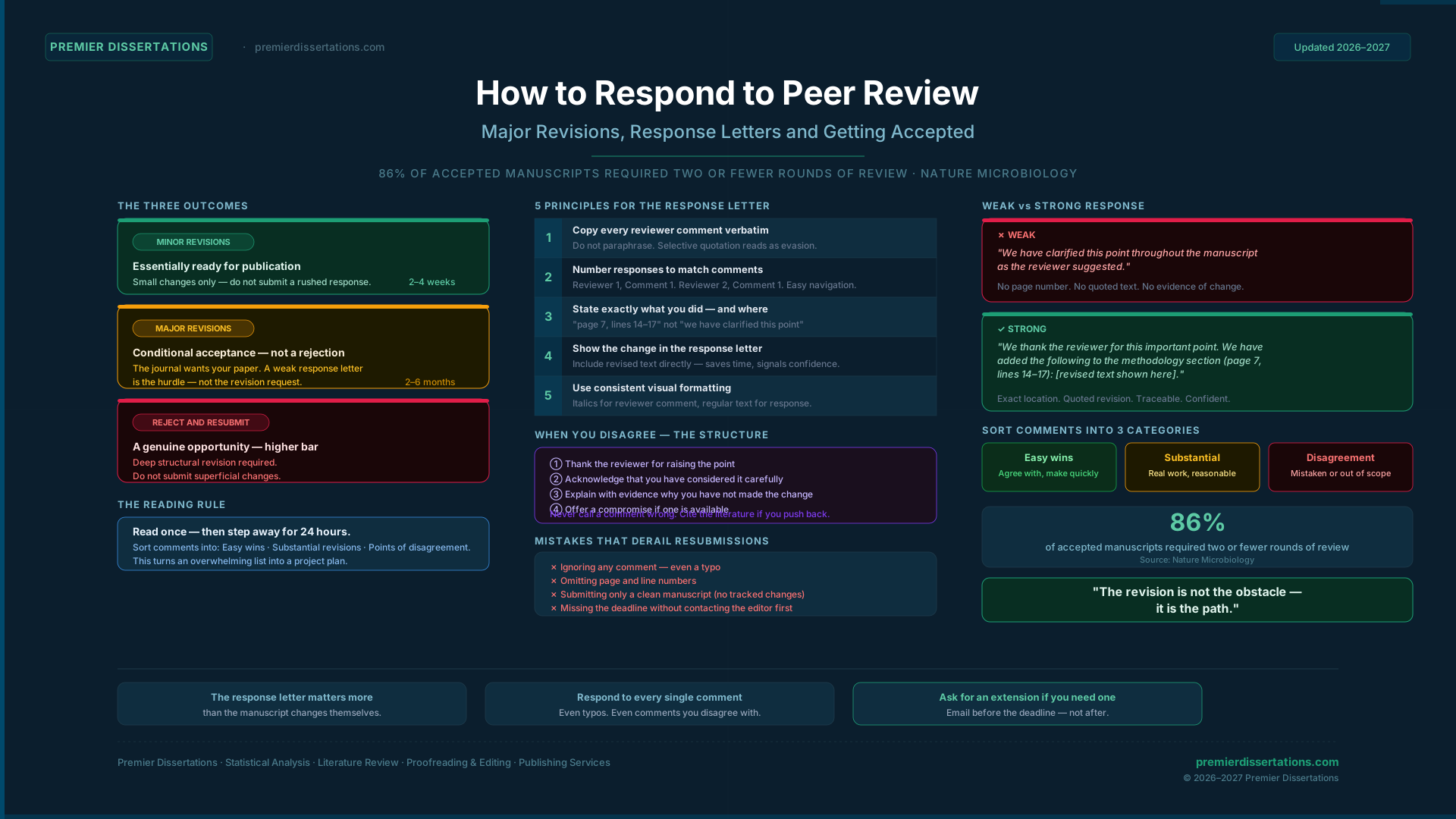
- Understanding Peer Review
- Common Reasons Student Papers Get Rejected
- How to Increase Your Chances of Getting Published
- Academic Integrity and Ethical Publishing
- Final Submission Checklist
Can High School Students Publish Research Papers?
Yes, high school students can publish research papers. This is possible in the UK and internationally, although the type of publication usually differs from the journals used by university academics and career researchers. In most cases, students publish through school research magazines, youth academic journals, essay competitions, pre-university research platforms, or supervised student research programmes. The important point is that publication at this stage is possible, but it depends on choosing a realistic route rather than aiming immediately for highly selective scholarly journals designed for experienced researchers.
A common misunderstanding is that a student must produce groundbreaking or laboratory-based research before any publication is possible. That is not usually true. At high school level, a publishable paper is often one that shows careful reading, a clear research question, logical structure, accurate referencing, and a strong understanding of a focused issue. In some subjects, a high-quality literature-based paper can be more suitable than an over-ambitious primary study. In others, a small survey, case-based analysis, or issue-led discussion may be enough if it is handled with maturity and academic care.
From an academic perspective, the strongest student papers are rarely the most complicated. They are usually the ones that stay within a manageable scope, make a clear argument, and show that the student understands how evidence should be selected, interpreted, and presented. This matters because editors and reviewers are not simply looking for intelligence. They are looking for clarity, discipline, and a paper that fits the purpose of their publication.
For students in sixth form or college, publishing can also become an early introduction to wider academic practice. It teaches lessons that later become essential in university work, such as narrowing a topic, following a research structure, responding to feedback, and avoiding weak or unsupported claims. Students who need help understanding how academic projects are planned may also benefit from reviewing our dissertation proposal examples and our dissertation examples to see how academic thinking is developed into a structured piece of writing.
Key point: High school students do not need to wait for university before trying to publish. What they do need is a realistic topic, a suitable journal or platform, and a paper that matches the expectations of that outlet.
What “Publishing” Actually Means at High School Level
Before starting the process, it is important to understand what “publishing a research paper” actually means at high school level. Many students imagine submitting their work to major academic journals used by university researchers. In reality, most high school publications take place through student-focused platforms that are designed for early-stage research. These include youth academic journals, school-based research publications, essay competitions, and supervised student research programmes.
This distinction matters because expectations are different. University journals often require advanced methodology, original data, and subject-level expertise developed over several years. Student journals, on the other hand, focus more on clarity of argument, structured writing, correct referencing, and a well-defined research question. A strong student paper does not need to be complex. It needs to be clear, focused, and academically responsible.
From an examiner’s perspective, the most common issue is not lack of intelligence, but misunderstanding the level required. Students sometimes attempt topics that are too broad or technically demanding, which leads to weak analysis and unclear conclusions. A well-chosen topic, supported by reliable sources and presented in a structured format, is far more likely to be accepted than an overly ambitious project that lacks depth or direction.
It is also important to recognise that publication at this stage is not about prestige alone. It is about demonstrating the ability to think academically, organise ideas, and communicate evidence effectively. These are the same skills expected in university coursework and dissertations. Students who want to strengthen their academic writing foundation may find it useful to review how structured arguments are developed in our literature review guide and how full academic projects are organised in our how to write a dissertation resource.
Academic insight: At high school level, publication is less about producing groundbreaking research and more about showing that you can follow academic standards. Editors look for clarity, structure, and discipline rather than complexity.
Why Publishing Early Matters
Publishing a research paper during high school is not simply an extra achievement. It reflects a level of academic initiative that universities recognise immediately. In competitive UK applications, particularly for subjects such as medicine, law, economics, and engineering, admissions tutors are not only looking at grades. They are also assessing how a student thinks, how they engage with their subject, and whether they can go beyond classroom requirements.
A well-prepared research paper provides clear evidence of these qualities. It shows that a student can define a question, explore existing literature, form an argument, and present findings in a structured way. This is very close to the type of work expected at undergraduate level. As a result, even a small but well-executed paper can carry more weight than a long list of general extracurricular activities.
From a practical perspective, publishing early also helps students understand how academic work is evaluated. The process of submitting a paper, receiving feedback, and making revisions introduces students to the standards used in higher education. These include clarity of writing, accuracy of referencing, logical organisation, and the ability to respond to critique. Students who develop these skills early often transition more smoothly into university coursework.
It is equally important to understand what publishing does not do. A published paper will not guarantee admission to a top university, and it should not be treated as a shortcut. However, when combined with strong grades and a focused personal statement, it can strengthen an application in a meaningful and credible way. Students preparing for this stage may also find it helpful to explore our dissertation help resources and review available dissertation topics to understand how academic interests are developed into research ideas.
Key insight: Publishing early is not about producing perfect research. It is about demonstrating that you can think independently, work with evidence, and present ideas in a structured academic format.



What Level of Research Is Good Enough?
One of the biggest reasons students delay submission is the belief that their research is not advanced enough. In most cases, this fear comes from comparing school-level work with published university research. That comparison is usually unhelpful. A high school paper does not need to look like a PhD journal article to be publishable. It needs to be well chosen, properly structured, and suitable for the outlet where it is being submitted.
At this stage, a strong paper usually begins with a focused question rather than a huge claim. Editors are more likely to respond positively to a student who handles a narrow topic well than one who attempts a very ambitious subject without enough control. A paper can be good enough if it shows clear reasoning, careful use of sources, and a consistent academic structure from introduction to conclusion. Students who are still shaping their ideas can review our dissertation topics page to see how broad interests are narrowed into workable research questions.
From an academic point of view, quality at high school level is judged less by technical complexity and more by intellectual discipline. Does the paper stay on topic? Does it use evidence properly? Does it make an argument instead of simply describing information? These questions matter more than whether the research sounds impressive. A student who can answer a clear question with maturity and structure is already working at a level that many student journals value.
Editor’s view: “Good enough” does not mean perfect. It means your paper is focused, evidence-based, clearly written, and realistic for student publication standards.
Types of Research High School Students Can Publish
Not every publishable paper requires original laboratory data or a large field study. In fact, many high school students are more successful when they choose a format that matches their current level of training and access to resources. The strongest route is often the one that allows careful thinking and clear presentation, not the one that sounds most advanced.
1. Literature-based papers
These are often the most realistic starting point. A literature-based paper analyses published sources, compares viewpoints, and develops an argument around existing research. This format suits students who are strong readers and can work carefully with academic material. Students who need help understanding this style can explore our literature review guide.
2. Small empirical studies
A short survey, simple experiment, or basic observational study can be publishable if the research question is modest and the method is clear. This is more suitable when students have teacher support and understand the limits of their sample. If you are unsure how methods should be chosen, our research methodology and data analysis guide can help you understand the basics.
3. Essay-style analytical papers
In humanities and social sciences, students can sometimes publish a well-argued analytical paper that explores an issue through critical reasoning and source engagement. This works best when the argument is tightly controlled and the writing is academically organised.
4. Extended project or independent study papers
Students completing an EPQ, independent project, or school competition entry may already have a base document that can be revised into a publishable paper. In many cases, the issue is not lack of content but lack of formatting and refinement.
The best type of research is the one you can complete properly. A shorter, more disciplined paper usually creates a stronger impression than a large project that loses direction halfway through.
Where to Publish a Research Paper as a High School Student
This is where many students become stuck. They may finish a paper, but they do not know what counts as a realistic publication outlet. The right answer depends on the subject, the strength of the paper, and how much feedback has already been built into the draft. At high school level, students should think in terms of suitable publication routes rather than prestige alone.
Student journals
These are often the best first option because they are designed for younger researchers. Their standards can still be serious, but the expectations are more appropriate for school-level work. A student journal is usually the most realistic path for a first submission.
School or sixth-form research magazines
Some schools, trusts, or student academic societies publish internal or public-facing research collections. These can be a strong starting point because they offer experience with formatting, submission, and editorial review without the pressure of a wider journal market.
Essay competitions and research competitions
Some competitions do not function as journals in the formal sense, but they still provide recognition, feedback, and a public academic platform. For many students, this is a valuable publication-adjacent route that helps build confidence and credibility.
Pre-university research programmes
Some structured research programmes guide students from project design to final submission. This route is especially useful when the student is capable but has little experience with academic standards or editing expectations.
What students should avoid is sending a first draft straight to a highly specialised academic journal with no realistic fit. Rejection in itself is not harmful, but repeated rejection caused by poor outlet choice wastes time and weakens confidence. It is better to match the paper to the right level and build publication experience step by step.
Practical rule: Choose the most credible outlet that still matches your current level. The best publication choice is not always the most famous one. It is the one where your paper has a genuine chance of being taken seriously.
How to Choose the Right Journal
Choosing the right journal is a decision-making task, not a guessing exercise. Many students select a journal based on name recognition or because the word “research” appears in the title. A better approach is to judge whether the journal fits the paper in front of you. That means looking carefully at scope, audience, submission rules, and the level of writing it usually accepts.
Start by asking a few direct questions. Is the journal intended for high school students, undergraduates, or professional researchers? Does it publish your subject area? Does it accept literature-based work, empirical studies, or both? Does it clearly explain word limits, referencing style, and review procedure? If these details are missing, the outlet may not be well organised enough to trust.
A sensible student also checks published examples before submitting. Reading sample papers helps you judge whether your own work is truly close to the standard expected. Students can compare structure and argument quality against our dissertation examples and review how early planning affects final quality through our dissertation proposal examples.
- Choose a journal that clearly states who it is for.
- Check whether your subject and paper type fit its usual publications.
- Review formatting rules before making final edits.
- Look for signs of credibility, not just attractive branding.
- Avoid any outlet that promises guaranteed publication for weak work.
Step-by-Step Process to Publish a Research Paper
Students often find publishing less intimidating once the process is broken into stages. In practice, most successful papers go through a sequence of narrowing, drafting, revising, and matching. Skipping these stages is one of the main reasons otherwise promising work gets rejected too early.
Step 1: Choose a focused question
Start with a question small enough to answer properly. Broad topics create weak papers because students spend too much time summarising and too little time analysing.
Step 2: Build a clear structure
Plan the paper properly before writing large sections. A weak structure often causes repetition and unclear arguments. Students who need support with academic organisation can use our how to write a dissertation guide as a model for disciplined academic flow.
Step 3: Write with evidence, not opinion
Even when the paper is student-level, unsupported claims weaken credibility. Every section should move from point to evidence to explanation.
Step 4: Edit before you submit
Many first drafts are not ready for publication. Tighten the argument, remove repetition, check transitions, and confirm that the paper actually answers the question it set out to explore.
Step 5: Match the paper to the right outlet
Do not submit blindly. Read author guidance, compare published work, and make sure your draft belongs there.
Step 6: Submit professionally
Follow instructions exactly. A well-written paper can still be delayed or rejected if the submission rules are ignored.
Step 7: Respond to feedback calmly
Revision is part of the process, not a sign of failure. Strong student authors usually improve their paper after comments rather than expecting instant acceptance.
Do You Need a Teacher or Supervisor?
A teacher or supervisor is not always essential, but good guidance can make a major difference. At high school level, the most valuable support is often not subject brilliance. It is practical academic direction. A teacher can help a student narrow the question, improve structure, identify weak reasoning, and avoid avoidable mistakes before submission.
That said, some students do publish without close supervision. This is more realistic when the project is literature-based, the topic is manageable, and the student is disciplined enough to revise carefully. The key issue is not whether a supervisor is formally required. It is whether the paper has been critically reviewed by someone who understands academic writing standards.
Students who lack direct school support can still strengthen their paper by studying academic models, comparing examples, and using structured guides. Our dissertation help resources and research methodology and data analysis guide can help students understand how strong academic work is shaped before submission.
Understanding Peer Review
Peer review sounds intimidating to many students, but the basic idea is straightforward. Before a paper is accepted, someone with academic knowledge reads it and checks whether it is clear, credible, and suitable for publication. In student journals, this process may be lighter than in professional academic publishing, but the principle remains the same. The paper is assessed before it is approved.
Reviewers usually look at a few core areas. Is the question clear? Is the structure logical? Are the claims supported by evidence? Is the referencing accurate enough for the level of publication? A paper may be promising and still receive requests for revision. That is normal. In fact, revision often shows that the publication is taking standards seriously.
Students should not interpret reviewer comments as a personal judgment. The stronger response is to treat them as part of academic development. The ability to improve a draft after critique is one of the clearest signs of maturity in research writing.
Simple definition: Peer review means your paper is read critically before acceptance, so the journal can decide whether it meets the level and standards expected.
Common Reasons Student Papers Get Rejected
Rejection does not always mean the student lacks ability. In many cases, the paper was either submitted too early or sent to the wrong outlet. Understanding the most common rejection reasons helps students improve before submission rather than learning the hard way afterwards.
- The topic is too broad. A wide topic usually creates descriptive writing instead of a focused argument.
- The paper lacks a clear question. Without a guiding question, the discussion often becomes loose and repetitive.
- The structure is weak. Promising ideas lose value when the reader cannot follow the logic from section to section.
- The evidence is thin or poorly used. A paper needs support, not assertion.
- The journal is a poor fit. Even a good paper may be rejected if it does not suit the publication’s scope or audience.
- Referencing is inconsistent. Errors in citation make the work look unfinished and sometimes careless.
Students who want to strengthen this area should study strong models before submitting. Reviewing dissertation examples can help students see how arguments are built and how evidence is integrated more convincingly across a longer academic text.
How to Increase Your Chances of Getting Published
Students often assume that acceptance depends mainly on brilliance. In reality, acceptance often depends on discipline. Editors are more likely to respond well to a paper that is controlled, readable, and properly matched than one that tries to appear highly intellectual without enough structure behind it.
- Choose a focused topic instead of a fashionable but over-wide one.
- Use reliable academic sources and engage with them carefully.
- Keep your argument clear from the first page to the final conclusion.
- Edit heavily before submission rather than relying on the first draft.
- Check all referencing and formatting details before uploading or emailing the paper.
- Ask for thoughtful feedback from a teacher, mentor, or skilled reader.
A student can also improve their chances by treating the paper as a serious academic project rather than a competition entry written at the last minute. Good planning matters. Strong structure matters. Revision matters. Students who want support with refining academic organisation may also benefit from exploring our dissertation help resources and our how to write a dissertation guide.
Examiner-level advice: Clarity wins more often than complexity. A precise, well-supported paper is far more publishable than a complicated draft that lacks control.
Academic Integrity and Ethical Publishing
Students sometimes focus so heavily on acceptance that they overlook the standards that make academic publishing credible in the first place. Academic integrity is not a final box to tick. It is part of the research process from the beginning. That includes honest use of sources, correct citation, original wording, and accurate representation of evidence.
Plagiarism is one of the quickest ways to damage a paper, even when it is unintentional. Students who paraphrase too closely, borrow structure without acknowledgment, or copy ideas without proper citation place the whole submission at risk. Before submitting, it is sensible to review originality using a plagiarism checker and to check whether the wording still sounds genuinely student-written rather than mechanically produced.
Students also need to be careful with AI-assisted drafting. Tools can sometimes help with planning or language support, but a publishable paper must still reflect the student’s own reasoning, interpretation, and academic judgment. Over-processed wording, invented references, or generic analysis can weaken trust immediately. Where students want to review writing quality more carefully, our AI detector tool may help them identify whether their draft has started to lose its natural academic voice.
Important: Ethical publishing is not about sounding formal. It is about showing that your work is genuinely yours, your sources are used honestly, and your argument has been developed with academic responsibility.
Final Submission Checklist
Before submitting your paper, pause and review it as an editor would. Many avoidable rejections happen because students are eager to submit the moment the draft feels finished. A final review often reveals issues that are easy to correct but costly to ignore.
- My topic is focused and realistic for student-level publication.
- My paper answers a clear research question rather than discussing the subject vaguely.
- My structure is logical from introduction to conclusion.
- My claims are supported with evidence and not left as opinion.
- My sources are cited consistently and accurately.
- I have checked the journal’s submission rules and formatting requirements.
- I have revised the draft after feedback or self-review.
- I have checked originality using a plagiarism checker.
- I have reviewed whether the wording still sounds natural using an AI detector tool.
- I am submitting to a journal or platform that genuinely matches my level and subject.
If you can answer yes to each point above, your paper is in a far stronger position than most first-time student submissions. At that stage, the goal is no longer perfection. It is readiness, credibility, and a submission that shows academic care.
Frequently Asked Questions (FAQs)
Get 3+ Free Dissertation Topics within 24 hours.