


How to Use Excel for Dissertation Data Analysis (Step-by-Step Guide with Examples)
May 11, 2026
How to Design a Dissertation Questionnaire (Step-by-Step Guide with Examples, Template & Best Practices 2026–2027)
May 14, 2026
Australian University Guides
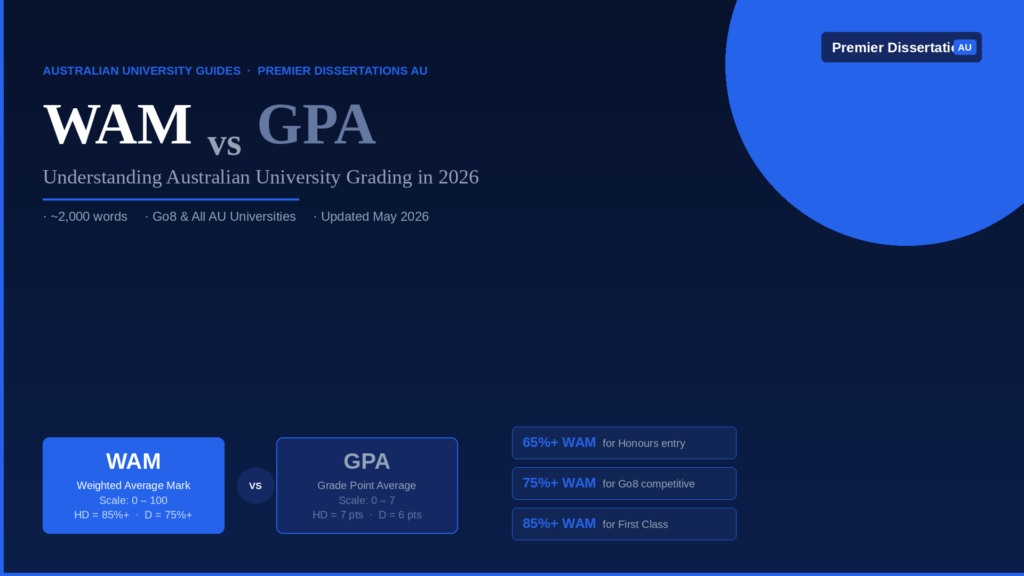
WAM vs GPA: Understanding Australian University Grading (2026)
In this guide
If you are studying at an Australian university, you have almost certainly come across the term WAM — Weighted Average Mark. But how exactly does it differ from a GPA? Which one matters more? And what WAM do you actually need to get into Honours, postgraduate study, or land a graduate role at a top firm?
This guide answers all of it — clearly, with real numbers — so you know exactly where you stand and what to do about it.
Worried your WAM is holding you back? Premier Dissertations AU helps Australian students produce high-quality thesis and assignment work — human-written, AI-free, Turnitin report included. From AUD $27/page.
Get a free quote →What Is WAM (Weighted Average Mark)?
WAM stands for Weighted Average Mark. It is the primary academic performance metric used by most Australian universities to measure a student's overall achievement across their degree.
Unlike a simple average, your WAM weights each subject's mark according to the number of credit points (units) that subject is worth. A 12-credit-point subject carries more weight than a 6-credit-point subject, which means it has a bigger impact on your WAM — for better or worse.
WAM is expressed as a number from 0 to 100, mirroring the raw percentage marks you receive in each subject. A WAM of 75 means your credit-weighted average across all completed subjects is 75%.
What Is GPA in Australia?
GPA — Grade Point Average — is a 0–7 scale used by some Australian universities and widely used internationally, particularly in the United States. In Australia, GPA is most commonly seen at institutions like QUT, USQ, Griffith University, and CQUniversity, which adopted the scale from American academic tradition.
The Australian GPA scale converts your percentage marks into grade points:
| Grade | Mark Range | GPA Points (7-point scale) |
|---|---|---|
| High Distinction (HD) | 85–100% | 7 |
| Distinction (D) | 75–84% | 6 |
| Credit (C) | 65–74% | 5 |
| Pass (P) | 50–64% | 4 |
| Fail (F) | 0–49% | 0 |
Note that the 7-point scale compresses all marks within a grade band into a single point value. A student who scores 85% and one who scores 99% both receive 7 GPA points — a distinction that WAM preserves.
WAM vs GPA: The Key Differences
| WAM | GPA (7-point) | |
|---|---|---|
| Scale | 0 – 100 | 0 – 7 |
| Granularity | High — reflects exact marks | Low — compresses marks into bands |
| Weighting | By credit points | By credit points (usually) |
| Used by | Most Go8 & major Australian universities | QUT, Griffith, USQ, CQU and others |
| International recognition | Australia-specific | Familiar in US, Canada, some Asian universities |
| Honours entry | Typical WAM requirement: 65–70%+ | Typical GPA requirement: 5.0+ |
The most important practical difference: WAM is more sensitive to high performance. Scoring 92% in a subject genuinely lifts your WAM more than scoring 86%, whereas on a GPA scale, both earn the same 7 points. This makes WAM a better reflection of truly exceptional academic work — but also means a few poor marks early in your degree can take longer to recover from.
How WAM Is Calculated
The standard WAM formula used across most Australian universities is:
WAM Formula
WAM = Σ (Mark × Credit Points) ÷ Σ (Credit Points)
Where Σ means "sum of" across all completed subjects
Example: You completed three subjects — Marketing (6 cp, 72%), Statistics (6 cp, 58%), and Research Methods (12 cp, 80%).
| Subject | Mark | Credit Points | Mark × CP |
|---|---|---|---|
| Marketing | 72% | 6 | 432 |
| Statistics | 58% | 6 | 348 |
| Research Methods | 80% | 12 | 960 |
| WAM | 24 total | 1,740 ÷ 24 = 72.5 |
Notice how the 12-credit Research Methods subject has twice the impact of the 6-credit subjects. Scoring well in high-credit subjects is one of the most efficient ways to lift your WAM.
Australian Grade Bands Explained
Australian universities use a four-tier grading system. The exact cutoffs vary slightly between institutions, but the standard bands used at Go8 universities are:
| Grade | Abbrev. | Mark Range | What It Means |
|---|---|---|---|
| High Distinction | HD | 85 – 100% | Outstanding — top-tier academic performance |
| Distinction | D | 75 – 84% | Excellent — well above average |
| Credit | Cr | 65 – 74% | Good — above average work |
| Pass | P | 50 – 64% | Satisfactory — meets minimum requirements |
| Fail | F | 0 – 49% | Does not meet minimum requirements |
What WAM Do You Need for Honours and Postgraduate Study?
WAM is the primary gateway to Honours and research postgraduate programmes in Australia. Most universities publish minimum WAM requirements for Honours entry, though competitive programmes often accept students well above the minimum.
| Programme | Typical Minimum WAM | Competitive WAM |
|---|---|---|
| Honours (most faculties) | 65 – 70% | 75%+ |
| Honours (Go8 competitive) | 70 – 75% | 80%+ |
| Masters by Research | 65% (or Honours) | 75%+ |
| PhD (direct entry) | First or Second Class Honours (A) | First Class Honours (85%+) |
| Research Scholarship (ARC/RTP) | First Class Honours | 85%+ WAM + publications |
If you are aiming for Honours and your WAM sits close to the cutoff, the final-year subjects carry the most weight — both in your WAM calculation and in the eyes of admissions committees. Performing strongly in your capstone and research units can make a significant difference.
Planning to apply for Honours? Our PhD-qualified team helps Australian students produce outstanding thesis and research work — from literature reviews and SPSS analysis to full Honours theses. From AUD $37/page.
Explore Honours thesis help →Does WAM Matter for Employment?
The short answer: it depends on the industry and the employer.
Graduate programmes at top-tier employers — including the big four accounting firms (Deloitte, PwC, EY, KPMG), major law firms, investment banks, and federal government agencies — often set a minimum WAM or GPA requirement as a screening filter. A Credit average (65–74%) is typically the floor; many competitive programmes prefer a Distinction average (75%+).
Even where WAM is not a formal requirement, a strong academic record signals work ethic, attention to detail, and the ability to perform under pressure — all qualities employers value in graduate candidates.
How to Improve Your WAM
If your WAM is lower than you need, the good news is that it can be recovered — especially if you are in your second or third year and have a significant number of credit points still to complete.
WAM for International Study Applications
If you are applying to international universities or graduate programmes overseas, you will often need to convert your Australian WAM or GPA into a format the receiving institution understands.
Most international institutions accept a WAM-to-GPA conversion table or the World Education Services (WES) equivalency assessment. The approximate conversions used by many US institutions are:
| Australian WAM | AU Grade | US GPA (4.0 scale, approx.) | UK Classification (approx.) |
|---|---|---|---|
| 85 – 100 | HD | 4.0 | First Class |
| 75 – 84 | D | 3.5 – 3.9 | Upper Second (2:1) |
| 65 – 74 | Cr | 3.0 – 3.4 | Lower Second (2:2) |
| 50 – 64 | P | 2.0 – 2.9 | Third Class |
Protect Your WAM — Get the Support You Need
Your WAM is built one assessment at a time. A few low marks in high-credit subjects early in your degree can drag it down for years — and recovering from a poor result takes consistent HD and D-level performance across multiple subjects thereafter.
Premier Dissertations AU helps Australian students at every stage of their degree — from first-year assignments to Honours and Masters theses — produce high-quality academic work that reflects their true ability.
Assignment and thesis help from AUD $27/page.
Get Expert Academic Support Today
Thesis, assignments, literature review, editing, or SPSS — Premier Dissertations AU is here to help protect your WAM.
PhD academics · Human-written · Turnitin + AI report · UniMelb, UNSW, USyd, Monash, UQ, ANU, UWA & more