

Academic Proofreading Standards in Oman
August 20, 2026
Why Does My Writing Get Flagged as AI?
September 4, 2026
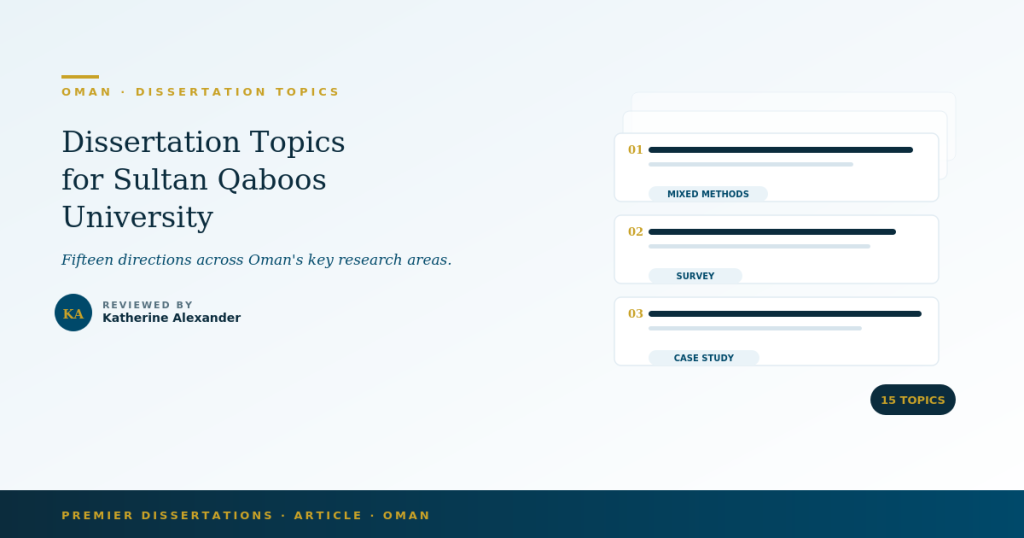
OMAN · DISSERTATION TOPICS
Fifteen research directions grounded in Oman's economic diversification, educational reform, health systems, and environmental priorities — each scoped for a single postgraduate project.
TL;DR
This list offers fifteen dissertation topics relevant to Sultan Qaboos University's postgraduate programmes — spanning Oman Vision 2040 and economic diversification, education and Omanisation, health systems, environmental sustainability, and governance. Each includes a methodology hint. These are starting points: refine with your supervisor and confirm data availability before committing.
Contents
Once you've written the dissertation, a pre-submission check catches structure and referencing issues before your committee sees them.
Get a checkHow to use this list
Every topic below is a direction, not a finished question. SQU's research strengths — particularly in engineering, medicine, education, and social sciences — mean some of these topics map directly onto existing departmental expertise, which can make supervisor matching easier. Pick two or three that interest you, check what data you can actually access (National Centre for Statistics and Information publications, SQU institutional data, Oman government strategy documents), and discuss them with your supervisor before narrowing.
Oman Vision 2040 and economic diversification
Oman Vision 2040 is driving structural economic change across tourism, logistics, fisheries, mining, and manufacturing — creating research territory at the intersection of policy and business.
SME development in Oman's special economic zones — barriers to growth and policy effectiveness
Method hint: Mixed methods: survey of SME owners in Duqm or Sohar SEZ combined with semi-structured interviews with zone-authority staff.
Tourism diversification in Dhofar — resident attitudes toward cultural and eco-tourism development
Method hint: Quantitative survey with Likert-scale attitudinal items distributed in Salalah and surrounding areas.
The effect of Oman's fiscal reforms on consumer spending patterns — a post-VAT introduction analysis
Method hint: Econometric analysis using NCSI household expenditure data and CPI series, pre- and post-VAT implementation.
Education, Omanisation, and human capital
Omanisation policies, teacher-training reform, and the push toward a knowledge economy make education and workforce development a rich research area for SQU postgraduates.
The effect of Omanisation quotas on graduate employment outcomes in the private sector
Method hint: Quantitative study using Ministry of Labour data correlated with graduate employment surveys.
Teacher preparedness for STEM-focused curricula in Omani public schools — a case study of Muscat governorate
Method hint: Mixed methods: teacher survey + classroom observation + semi-structured interviews with curriculum coordinators.
Student satisfaction and academic performance in blended-learning programmes at SQU
Method hint: Quantitative survey using a validated satisfaction instrument, correlated with GPA data (anonymised, with ethics approval).
Once you've picked a topic and written it up, a pre-submission review catches issues before your committee reads it.
Request a reviewHealth systems and public health
Oman's health system has achieved rapid gains in life expectancy and disease control. Research questions now focus on chronic-disease management, health-service delivery, and the sustainability of the system under demographic change.
Diabetes management outcomes in primary healthcare centres across Muscat — a service-quality perspective
Method hint: Quantitative cross-sectional study using clinical outcome data and patient-satisfaction surveys from 5–8 health centres.
Mental health service accessibility in rural Oman — barriers and referral pathways
Method hint: Qualitative study using semi-structured interviews with primary-care providers and community health workers in interior governorates.
The adoption of electronic health records in Omani hospitals — clinician experiences and workflow impact
Method hint: Case study of 2–3 hospitals using TAM-based clinician surveys combined with workflow observation.
Environment, water, and sustainability
Water scarcity, desertification, marine conservation, and renewable energy deployment are all active research areas at SQU with strong data availability and faculty expertise.
Household water-conservation behaviour in Muscat — awareness, pricing signals, and policy effectiveness
Method hint: Quantitative household survey combined with water-consumption billing data analysis.
Solar energy adoption among industrial firms in Oman's Sohar Industrial Zone
Method hint: Exploratory case study of 3–4 early-adopter firms using interviews with operations managers and analysis of energy-procurement data.
The impact of coastal development on marine biodiversity in the Sea of Oman — a spatial analysis
Method hint: GIS-based spatial analysis using satellite imagery, development-permit data, and marine-survey records.
Governance, law, and public administration
Oman's evolving governance framework — including the Basic Law amendments, digital-government initiatives, and public-sector reform — creates postgraduate research questions around institutional design and citizen engagement.
Citizen satisfaction with Oman's digital-government services — usability, trust, and adoption
Method hint: Quantitative survey using an e-government adoption model distributed to service users in Muscat and interior governorates.
Public-sector performance management reform in Oman — implementation gaps and organisational readiness
Method hint: Qualitative case study of 2–3 government ministries using document analysis and interviews with HR/reform-unit staff.
The role of Majlis al-Shura in Omani legislative development — stakeholder perceptions of effectiveness
Method hint: Qualitative study using semi-structured interviews with current and former members, supplemented by analysis of published session records.
Narrowing your topic
The same scoping advice applies here as elsewhere: check data availability before committing, write a one-sentence question and test whether the answer could go either way, and discuss your shortlist with your supervisor. SQU's institutional data — student records, clinical data, campus-based surveys — may be accessible with ethics approval, giving you primary-data options that external researchers don't have. For guidance on preparing the final submission once the dissertation is written, see our companion piece on academic proofreading standards in Oman.
A note on SQU departmental strengths
Sultan Qaboos University has particular research strengths in engineering, medicine, education, and marine science. Topics that align with an existing departmental research cluster tend to benefit from better supervisor matching, access to lab or field facilities, and stronger literature support within the department. Checking your department's published research priorities or recent thesis titles can help you identify which topics are well supported and which are entering less-charted territory.
Turn your topic into a submission you can defend.
A pre-submission review checks structure, referencing, and originality — so you go into the viva with the groundwork already done.