


5 Best Online Master’s in Healthcare Administration Programs for Working Professionals
October 7, 2026
Career & Postgraduate Life · GCC
Your dissertation is not just an academic requirement — it is a professional asset. Here is how to make it work for you in interviews, applications, and early-career conversations across the Gulf.
In this article
- Why GCC Employers Care About Your Dissertation
- Choosing a Topic with Career Leverage
- Aligning Research with GCC Economic Priorities
- How to Talk About Your Research in Interviews
- Turning Your Dissertation into a Portfolio Piece
- Using Your Research to Build a Professional Network
- Common Mistakes That Reduce Career Value
Finishing your dissertation? A pre-submission review ensures it is polished enough to show employers, not just examiners.
Order a reviewWhy GCC Employers Care About Your Dissertation
The GCC job market has a particular relationship with postgraduate qualifications. In sectors like government administration, banking, energy, healthcare, and education, a master's degree is often a formal requirement for mid-level and senior roles — not a differentiator but a baseline. This means your dissertation is not just assessed by your university; it becomes part of your professional profile.
What employers are looking for, however, is not what your supervisor is looking for. Your supervisor cares about methodology, literature positioning, and academic contribution. An employer cares about three things: can you research a complex problem independently, can you communicate what you found clearly, and does your work show familiarity with the industry or region they operate in.
That gap between academic assessment and professional relevance is where most graduates lose value. They complete a dissertation that satisfies the university but says nothing useful to an employer. The rest of this article is about closing that gap.
Choosing a Topic with Career Leverage
Topic selection is the single highest-leverage decision you make in your entire dissertation process — and it is also the one most students treat as an afterthought. A well-chosen topic does double duty: it satisfies academic requirements and positions you as someone who understands a real problem in a real industry.
The principle is straightforward: choose a topic that someone in your target industry would want to read the executive summary of. Not the full 15,000 words — the two-page summary of what you studied, what you found, and what it means.
What "career leverage" looks like by sector
In finance and banking, topics around fintech adoption, regulatory compliance, Islamic finance innovation, or risk modelling in Gulf markets carry immediate professional relevance. If you are considering topics in this space, our guide to dissertation topics on Bahrain's fintech sector offers concrete starting points.
In government and public administration, research that connects to national vision programmes — economic diversification, digital transformation, labour market nationalisation — signals that you understand the policy landscape you would be working within.
In energy and sustainability, topics around energy transition, carbon capture economics, renewable energy policy, or ESG reporting frameworks align directly with the region's most active investment areas.
In education and academia, research on pedagogy, curriculum design, assessment practices, or educational technology in Gulf contexts positions you for roles in universities, training organisations, and education consultancies across the GCC.
The best dissertation topic is one where your examiner says "well-researched" and a hiring manager says "we need someone who understands this." A useful principle for topic selection
Aligning Research with GCC Economic Priorities
Every GCC country has a national economic strategy — Saudi Vision 2030, UAE Centennial 2071, Qatar National Vision 2030, Kuwait Vision 2035, Oman Vision 2040, Bahrain Economic Vision 2030. These are not abstract policy documents. They are the frameworks that drive government spending, private-sector incentives, and hiring priorities across the region.
A dissertation that connects to one of these frameworks — not by name-dropping it in your introduction, but by genuinely researching a problem the framework is trying to solve — carries professional weight that a purely theoretical study does not. An employer in Riyadh does not need you to recite Vision 2030 objectives. They need to see that you can think systematically about the problems Vision 2030 is designed to address.
A note on authenticity
Aligning your research with national priorities does not mean retrofitting a vision statement onto an unrelated topic. Examiners and employers can both spot this. If your genuine research interest does not connect to a national strategy, that is fine — the other strategies in this article still apply. Forced alignment is worse than no alignment.
If you are studying in Saudi Arabia and looking for topic inspiration that connects to the Kingdom's economic priorities, our guide to MSc dissertation topics in Kuwait's finance sector shows how to frame financial research with regional relevance — a transferable approach across GCC markets.
How to Talk About Your Research in Interviews
Most graduates describe their dissertation badly in interviews. They either recite the title and methodology as if reading from the abstract, or they dismiss it entirely — "it was just a requirement." Neither response helps.
An employer asking about your dissertation is giving you an open invitation to demonstrate three things: that you can identify a meaningful problem, that you can work through it systematically, and that you can communicate what you learned. That is a gift in an interview format where most questions test only one skill at a time.
The three-sentence framework
Practise describing your dissertation in three sentences. Sentence one: the problem you investigated and why it matters (to the industry, not to academia). Sentence two: how you went about it — not your methodology label, but the practical approach. Sentence three: the one finding that would interest someone in this room.
For example: "I studied how mid-size banks in the Gulf are adapting their compliance frameworks for open banking regulations. I interviewed compliance officers at six banks across three GCC countries and compared their approaches. The main finding was that banks with dedicated fintech compliance teams were processing regulatory changes roughly twice as fast as those running it through general compliance — which has direct implications for how compliance functions should be structured."
That takes thirty seconds. It tells the interviewer what you studied, how you think, and that you understand their industry. The full methodology, literature review, and theoretical framework can come up if they ask follow-up questions — which they will, because you have given them something to be curious about.
Want your dissertation polished enough to discuss confidently in interviews? A pre-submission review catches the issues that undermine credibility.
Request a reviewTurning Your Dissertation into a Portfolio Piece
Your dissertation is a 10,000–15,000 word document that almost no employer will read in full. But parts of it — repackaged — can become genuine career assets.
Write a two-page executive summary that strips out the academic apparatus (literature review, methodology justification, theoretical framework) and focuses on the problem, the approach, and the findings. Use language your target industry uses, not academic terminology. This becomes a document you can attach to job applications, share on LinkedIn, or hand to a contact at a networking event.
If your dissertation involved original data — surveys, interviews, case studies, financial analysis — consider writing a short article or post summarising your findings for a professional audience. LinkedIn articles, industry blogs, and professional association newsletters are all viable outlets. You do not need to be published in a journal for your research to have professional visibility.
If your research involved a practical deliverable — a framework, a model, a set of recommendations — that deliverable can be presented independently. A risk assessment framework, a customer segmentation model, or a policy recommendation document carries more weight in a portfolio than a bound dissertation ever will.
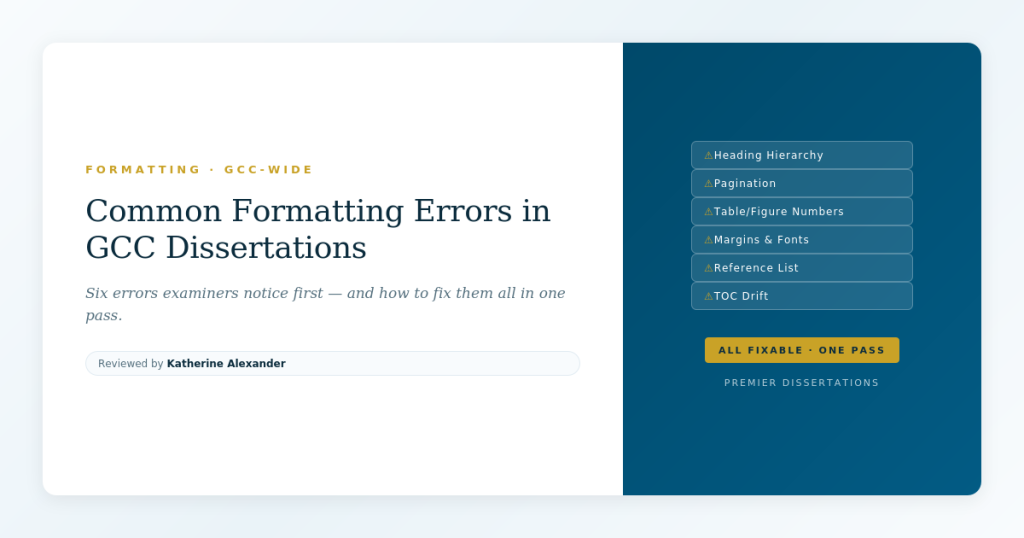
On the presentation side, make sure the finished document is clean and professional. Common formatting errors may not affect your grade significantly, but they affect the impression your dissertation makes if a potential employer or professional contact ever opens it. The details matter when your work is representing you outside the university.
Using Your Research to Build a Professional Network
Your dissertation research gives you a legitimate reason to contact people you would otherwise have no access to. If your study involved interviewing professionals, surveying industry participants, or analysing company practices, you have already built connections — use them.
After your dissertation is complete, send a brief thank-you note to anyone who participated in your research, along with a short summary of your findings. This is professional courtesy, but it is also strategic: it reminds them you exist, demonstrates that their time produced a tangible result, and opens the door for future conversations about roles, referrals, or industry insights.
If you have not started your research yet, consider this when designing your methodology. A study that involves interviewing senior professionals in your target industry gives you access to exactly the people you want to know — access you earn through the research process itself, not through cold outreach. This is particularly powerful in the GCC, where professional relationships and personal introductions carry significant weight in hiring decisions.
For more on managing the time demands of this kind of research alongside work, see our guide to balancing work and postgraduate study in the Gulf.
Common Mistakes That Reduce Career Value
A few patterns consistently reduce the professional value of otherwise strong dissertations:
- Purely theoretical topics. A theoretical contribution is valuable in academia. In the job market, it is invisible. If your topic has no connection to a recognisable industry problem, it will not come up in interviews — and if it does, it will be hard to describe compellingly.
- Generic research contexts. "Employee motivation in the private sector" could be anywhere. "Employee motivation in GCC family-owned businesses navigating professionalisation" is specific, relevant, and memorable. Context is what makes research interesting to employers.
- Poor finishing. Typos, inconsistent formatting, broken references, and sloppy presentation undermine credibility. If you are sharing your dissertation or its summary with professional contacts, it needs to look like a professional document, not a draft. A thorough proofreading pass is worth the investment.
- Not preparing to discuss it. The most common mistake of all. If you cannot describe your dissertation compellingly in thirty seconds, the topic, the methodology, and the findings are all wasted career capital.
- Treating it as finished. A submitted dissertation is not a closed file. It is raw material for articles, presentations, frameworks, and conversations. The graduates who extract the most career value are the ones who keep working with the material after the grade arrives.
If you are still in the process of writing and want to ensure your cross-cultural methodology is ethically sound, our guide to cross-cultural research ethics in the GCC covers the design decisions that matter most — several of which also demonstrate professional competence to a future employer.
Make your dissertation interview-ready
A pre-submission review polishes your dissertation so it works for your examiner and your career — catching the issues that undermine both academic and professional credibility.