

Dissertation Topics for Sultan Qaboos University
September 1, 2026
Free vs Paid Survey Tools for Your Dissertation – Which Do You Actually Need?
September 10, 2026
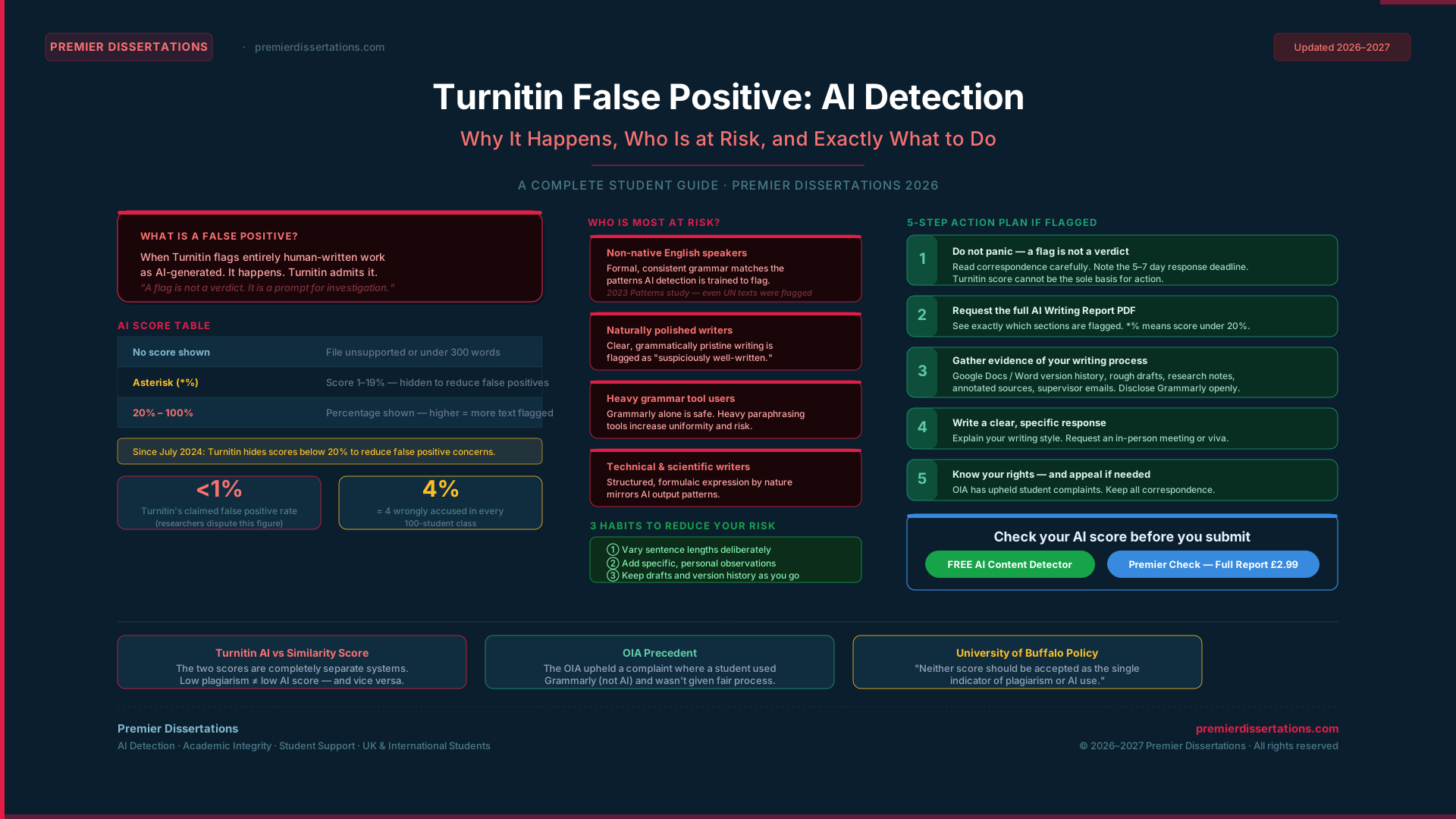
Human writing gets flagged as AI-generated more often than people realise. Turnitin's own data shows 4% of sentences are falsely flagged. Real authors, university students, and even published books have been affected. This page explains why it happens, documented cases, and what you can do about it.
If your own writing has been flagged as AI-generated, you are not imagining the unfairness of it. This is not a rare glitch. Turnitin's own Chief Product Officer has acknowledged that across 38.5 million analysed documents, the tool incorrectly flagged 4% of sentences as AI-written. Vanderbilt University did the maths on its own submissions and disabled the tool entirely rather than risk it. Even a published author, Janelle Shane, has had her own book flagged.
This page walks through why detectors get this wrong, real documented cases, the specific writing patterns that trigger false flags, and what you can do to protect yourself before submitting.
If you have already been flagged by Turnitin and need to know what to do next, see our dedicated guide: Turnitin False Positive AI Detection — What to Do.
Why AI Detectors Get This Wrong
AI detection tools like Turnitin, GPTZero, and Originality.ai are not actually "reading" your work. They are running statistical pattern analysis on two specific features of your writing:
This measures how predictable or surprising your word choices are. Human writing tends to be more varied and unpredictable. AI text tends to choose the most statistically likely next word. Clear, well-structured writing with precise vocabulary can actually look more "predictable" to a detector, because it follows grammatical rules closely.
This measures variation in sentence length. Human writing naturally swings between short and long sentences. AI writing tends to be more uniform. If you write clearly and consistently, with sentences of roughly similar length, detectors may misread this as an AI signature.
The core problem is straightforward: detectors are looking for statistical patterns that indicate AI generation, but human writing often shares those same patterns. Good academic writing, in particular, tends to be clear, well-organised, and grammatically consistent — all things that can trigger false positives.
Real, Documented Cases of False AI Detection
These are not hypothetical scenarios. Each case below is publicly documented and verifiable.
Janelle Shane, a real published author documented on Wikipedia's "Artificial intelligence content detection" page, had portions of her book "You Look Like a Thing and I Love You" flagged as AI-generated. She wrote every word herself.
Turnitin's Chief Product Officer stated that across an analysis of 38.5 million documents, the tool incorrectly flagged approximately 1% of overall documents and 4% of individual sentences. A University of Kansas Center for Teaching Excellence piece calculated this to roughly 38,500 students falsely flagged.
Vanderbilt University disabled Turnitin's AI detector entirely. They calculated that even the company's own claimed 1% false positive rate would mean roughly 750 wrongly flagged papers a year, based on the 75,000 papers the university submitted in 2022.
A Washington Post journalist conducted a controlled test with 5 real high school students. Turnitin got over half of 16 test essays at least partly wrong, including an 8% false flag on a genuine student's original essay.
Reported by ABC News: ACU recorded nearly 6,000 alleged academic misconduct cases in 2024, roughly 90% AI-related. A substantial share were dismissed after investigation. ACU subsequently abandoned Turnitin's AI detection tool after finding it ineffective.
Per AP reporting, Temple University staff who tested Turnitin's detector directly found it "incredibly inaccurate," particularly with hybrid work that involved part-AI, part-human editing.
These three universities also stopped using Turnitin's AI detector over the same concern, per The Register's reporting.
Common Writing Patterns That Get Flagged
Certain writing habits make you more likely to be flagged, even though you wrote everything yourself. Here are the specific patterns detectors are looking for:
If your sentences are consistently similar in length, detectors read this as low burstiness and mark it as AI-like. Good academic writing often has this characteristic because it is clear and measured.
Phrases like "in addition," "furthermore," "it is important to note," and "in today's world" are statistically common in AI text. They are also common in human academic writing because they are standard academic phrasing. The overlap is the problem.
AI text tends to follow a predictable structure: introduction, point, evidence, conclusion. Human writing is often more meandering, but the kind of clear, well-organised writing that gets good grades can look like AI structure to a detector.
AI text is generally grammatically flawless. Human writing contains natural variation, occasional imperfect phrasing, and a more varied voice. If you write with precision and accuracy, you can be flagged for being too clean.
The formal, objective tone required in academic writing overlaps heavily with AI writing style. This is a genuine structural problem: the characteristics of good academic writing are the same characteristics detectors are trained to flag.
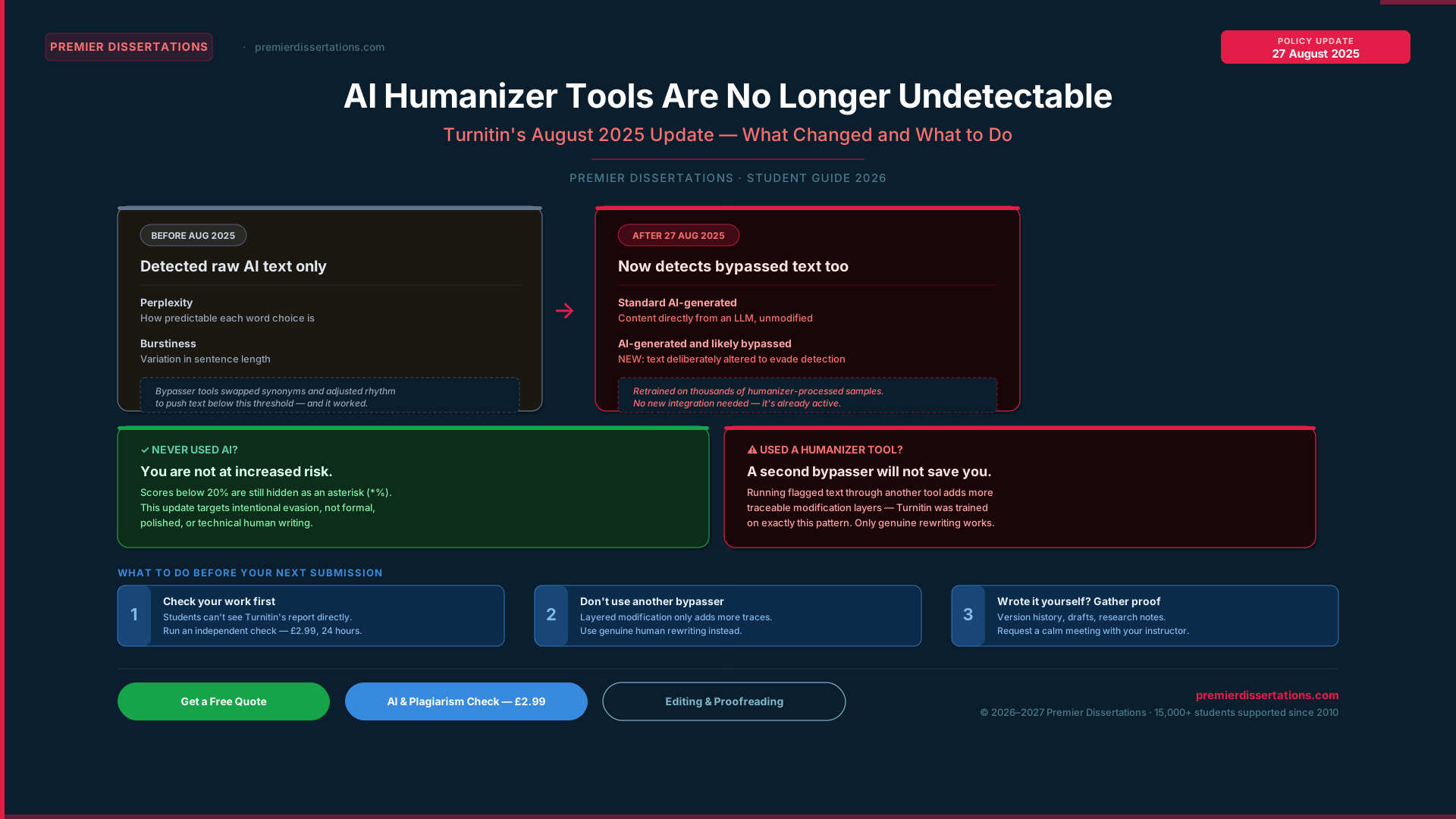
For more on specific risks with paraphrasing and grammar tools, see our guide on Can Turnitin Detect AI Humanizers?
What This Means If You Are a Non-Native English Writer
The risk of false positives is higher for non-native English writers. This is not speculation. The underlying reason is straightforward:
If your English is grammatically correct but uses a more limited vocabulary range or follows textbook sentence structures, your writing will have lower perplexity than a native speaker's writing. Lower perplexity is exactly what AI detectors are trained to flag. You are being penalised for writing clear, correct English.
This is not a failure of your writing ability. It is a failure of the detection tools. For a more detailed explanation of the underlying mechanism and what to do if you have been flagged, see our main guide:
Turnitin False Positive AI Detection — Full Guide
Frequently Asked Questions
Does being flagged mean my writing is bad? +
No. Being flagged as AI-generated says something about statistical patterns in your sentence structure, not the quality of your ideas or argument. In fact, some of the writing most likely to be flagged is clear, well-organised, and grammatically precise — exactly the qualities a good essay is supposed to have. A flag is a signal about phrasing patterns, not a verdict on your ability as a writer.
Source: Real Quora thread question
Can I prove my work is human-written if it has been flagged? +
Yes. Save your document history. Use Google Docs or Word with version history enabled. Keep your research notes and drafts. If you are flagged, provide your supervisor with your writing process — early drafts, editing history, and the final version. These are the strongest forms of evidence because they show progression and revision, which AI text lacks. See our Turnitin false positive guide for a full step-by-step appeals process.
Why do AI detectors flag formal academic writing so often? +
AI detectors look for low perplexity and low burstiness. Formal academic writing tends to use predictable vocabulary, consistent sentence structures, and clear logical flow. These are the same characteristics AI writing has. The overlap is structural. A clear, well-organised academic essay can score as high as AI text on the statistical features detectors measure. This is a design flaw in the detectors, not a reflection of your writing quality.
Is there a way to check my writing for AI flags before I submit? +
Yes. You can run your work through a free AI detector to see if it flags before you submit. Premier Dissertations offers a Turnitin-style AI and similarity check for £2.99, with human academic editors available to rewrite any flagged sections. This gives you the same information your university sees, so you can address issues before submission rather than after.
See: Free AI Content Detector Tool and Premier Check — £2.99
Should I rewrite my work to avoid being flagged? +
If you have already written a good piece of work, do not rewrite it solely to avoid detection. That can change your argument and reduce clarity. Instead, use a detection check to identify which specific sections are being flagged. If sections are flagged, you can revise those particular paragraphs for more varied sentence structure and phrasing. If the entire document is flagged without any real AI use, that points to an unreliable detection result. A human editor can help you revise flagged sections while preserving your original argument and voice.
Can grammar tools like Grammarly cause false AI flags? +
Yes. Tools like Grammarly, QuillBot, and Hemingway Editor standardise your writing. They fix grammar, replace repetitive words, and make sentences more consistent. This standardisation reduces perplexity and burstiness, making your writing look more like AI text. The more you use these tools, the more predictable your writing becomes, and the more likely you are to be flagged. If you use them, keep your original drafts as evidence of your natural writing voice.
See also: Can Turnitin Detect AI Humanizers?
Why do universities keep using AI detectors if they are so unreliable? +
Many universities are re-evaluating. Vanderbilt, Michigan State, Northwestern, UT Austin, and Australian Catholic University have all stopped using Turnitin's AI detector over accuracy concerns. Others continue using it because they see it as a screening tool, not a definitive judgement. The key is knowing the limitations. If you are flagged, you have the right to challenge it, especially if you have evidence of your writing process. The universities that have disabled the tool are making the responsible choice based on the evidence.
Check Your Work Before Submission
Premier Dissertations offers a Turnitin-style AI and similarity check for £2.99, with human academic editors available to rewrite any flagged sections. If you have been flagged, or want to check before you submit, our UK academic editors can review your work and, if needed, rewrite the affected sections by hand rather than running it through another automated tool.
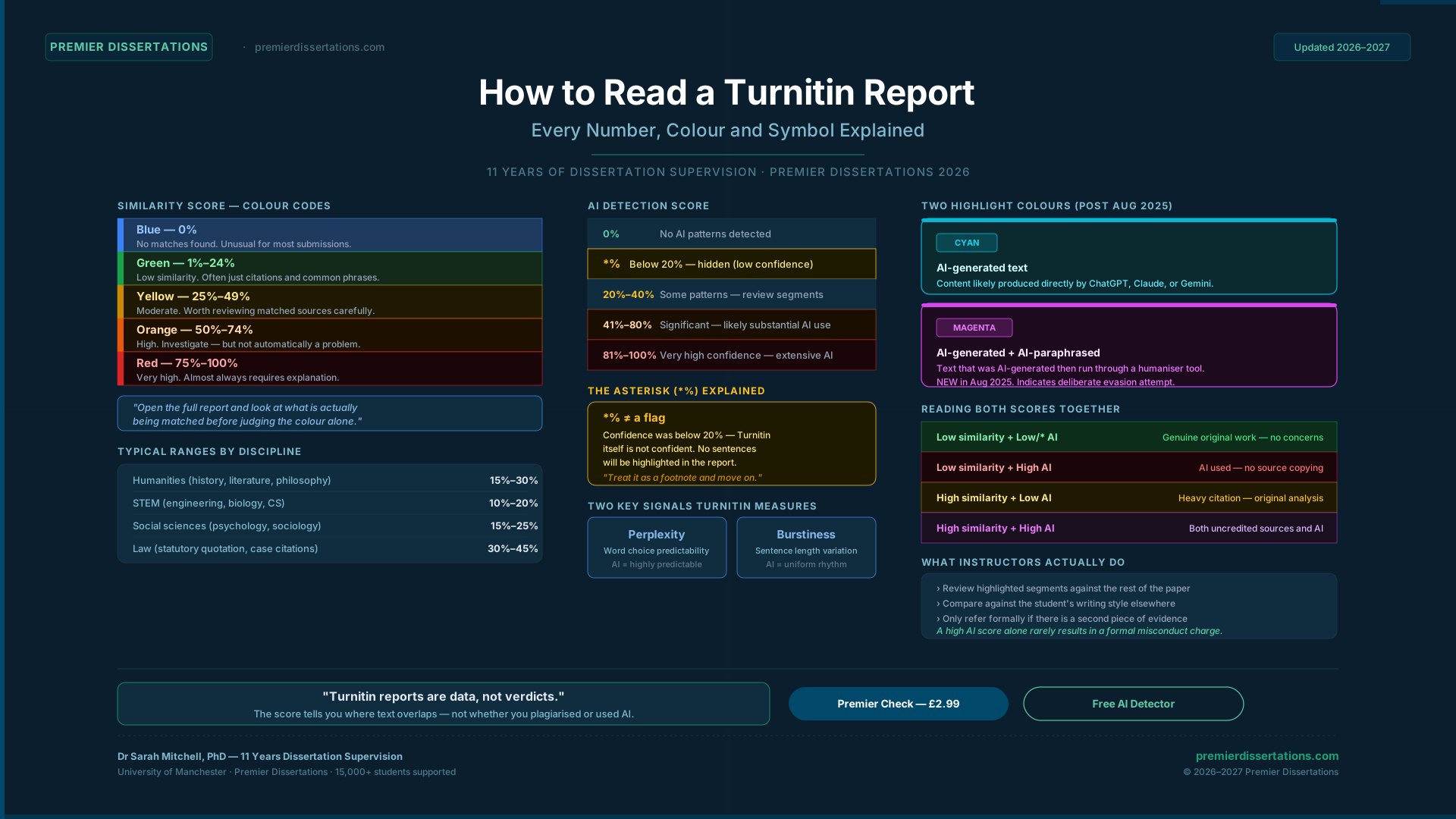
Every check includes a full report — similarity score, AI detection score, and a section-by-section breakdown — the same information your university sees.
Premier Check — £2.99
Full Turnitin-style AI and similarity report. Same data your university sees.
Need human help with flagged sections? Our editors can rewrite the affected paragraphs while preserving your argument and voice. This is real human editing, not another AI tool. See our editing services:
Dissertation Proofreading and Editing · Dissertation Help
Katherine Alexander, PhD
UK Academic Editor at Premier Dissertations
Katherine Alexander holds a PhD in English Literature from the University of Edinburgh and has edited academic work across humanities, social sciences, and STEM subjects for over a decade. She specialises in academic writing clarity and AI detection risk reduction.
Trusted by 15,000+ UK and international students and researchers. 4.8/5 across 61 verified reviews.
Ready to Check Your Work? Let's Make Sure You're Safe Before Submission
Premier Dissertations offers a Turnitin-style AI and similarity check for £2.99. If you have been flagged, or want to check before you submit, our UK academic editors can review your work and, if needed, rewrite the affected sections by hand rather than running it through another automated tool.
Check Your Work NowTrusted by 15,000+ students and researchers worldwide
What Students Say About Us
Verified reviews from UK university students who used our AI checking, editing, and dissertation support services.











Verified reviews · 4.8/5 rating · Trusted by students worldwide
How It Works
From checking your writing for AI flags to getting human editing support: simple, fast, and fully confidential.
-
01 · Check Your WorkUse our free AI detector or the £2.99 Premier Check to see if your writing would be flagged before submission.
-
02 · Get a Full ReportReceive a Turnitin-style report with similarity score, AI detection score, and section-by-section breakdown.
-
03 · Human Editing if NeededOur UK academic editors can rewrite flagged sections by hand, preserving your argument and voice.
-
04 · Submit with ConfidenceYou get the same information your university sees, so you can address issues before submission rather than after.
100% confidential · UK-qualified support · Turnitin-safe
Get an immediate response:
WhatsApp ·
Email ·
Live Chat
24/7 response · UK-qualified support · 100% confidential
Get Your Writing Checked for AI Flags — Free Detector or Full £2.99 Report
Use our free AI detector to check your work, or get a full Turnitin-style report with similarity score, AI detection score, and section-by-section breakdown — the same information your university sees.