



How to Respond to Supervisor Feedback: When to Comply and When to Push Back
September 15, 2026
10 Career-Focused MBA Degrees for Advancing in Business and Management
September 17, 2026
BAHRAIN · REFERENCING
The referencing style your department requires isn't a preference — it's a rule, and the marks lost to inconsistency are entirely avoidable once you know which rule applies.
TL;DR
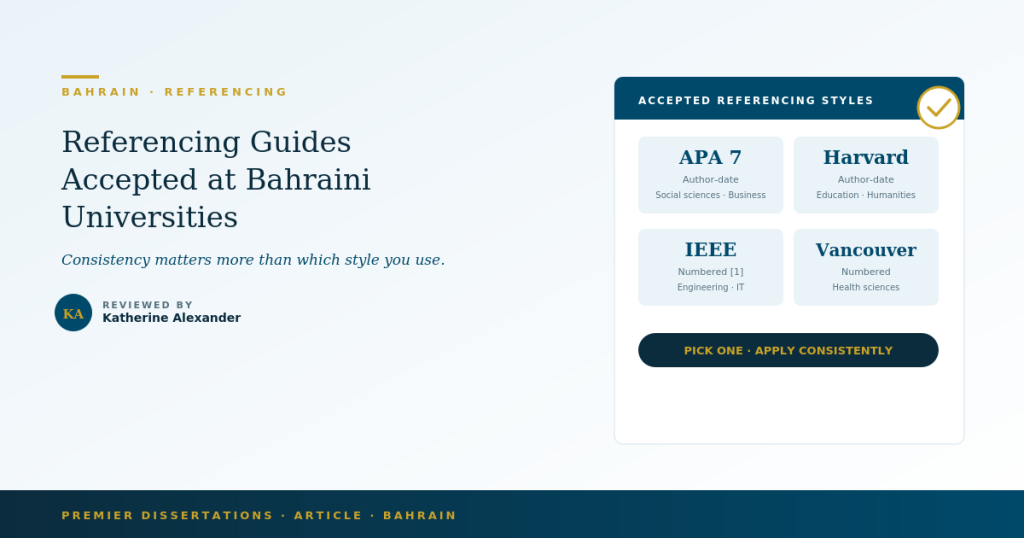
Bahraini universities accept a range of referencing styles depending on the discipline — APA and Harvard are the most common across social sciences, business, and education, while IEEE and Vancouver appear in engineering and health sciences. The critical requirement isn't which style you choose but that you apply it consistently from the first citation to the last. This guide maps the main styles used across Bahrain's postgraduate landscape and covers the consistency errors that actually cost marks.
Contents
Want your entire reference list checked for consistency before submission? A pre-submission review catches what spell-check can't.
Get a reviewThe referencing landscape in Bahrain
Bahrain's postgraduate landscape includes the University of Bahrain, Bahrain Polytechnic, the Royal College of Surgeons in Ireland – Bahrain (RCSI Bahrain), the Arabian Gulf University, and several private institutions. Each has its own conventions, and within a single university, different departments may require different styles. The University of Bahrain's College of Business Administration, for example, may default to APA while its College of Engineering follows IEEE. The first step — before writing a single citation — is confirming which style your specific programme requires. This information is almost always in the postgraduate handbook, and if it's not, your supervisor is the authoritative source.
APA and Harvard — the dominant styles
APA (currently 7th edition) and Harvard are both author-date systems that share the same basic logic: an in-text citation gives the author's surname and year, and the reader looks up the full details in an alphabetical reference list at the end. The differences between them are largely formatting details — how the reference-list entries are punctuated, whether titles are italicised or placed in quotation marks, and how electronic sources are presented. In practice, what matters most is picking the one your department requires and applying it without deviation. For a detailed walkthrough of APA 7 specifically, including how to handle common source types, see our cross-cluster guide on APA 7 referencing for Qatar universities — the formatting rules are identical regardless of country.
IEEE and Vancouver — discipline-specific styles
Engineering programmes across Bahraini universities commonly require IEEE (Institute of Electrical and Electronics Engineers) referencing, which uses numbered citations in square brackets rather than author-date. Health sciences programmes — particularly at RCSI Bahrain and the Arabian Gulf University's medical programmes — often use Vancouver style, which similarly uses numbered references but follows different formatting conventions for the reference list. Both styles require the reference list to be ordered by first appearance in the text rather than alphabetically, which means the order changes if you add or remove a citation during revision. This is a common source of errors in late-stage editing: inserting a new reference in Chapter 2 can throw off every numbered citation from that point onward.
A note on reference managers
Reference managers like Zotero, Mendeley, and EndNote handle APA, Harvard, IEEE, and Vancouver formatting, but they're only as reliable as the metadata you feed them. Government reports, institutional publications, and Arabic-language sources often need manual correction after import. Always proofread the generated reference list against the rules of your required style before submission — automated doesn't mean accurate.
Why consistency matters more than style choice
The single most important principle in referencing at any Bahraini university is consistency. An examiner who sees APA formatting in Chapter 1 and Harvard formatting in Chapter 3 — or worse, a blend of both within a single chapter — reads it as a signal that the student hasn't paid attention to detail, and that signal affects how they read everything else. Consistency means the same style applied to every citation, the same formatting for every reference-list entry of the same type, the same punctuation conventions throughout, and the same approach to electronic sources from the first page to the last.
Want your referencing checked for consistency across every chapter?
Request a reviewThe errors that actually cost marks
The referencing errors that appear most frequently in Bahraini postgraduate examiner feedback follow the same patterns seen across the GCC:
- Mismatched entries: in-text citations with no corresponding reference-list entry, or reference-list entries with no in-text citation. The most common error, and the easiest to catch with a systematic reconciliation.
- Style mixing: APA in one chapter, Harvard in another — usually because chapters were written months apart.
- Missing locators for direct quotations: a page number, paragraph number, or section heading is required for every direct quote in author-date styles.
- Inconsistent formatting of the same source type: one journal article with a DOI, another without; one with the journal name italicised, another in plain text.
- Numbered-style renumbering errors: for IEEE and Vancouver, inserting or removing a citation mid-document without updating all subsequent numbers.
Handling Arabic-language sources
Many Bahraini postgraduate dissertations draw on Arabic-language scholarship, government reports, or legal texts, and these need to coexist in the reference list with English-language sources. The general convention across most styles is to cite in the original language with a transliteration and an English translation of the title in square brackets. The practical challenge is consistency: if some Arabic sources are transliterated and others are not, or if the translation format varies between entries, the reference list reads as inconsistent. Establish a single convention from the first draft and apply it uniformly. For more on editing challenges when Arabic and English coexist in the same thesis, see our guide on editing bilingual theses in Kuwait — the principles apply equally in Bahrain.
A pre-submission referencing check
A systematic referencing check before submission catches most errors. A practical routine:
- Confirm your required style from the programme handbook — not from a classmate or a previous year's thesis.
- Reconcile in both directions: every in-text citation in the reference list; every reference-list entry in the text.
- Check one source type at a time: all journal articles, then all books, then all reports. This makes formatting inconsistencies visible.
- Search for direct quotations and confirm each has a locator (page, paragraph, or section).
- For numbered styles (IEEE/Vancouver): verify the sequence from [1] to the final reference with no gaps or duplicates.
For the broader submission-readiness framework at Omani and Bahraini institutions, see our companion piece on academic proofreading standards in Oman. And for research-topic ideas specific to Bahrain's fintech sector, see our list of dissertation topics on Bahrain's fintech sector.
Get every citation right before your examiner starts counting.
A pre-submission review checks referencing consistency, formatting, and reconciliation across every chapter — the things that lose quiet marks throughout the document.