


Handling Viva Voce at Kuwait Universities
August 20, 2026
Dissertation Topics for Sultan Qaboos University
September 1, 2026
OMAN · ACADEMIC PROOFREADING
Proofreading a thesis isn't about catching typos — it's about ensuring that every element a committee checks for consistency is actually consistent.
TL;DR
Academic proofreading for Omani postgraduate submissions goes well beyond spelling and grammar. It covers formatting consistency (margins, fonts, heading levels), referencing accuracy (in-text and reference-list reconciliation), structural coherence (the introduction's promises matched to the body's delivery), and register (formal, hedged, appropriately impersonal). The most impactful proofreading catches systematic errors — the ones that repeat on every page — rather than one-off typos. This guide covers what Omani examining committees typically check and how to proofread systematically before submission.
Contents
Ready to submit? A pre-submission review catches the systematic issues that individual proofreading passes often miss.
Get a reviewWhy proofreading goes beyond typos
When most students think of proofreading, they think of spelling mistakes and grammatical errors. Those matter, but at postgraduate level in Oman — across Sultan Qaboos University, the University of Technology and Applied Sciences, and other institutions — the errors that actually affect marks are usually systematic rather than individual: inconsistent heading levels across chapters, in-text citations that don't match the reference list, formatting that drifts from the university template over the course of a long document, and register shifts between chapters written months apart. A proofread that only catches typos misses the things that committees notice first.
Formatting consistency
Omani universities typically provide a thesis formatting template or a set of specifications in the postgraduate handbook. The details vary, but the principles are consistent: margins, fonts, line spacing, pagination, heading hierarchies, and table/figure numbering all need to be uniform from the first page to the last. A few formatting issues that surface repeatedly in examiner feedback:
- Heading-level drift: Chapter 2 uses bold 14pt for H2 headings; Chapter 4 uses bold 12pt. Written months apart, nobody noticed.
- Table and figure numbering: Some chapters number sequentially within the chapter (Table 3.1, Table 3.2); others number sequentially across the whole document. Both conventions exist — but mixing them within one dissertation is always wrong.
- Page-number continuity: Roman numerals for front matter, Arabic numerals for the body, and a smooth transition between the two. PDF export sometimes resets page numbering silently.
- Margin consistency: Binding margins (usually a wider left margin) need to apply throughout, including appendices.
Referencing accuracy
Referencing accuracy involves two separate checks that students often conflate: first, that every in-text citation appears in the reference list and every reference-list entry appears in the text (reconciliation); and second, that every entry is formatted consistently according to the required style (formatting). Both need to be correct, and doing one doesn't guarantee the other. A reference list can be perfectly formatted but still contain entries that never appear in the text — or vice versa. For a detailed walkthrough of APA 7 formatting specifically, see our cross-cluster guide on APA 7 referencing for Qatar universities — the formatting principles apply equally at Omani institutions that require APA.
A note on referencing style
Omani universities and departments vary in their required referencing style — APA, Harvard, IEEE, and others are all used depending on the discipline. The critical point isn't which style you use but that you use it consistently from the first citation to the last. Check your programme handbook before starting, and don't switch styles mid-document even if a source looks awkward in your chosen format.
Want formatting, referencing, and structure checked together before submission?
Request a reviewStructural coherence
Structural coherence means the dissertation reads as one document, not five chapters written at different times and stapled together. The introduction's roadmap should match what the body chapters actually deliver. The terminology used for a key concept in Chapter 1 should be the same terminology used in Chapter 5. The table of contents should reflect the actual heading structure of the document (not a version from three drafts ago). These are the kinds of issues that a full read-through catches but a chapter-by-chapter proofread misses — which is why reading the entire document in a single sitting, at least once, is worth the time investment before submission.
Academic register and tone
Academic register at Omani postgraduate level generally means formal, impersonal, and appropriately hedged: "this study suggests" rather than "this study proves," third-person or careful first-person rather than casual phrasing, and precise terminology rather than colloquial equivalents. The most common register problems in multilingual writers aren't about individual word choices — they're about consistency: a chapter that opens in formal academic English and drifts into a more conversational register by the fourth page, or hedging that's careful in the methodology chapter but absent in the discussion.
Considerations for multilingual writers
A large proportion of postgraduate students at Omani universities are writing in English as a second or third language, and examining committees are generally aware of this. The standard they apply is clarity and consistency, not native-speaker prose. The proofreading issues most commonly flagged for multilingual writers are:
- Long, multi-clause sentences that bury the main point — shorter sentences with clear subjects and verbs are almost always clearer.
- Article usage (a/an/the) — errors are common and rarely affect meaning on their own, but accumulated across sixty thousand words they affect readability.
- Direct translation of Arabic or other L1 phrase structures into English, particularly in linking phrases and hedging expressions.
- Inconsistent verb tense in the literature review (past tense for what authors did vs present tense for what the field knows).
For topic ideas that might shape the dissertation content itself, see our list of dissertation topics for Sultan Qaboos University.
A systematic proofreading process
The most effective proofreading approach treats it as a series of focused passes rather than one attempt to catch everything at once:
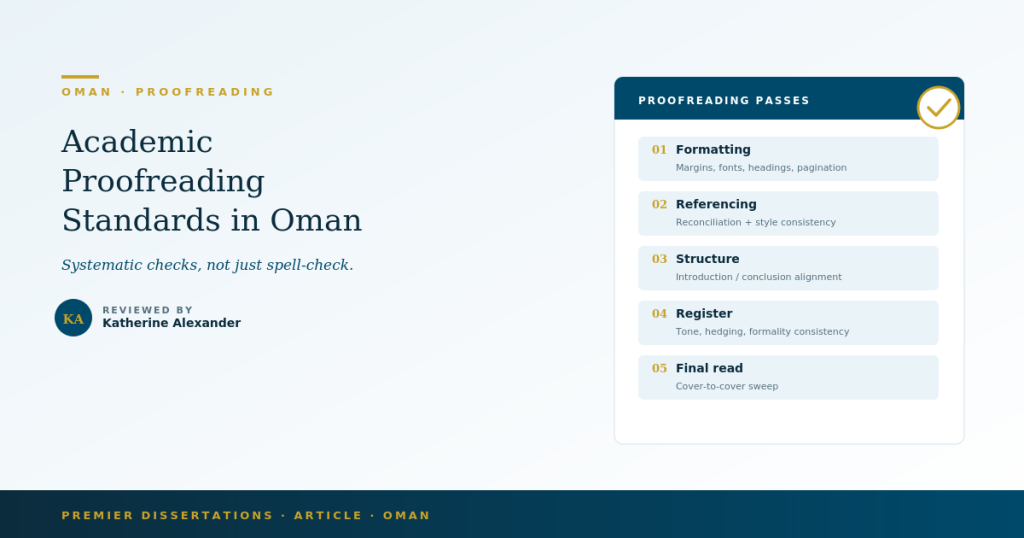
- Formatting pass: check margins, fonts, heading levels, pagination, and table/figure numbering from first page to last. Do this before any content editing.
- Referencing pass: reconcile in-text citations against the reference list in both directions. Check formatting consistency for each source type.
- Structural pass: read the introduction and conclusion together — do they match? Then check that the table of contents reflects the actual heading structure.
- Register pass: read aloud (or have a text-to-speech tool read) at least the introduction, discussion, and conclusion chapters. Inconsistencies in tone and hedging are more audible than visible.
- Final read: a full cover-to-cover read for anything the focused passes missed — typos, orphaned sentences, repeated paragraphs from copy-paste.
For guidance on referencing standards accepted across Bahraini universities — which share many conventions with Omani institutions — see our companion piece on referencing guides accepted at Bahraini universities.
Submit with every systematic check already done.
A pre-submission review covers formatting, referencing, structure, and register — the things that lose marks quietly across every chapter.