


7 Best Evening MBA Degrees in San Francisco for Professionals Advancing Their Careers
July 30, 2026
MSc Dissertation Topics in Kuwait’s Finance Sector
August 10, 2026
KUWAIT · BILINGUAL EDITING
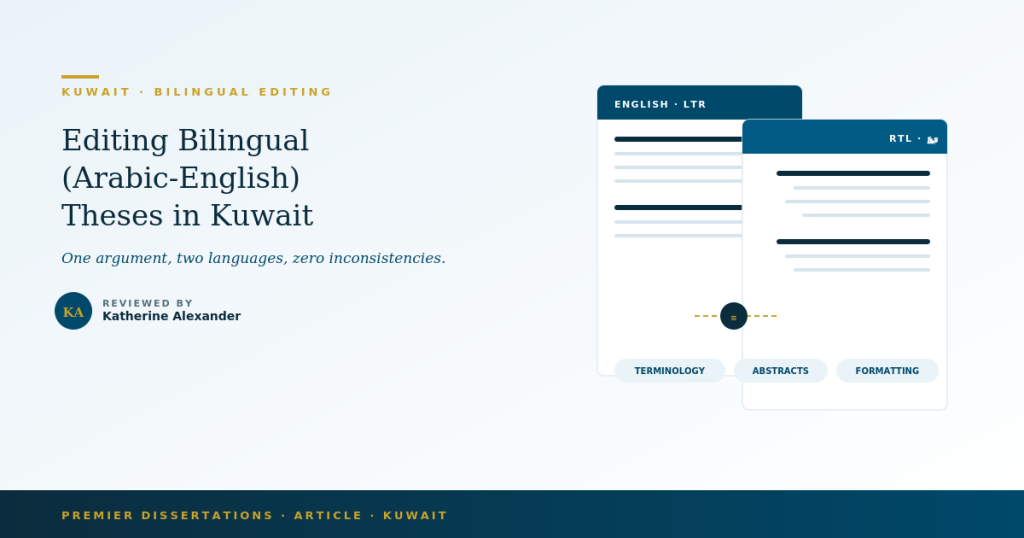
A bilingual thesis isn't two separate documents — it's one argument expressed in two languages, and the editing process needs to treat it that way.
TL;DR
Bilingual theses in Kuwait require more than translation — they need consistent terminology across Arabic and English sections, aligned abstracts, coherent formatting in both text directions, and a reference list that handles sources in both languages correctly. The most common issues are terminological drift between the two versions, formatting inconsistencies caused by mixed text directions, and abstracts that summarise different content. This guide covers the practical editing challenges and how to address them before submission.
Contents
Editing a bilingual thesis? A pre-submission review checks consistency across both languages — terminology, formatting, and referencing.
Get a reviewWhy bilingual theses are common in Kuwait
Kuwait's postgraduate landscape includes programmes taught in Arabic, programmes taught in English, and programmes where the primary language is one but key components — the abstract, certain chapters, or the entire defence — are conducted in the other. Kuwait University, in particular, has departments where the dissertation is written in Arabic with an English abstract and summary, and departments where the reverse applies. The result is that many students produce a thesis with substantial content in both languages, which creates editing challenges that go well beyond what a monolingual dissertation requires. The key shift in thinking is that a bilingual thesis isn't a document plus a translation — it's a single academic argument that needs to be coherent in both languages simultaneously.
Keeping terminology consistent across languages
Terminological drift is the most common substantive problem in bilingual theses. A technical term that's rendered one way in the Arabic sections and a slightly different way in the English sections — or worse, a term that's used consistently in English but translated inconsistently into Arabic across different chapters — creates confusion for examiners reading both versions. The practical fix is a terminology glossary built at the start of the writing process: a two-column list of every key term in both languages, agreed with the supervisor, and referenced throughout drafting. Retro-fitting this after the thesis is written is possible but far more time-consuming.
Aligning the Arabic and English abstracts
Many programmes require both an Arabic and an English abstract, and examiners often read both. The most common problem isn't poor translation but misalignment: the two abstracts summarise slightly different aspects of the research, use different emphasis, or reflect different stages of the writing process (one written early, the other updated late). Both abstracts should be written — or at minimum, reviewed and reconciled — at the same time, after the main body is finalised, and they should cover the same four elements: the research question, the method, the key findings, and the significance.
A note on machine translation
Machine translation tools have improved significantly, but they remain unreliable for academic Arabic — particularly for technical terminology, hedging language ("this suggests" vs "this proves"), and the formal register expected in a thesis abstract. A machine-translated abstract should always be reviewed by someone with academic Arabic proficiency before submission. If your programme has specific requirements about who can certify the Arabic version, check those early.
Formatting challenges with mixed text directions
Arabic is written right-to-left (RTL); English is written left-to-right (LTR). When both appear in the same document — even if they're in separate sections — formatting problems emerge at the boundaries: paragraph alignment flips unexpectedly, punctuation marks appear on the wrong side of a sentence, table headers reverse direction, and page numbers or headers behave inconsistently. Most word processors handle bidirectional text adequately at the paragraph level but struggle with mixed-direction content within a single paragraph (for example, an English citation inside Arabic body text, or an Arabic term inside an English methodology chapter). A few practical habits reduce these issues:
- Use explicit paragraph direction settings rather than relying on auto-detection.
- Keep Arabic-language sections in separate pages or clearly bounded sections rather than interleaving sentences in both languages within the same paragraph.
- Check headers, footers, and page numbers after every major formatting change — these are the elements most likely to flip direction silently.
- Export to PDF and review the final output carefully, since what appears correct in the editing view sometimes renders differently in print or PDF.
Want both language versions checked for consistency before submission?
Request a reviewReferencing sources in both languages
A bilingual thesis typically draws on sources in both Arabic and English, and these need to coexist in a single reference list. APA 7 — the most commonly required style in Kuwaiti social-science and business programmes — recommends citing non-English sources in their original language with a transliteration and an English translation of the title in square brackets. The practical challenge is consistency: if some Arabic sources are transliterated and others are not, or if the translation format varies across entries, the reference list reads as inconsistent even if every individual entry is technically correct. A consistent convention applied from the first draft saves substantial reformatting time later.
For a detailed guide to APA 7 formatting, including how to handle non-English sources, see our companion piece on APA 7 referencing for Qatar universities — the principles apply equally in Kuwait.
Common errors and how to catch them
The errors that appear most frequently in bilingual thesis feedback cluster around a small number of issues:
- Terminological inconsistency: the same concept rendered differently in Arabic across chapters, or an English term used inconsistently in the Arabic sections.
- Abstract misalignment: the Arabic and English abstracts describing slightly different research or emphasising different findings.
- Direction-related formatting errors: flipped headers, misplaced punctuation, or reversed table layouts at RTL/LTR boundaries.
- Reference-list inconsistency: some Arabic sources transliterated and translated, others not, or inconsistent formatting between Arabic and English entries.
- Register mismatch: the Arabic version using a more formal or more informal register than the English version, or vice versa — both should match the academic register expected by the examining committee.
A practical editing process
Editing a bilingual thesis works best when it follows a structured sequence rather than trying to fix everything in a single pass:
- Terminology audit: check every key term against the glossary in both languages. Flag and resolve any inconsistencies before moving on.
- Abstract reconciliation: read both abstracts side by side and confirm they cover the same four elements (question, method, findings, significance).
- Structural consistency: check that heading levels, chapter numbering, and the table of contents are consistent across both language sections.
- Reference-list reconciliation: run the standard in-text-to-reference-list cross-check, then verify formatting consistency for Arabic-language sources specifically.
- Formatting review: export to PDF and check all RTL/LTR boundaries, headers, footers, page numbers, and table layouts.
For the broader requirements framework that this editing process sits within, see our companion piece on dissertation requirements at Kuwait University.
One argument, two languages, zero inconsistencies.
A pre-submission review checks terminology, abstract alignment, formatting, and referencing across both language versions — before your committee reads either one.