

How to Write a Literature Review — Kuwaiti Standards
August 17, 2026
Academic Proofreading Standards in Oman
August 20, 2026
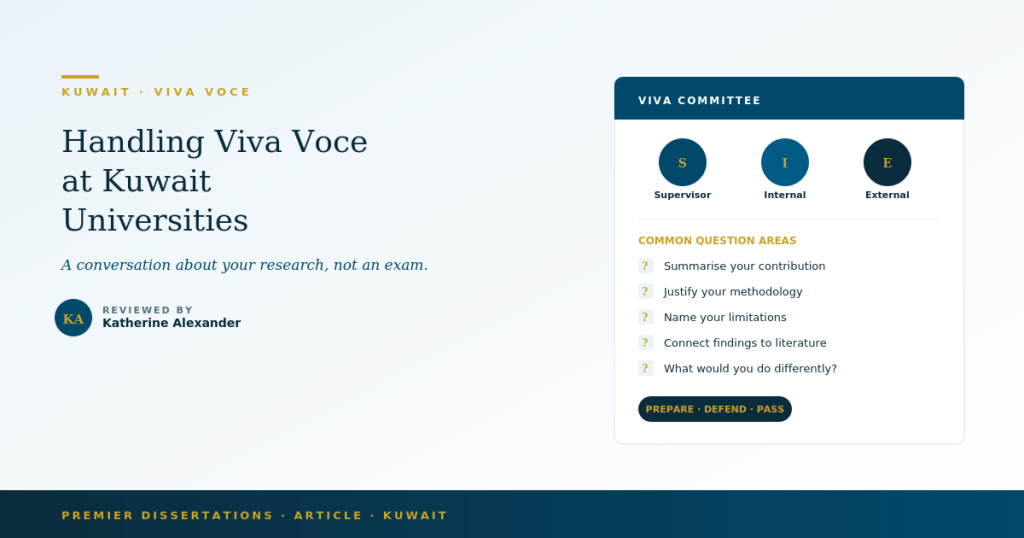
KUWAIT · VIVA VOCE
The viva isn't a test of memory — it's a conversation about your own research, and the students who prepare for a conversation do better than those who prepare for an exam.
TL;DR
The viva voce (or munaqasha) at Kuwaiti universities is an oral defence where you present and defend your dissertation in front of an examining committee. Preparation that helps most: re-reading your own work with fresh eyes, knowing your methodology choices and their limitations without being prompted, anticipating the questions your own writing invites, and practising explaining your contribution in plain language. This guide covers the format, what examiners typically probe, common mistakes, and a practical preparation routine.
Contents
Going into the viva soon? A pre-submission review ensures the document your committee is reading is as strong as the defence you're preparing.
Get a reviewWhat to expect from the viva
The viva at Kuwaiti universities typically follows a set structure: the student delivers a presentation summarising the research (usually 15–20 minutes, sometimes with slides), followed by a question-and-answer session led by the examining committee. The total duration varies — anywhere from 45 minutes to two hours depending on the programme and the committee's questions — but most run between one and one-and-a-half hours. The tone is closer to a professional discussion than a courtroom cross-examination: the committee has already read the dissertation and is now testing whether the student can explain, defend, and contextualise the work under questioning. The outcome is usually communicated shortly after the session — pass, pass with minor corrections, pass with major corrections (referral), or, much less commonly, fail.
Who sits on the committee
A typical Kuwaiti viva committee includes the supervisor (who has guided the work but steps back during the examination itself), one or two internal examiners from the department, and often an external examiner from another university or, in professional programmes, from industry. The external examiner's role is to provide an independent assessment and to ensure that the standard is consistent with comparable programmes elsewhere. Each committee member may focus on different aspects: the supervisor on the research process, the internal examiner on methodological rigour and field knowledge, and the external examiner on the contribution's significance and the quality of the argument.
What examiners typically ask
While every viva is different, certain question types appear consistently across Kuwaiti postgraduate programmes:
- "Can you summarise your contribution in two or three sentences?" This tests whether you can articulate the core value of your work without reading from the document.
- "Why did you choose this methodology over alternatives?" The most commonly probed area — examiners want justification, not description.
- "What are the main limitations of your study?" A student who can name limitations honestly and explain their impact is more credible than one who is defensive.
- "How does this finding connect to the literature you reviewed?" This checks whether the discussion chapter does its job — connecting findings back to existing research rather than restating results.
- "If you were starting this research again, what would you do differently?" This tests reflective awareness and methodological maturity.
- "What are the practical implications of your findings?" Particularly common in business, education, and policy-focused programmes.
A note on language
In some Kuwaiti programmes, particularly Arabic-medium departments, the viva may be conducted in Arabic, in English, or in a mix of both. Confirm the expected language with your supervisor before the date. If the viva is bilingual, prepare key terminology in both languages — shifting mid-sentence between Arabic and English is common in Gulf academic settings but can undermine clarity if the technical terms aren't consistent across both languages. Our guide on editing bilingual theses in Kuwait covers the terminology-consistency challenge in more detail.
Defending your methodology
Methodology is the section that attracts the most questioning in most vivas, because it's where the student's choices are most visible and most open to challenge. The key is to be able to explain not just what you did but why you made each major decision — why this research design, why this sample size, why this analytical technique, and what would have been gained or lost by choosing differently. A few practical pointers:
- Re-read your methodology chapter the week before the viva and note every place where you made a choice. For each one, prepare a one-sentence justification.
- Know the limitations of your design without being prompted — an examiner who has to point them out is less impressed than one who hears you name them first.
- If you used a framework (TAM, Yin's case-study design, grounded theory), be prepared to explain why that framework was the right fit, not just what it says.
For a deeper look at how to justify methodological choices in the written chapter itself, see our companion piece on dissertation requirements at Kuwait University.
Want your dissertation reviewed for the same things the committee will probe in the viva?
Request a reviewHandling questions about limitations
Limitations questions are not traps — they're opportunities to demonstrate methodological self-awareness. The strongest viva answers name a specific limitation, explain how it affects the findings (not just that it "limits generalisability" in the abstract), and briefly note what a future study might do to address it. Students who respond defensively ("I don't think that's a limitation") or evasively ("all research has limitations") lose credibility, because the committee can see the limitations whether the student acknowledges them or not. Owning them confidently is always the stronger position.
Common mistakes in the room
A few viva mistakes appear often enough in feedback to be worth naming:
- Reading from the dissertation. The committee has already read it. They want to hear you talk about it in your own words, not watch you find the right paragraph.
- Presenting too long. If you're given 15 minutes, use 15 minutes. An over-long presentation eats into the discussion time where most of the assessment happens.
- Not listening to the question. Answering the question you prepared for rather than the question actually asked. If you're unsure, it's always better to ask for clarification than to answer the wrong question.
- Being defensive rather than reflective. The viva is a scholarly conversation, not a debate to win. Acknowledging a valid point from the examiner — "that's a fair critique, and in retrospect I might have…" — reads as intellectual maturity.
- Not preparing for the "so what?" question. Being able to explain why your findings matter — to the field, to practitioners, or to policy — in plain language is essential and often under-rehearsed.
A practical preparation routine
A structured preparation routine in the two weeks before the viva covers most of what you'll need:
- Full re-read. Read the entire dissertation from cover to cover as if you were the examiner. Note anything that's unclear, inconsistent, or underdeveloped — those are the areas the committee will probe.
- Methodology audit. List every major methodological choice and write a one-sentence justification for each.
- Limitations list. Write out three to five specific limitations with a sentence each on their impact and what a future study might do differently.
- Contribution statement. Practise explaining your research contribution in two to three sentences without jargon — to a peer, a family member, or out loud to yourself.
- Mock viva. If possible, do a practice run with a peer or colleague. Even answering questions out loud once makes the real viva significantly less nerve-wracking.
For guidance on how the literature review is typically probed in the viva, see our guide on writing a literature review to Kuwaiti standards. For the broader requirements framework, see dissertation requirements at Kuwait University.
Go into the viva with the document already at its strongest.
A pre-submission review checks structure, methodology justification, referencing, and consistency — so the defence is about your argument, not about avoidable errors.