


Is ScienceDirect the Same as Elsevier? A Complete Guide
August 13, 2026
Handling Viva Voce at Kuwait Universities
August 20, 2026
KUWAIT · LITERATURE REVIEW
The literature review is the chapter most students draft first and rewrite last — and the gap between the two versions is usually where the real learning happens.
TL;DR
A strong literature review at Kuwaiti postgraduate level is organised thematically rather than source-by-source, builds toward a clearly stated research gap, and demonstrates critical engagement with existing studies rather than just summarising them. The most common weaknesses are descriptive summarising without analysis, poor organisation, over-reliance on textbooks at the expense of journal articles, and failure to connect the review to the methodology that follows. This guide covers how to structure, write, and revise a literature review that meets the expectations of Kuwaiti examining committees.
Contents
Already drafted your literature review? A pre-submission review checks structure, critical engagement, and referencing consistency.
Get a reviewWhat a literature review is actually for
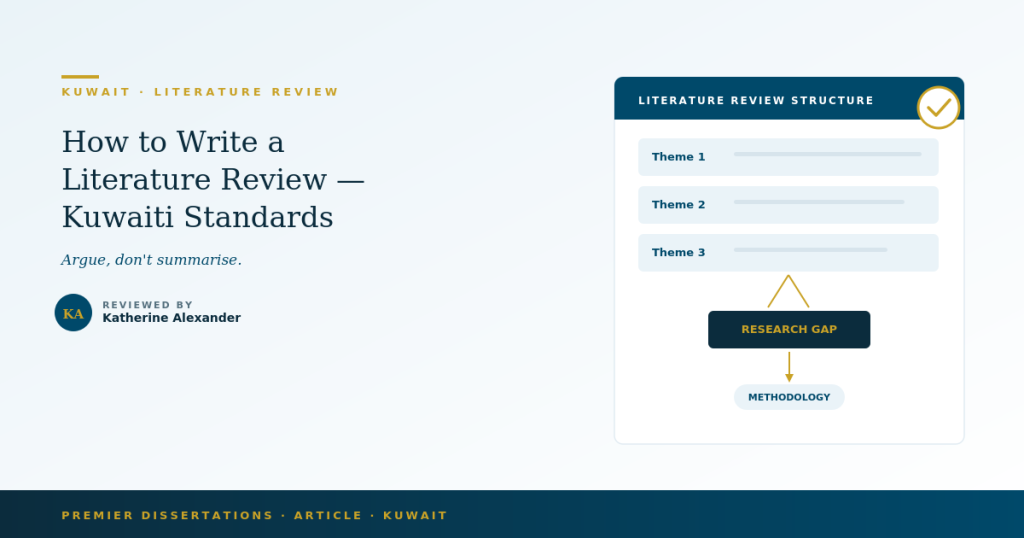
The literature review serves three functions simultaneously: it demonstrates that the student knows the field well enough to contribute to it, it maps the existing research landscape to identify where a gap or unresolved question exists, and it establishes the conceptual or theoretical framework that will shape the methodology and analysis. If it only does the first — showing breadth of reading — it reads as a reading list rather than a chapter. The strongest literature reviews at Kuwaiti universities do all three in a way that makes the methodology chapter feel like a natural next step rather than an abrupt shift.
Organising by theme, not by source
The most common structural mistake in literature reviews is organising them source-by-source: "Smith (2020) found X. Jones (2021) argued Y. Ahmed (2022) concluded Z." This reads as a series of book reports rather than an argument. The alternative — thematic organisation — groups studies by what they found or debated rather than by who wrote them. A section on, say, the relationship between board independence and firm performance would discuss all relevant studies together, comparing their findings, methods, and contexts, rather than treating each one as a standalone paragraph. The thematic approach makes it much easier for the reader (and the examiner) to see where the evidence converges, where it conflicts, and where the gaps are.
Moving from summary to critical engagement
Critical engagement means doing more than reporting what a study found — it means evaluating how it reached those findings, how its methods and context affect the reliability of its conclusions, and how it relates to other studies on the same question. A few practical shifts help move prose from summary to analysis:
- After summarising a finding, add a sentence on why it matters or what limits its applicability — "however, this study's sample was drawn from a single industry, which limits generalisability to the broader Kuwaiti context."
- When two studies reach different conclusions, don't just report both — explain what might account for the difference (different methods, different time periods, different definitions of the same variable).
- Use signal phrases that indicate evaluation, not just attribution: "convincingly demonstrates," "fails to account for," "raises but does not resolve" — these show the reviewer is thinking, not just citing.
A note on Arabic-language sources
Kuwaiti examining committees may expect the literature review to engage with Arabic-language scholarship where it exists for the topic, not only English-language sources. If your field has a body of Arabic academic literature — particularly from Kuwaiti, Gulf, or broader Arab-world journals — incorporating it demonstrates both breadth and contextual awareness. If your thesis is written in English, cite Arabic sources with a transliteration and English translation of the title per your required referencing style. For more on handling bilingual referencing, see our guide on editing bilingual theses in Kuwait.
Want your literature review checked for structure and critical engagement before submission?
Request a reviewChoosing and balancing sources
Source selection is where a literature review's credibility is built or undermined. A few principles consistently appear in examiner feedback at Kuwaiti institutions:
- Prioritise peer-reviewed journal articles over textbooks, particularly for empirical claims. Textbooks are useful for establishing foundational definitions but shouldn't dominate the review.
- Include recent sources. A literature review where the most recent study cited is five years old signals that the student stopped searching too early. Aim for a mix of foundational works and publications from the last three to five years.
- Balance breadth and depth. Covering fifty sources superficially is less useful than covering twenty-five in a way that compares their methods, findings, and limitations.
- Include Kuwaiti and GCC context where relevant. A literature review on banking regulation that draws only on US and European studies, despite a Kuwaiti research question, will be flagged for missing contextual relevance.
Building toward the research gap
The literature review should end — or build toward its end — with a clearly articulated statement of what the existing literature does not cover, does not resolve, or has not examined in the specific context the dissertation addresses. This is the research gap, and it's the bridge between the literature review and the methodology chapter. A gap can be geographic (this has been studied in Europe but not in Kuwait), methodological (most studies are quantitative but qualitative perspectives are missing), temporal (the most recent data predates a significant policy change), or conceptual (two bodies of literature that haven't been connected yet). The strongest gap statements are specific and testable, not vague — "more research is needed" is not a gap; "no study has examined how CBK's 2023 macroprudential framework affected credit allocation to SMEs" is.
Common weaknesses and how to fix them
The issues that appear most frequently in examiner feedback on Kuwaiti postgraduate literature reviews:
- Descriptive rather than analytical. The review summarises each source but doesn't evaluate, compare, or connect them. Fix: add a comparative or evaluative sentence after every summary paragraph.
- Source-by-source organisation. Studies are listed in sequence rather than grouped by theme. Fix: reorganise around three to five themes drawn from the research question's key concepts.
- Over-reliance on textbooks. Foundational texts dominate at the expense of recent empirical studies. Fix: aim for at least 60–70% journal articles; use textbooks only for definitions and frameworks.
- No clear gap statement. The review ends without stating what's missing. Fix: write the gap statement first, then structure the review to build toward it.
- Disconnected from methodology. The review doesn't create a logical path to the research design. Fix: end the chapter by connecting the identified gap to the question and method that follow.
For how the literature review fits into the broader five-chapter structure, see our guide on dissertation requirements at Kuwait University.
Revising the literature review before submission
The literature review is almost always the chapter that changes most between first draft and final submission, because the student's understanding of the field deepens as the research progresses. A practical revision checklist:
- Re-read the chapter and check whether every section contributes to the gap statement at the end. Remove or relocate material that doesn't.
- Check that the organisation is thematic, not chronological or source-by-source.
- Verify that recent sources (last three to five years) are represented in every major section.
- Confirm that the gap statement is specific, testable, and logically connected to the methodology chapter.
- Run a referencing reconciliation: every in-text citation in the reference list, every reference-list entry in the text.
If you're preparing for the viva after the review is finalised, our companion piece on handling viva voce at Kuwait universities covers what examiners typically probe in the literature-review discussion.
Make your literature review argue, not just summarise.
A pre-submission review checks thematic structure, critical engagement, source balance, and the gap statement — the things examiners look for first.