


Research Gap Examples: 15+ Real Dissertation Gaps That Actually Worked (UK, 2026)
June 16, 2026
Data Collection Methods: A Complete Guide for Research (2026)
June 19, 2026
Why Students Struggle With the Rationale Section
After supervising dissertation proposals for more than a decade, I noticed the same pattern repeatedly.
Students often spend pages summarising articles, theories, and statistics, but never fully explain why their own study is necessary.
That usually happens because the rationale gets confused with the background section.
| Background | Rationale |
|---|---|
| What researchers already know | What researchers still do not know |
| Summarises existing literature | Explains why that missing knowledge matters |
| Descriptive | Justificatory |
That distinction sounds small, but it changes the entire quality of a dissertation introduction.
One student once brought me a 2,500-word proposal draft with twenty references and almost no actual rationale. The literature summary was detailed. The problem was that nothing in the proposal clearly justified why another study was needed.
Once we narrowed the gap to one unanswered question, the whole project suddenly became clearer, including the methodology.
That happens more often than students expect. (And honestly, I did the same thing during my PhD.)
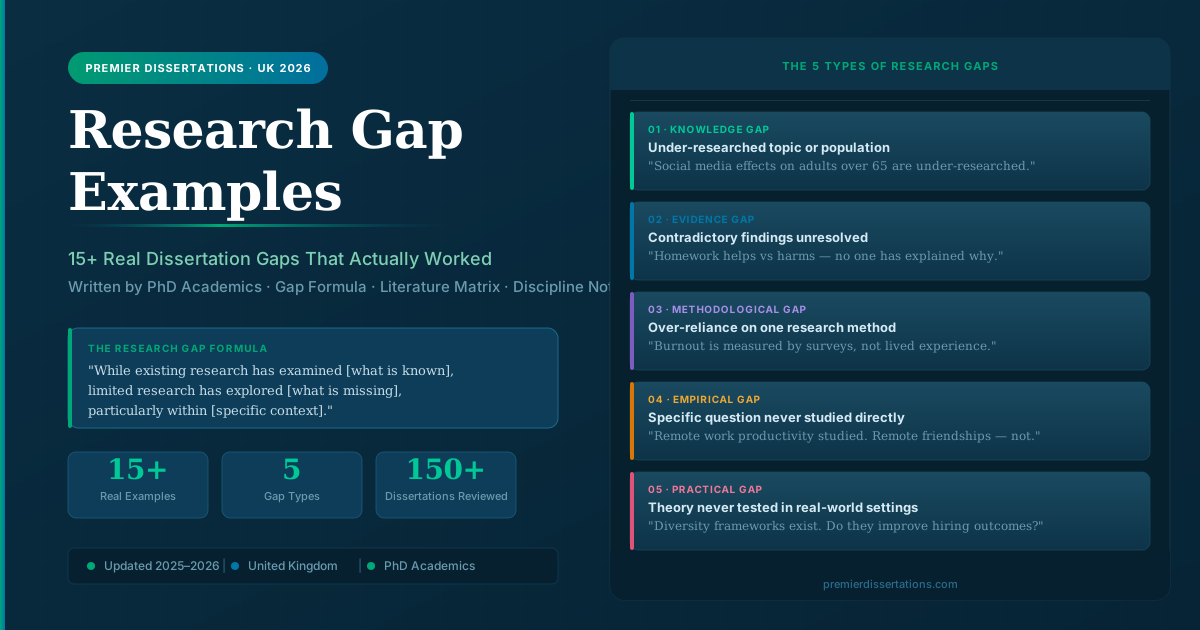
For a deeper look at how to identify research gaps, the engine of your rationale, see our guide: Research Gap Examples: 15+ Real Dissertation Gaps That Actually Worked.
What Examiners Actually Look For
Most supervisors and examiners are not expecting groundbreaking discoveries at the undergraduate or master's level.
What they want is evidence that you understand:
Strong rationales tend to feel focused. Weak rationales usually sound broad, emotional, or generic.
For example:
That clarity matters more than students realise. For more sentence frames and detailed examples of dissertation proposals, visit our Dissertation Proposal Examples library.
Step-by-Step: How to Write a Research Rationale
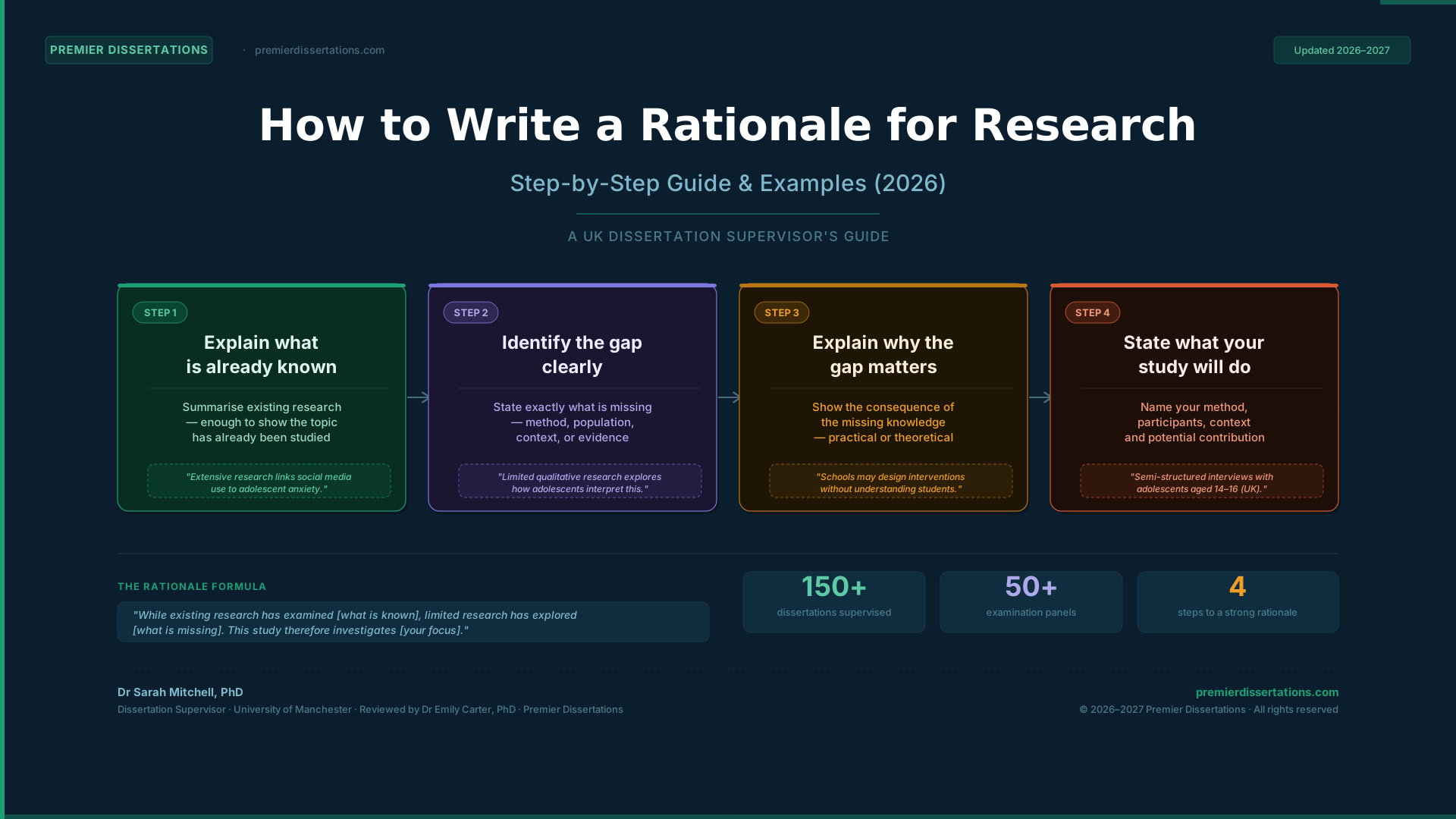
(1) Establish what is known, (2) Identify the gap, (3) Explain why the gap matters, (4) State your contribution.
Alt text: "Flowchart showing four steps to write a research rationale: background, gap, justification, significance."
Start by establishing the current state of research. This should be concise. You are not writing a full literature review. You only need enough evidence to show the reader that the topic has already been studied.
That paragraph does two things well: it demonstrates awareness of existing literature and avoids unnecessary detail.
A common mistake is turning this section into a long historical overview. Most rationales become much stronger once students start trimming information that does not directly support the gap.
This is the core of the rationale. Your reader should never have to guess what the missing piece is.
Good research gaps are usually specific rather than dramatic.
| Gap Type | Example |
|---|---|
| Methodological | Existing studies rely only on surveys |
| Population | Older adults have not been studied sufficiently |
| Context | Research exists globally but not in UK universities |
| Evidence | Findings between studies contradict each other |
| Practical | Theory exists, but real-world application is unclear |
Notice something important: the paragraph does not say "More research is needed." That phrase appears in almost every academic paper ever written. Instead, the rationale identifies exactly what is missing.
That precision is what gives the study credibility.
This is the section many students skip. They identify a gap but never explain why anyone should care about it.
A rationale becomes persuasive when it shows the consequences of the missing knowledge.
Ask yourself:
Examiners respond well to this kind of practical significance.
Finally, explain how your research responds to the gap.
At this stage, clarity matters more than complexity. Include:
That sounds focused, realistic, and academically credible.
Need help structuring your full proposal around a clear rationale? Our Dissertation Proposal Writing Service pairs you with a UK academic who can review your rationale and methodology.
Get Proposal HelpThe 4 Parts of a Strong Research Rationale (At a Glance)
| Part | Purpose | Example Phrase |
|---|---|---|
| Background | Establish what is already known | "Previous studies have shown…" |
| Gap | Explain what is missing | "However, limited research explores…" |
| Justification | Explain why the gap matters | "This matters because…" |
| Significance | Show what your study contributes | "This study addresses the gap by…" |
Students who follow this structure usually produce much clearer introductions.
Real Example: Weak vs Strong Rationale
Weak Version
Strong Version
Sentence Frames You Can Adapt
Use these templates to draft your rationale quickly.
These templates are especially useful when drafting early proposal sections. For more examples, browse our Academic Library.
Common Mistakes That Weaken Rationales
| Mistake | Why It Hurts | Better Approach |
|---|---|---|
| Writing only background | The rationale never becomes clear | Explicitly identify the missing element |
| Saying "more research is needed" | Too generic | Specify what kind of research is missing |
| Using emotional arguments | Weak academic justification | Use evidence-based reasoning |
| Overstating significance | Reduces credibility | Keep claims realistic |
| Including no citations | Looks opinion-based | Use recent academic sources |
One of the easiest ways to improve a rationale is to replace vague language with specific academic limitations.
Specificity instantly improves academic quality.
How Long Should a Research Rationale Be?
There is no universal word count. The quality of the argument matters more than the length. Still, these ranges work well in most UK universities.
| Academic Level | Typical Length |
|---|---|
| Research proposal | 150–300 words |
| Undergraduate dissertation | 150–300 words |
| Master's dissertation | 250–400 words |
| PhD thesis | 400–800 words |
Some students assume longer automatically means stronger. In practice, concise rationales often perform better because the logic remains easier to follow.
For authoritative guidance on research project scoping, see the UK Research Integrity Office.
Frequently Asked Questions (People Also Ask)
These answers are optimised for Google's featured snippet box. The first sentence directly answers the question; the rest provides context.
Final Checklist Before Submission
Before submitting your dissertation or proposal, run through this checklist:
Download a printable PDF of this checklist from our Academic Library.
Final Thought
Here is a truth that many students learn too late. Your research rationale is not just a paragraph to satisfy a marking rubric. It is your argument for why the academic world should pay attention to your work.
A weak rationale says: "I studied this because I thought it was interesting."
A strong rationale says: "I studied this because the existing literature has a blind spot, and here is why that blind spot matters, and here is what we will know once I fill it."
One convinces examiners. The other does not. Write your rationale like you mean it. Because if you do not believe your research matters, no one else will. Good luck.
Need Help Writing Your Research Rationale?
Whether you need your rationale reviewed, a full proposal written, or your introduction chapter strengthened — our team of UK-qualified PhD academics is here to help.
PhD academics · Human-written · Turnitin and AI report · Trusted by 15,000+ UK studentsGet 3+ Free Wildlife Dissertation Topics within 24 hours?