

How to Write a Literature Review for Australian Universities (2026 Guide)
June 13, 2026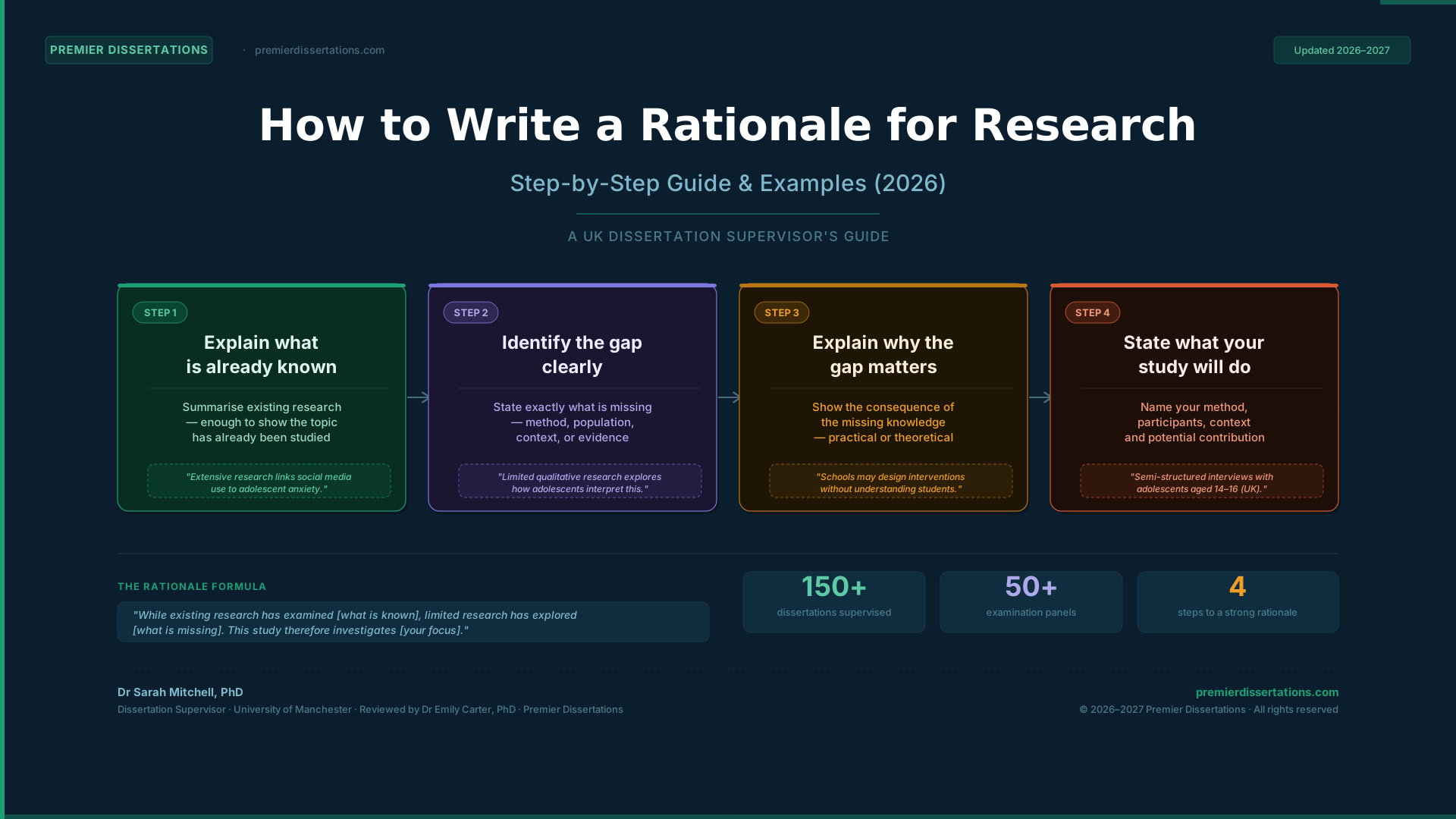
How to Write a Rationale for Research: Step‑by‑Step Guide & Examples (2026)
June 17, 2026
Updated 2025–2026 | United Kingdom | Written by PhD Academics
Explore This Page
Here is something I have learned from marking over 150 dissertations. Students fail because their research gap is vague, generic, or already answered by someone else. Not because their grammar is imperfect. Not because they missed a few references. Because they never clearly answered the question: "Why was this study necessary?"
Examiners ask that question silently while reading your introduction. If they cannot find the answer quickly, they stop reading generously.
This guide exists because that problem is fixable. One quick caveat: some supervisors prefer different gap structures. What works for one examiner might need adjustment for another. Use this guide as a foundation, but always check your department's specific expectations.
01What Is a Research Gap?
02Research Gap vs Literature Gap
03Why It Shapes Your Dissertation
04The 5 Types of Research Gaps
0515+ Real Gap Examples
06What Examiners Look For
07Can a Small Gap Get a Distinction?
08How Many Sources Do You Need?
09How to Find Your Research Gap
10Writing a Literature Review
11Turning a Gap Into a Question
12How Recent Should Sources Be?
13Frequently Asked Questions
14Checklist Before You Finalise
The Research Gap Formula — Use This Today
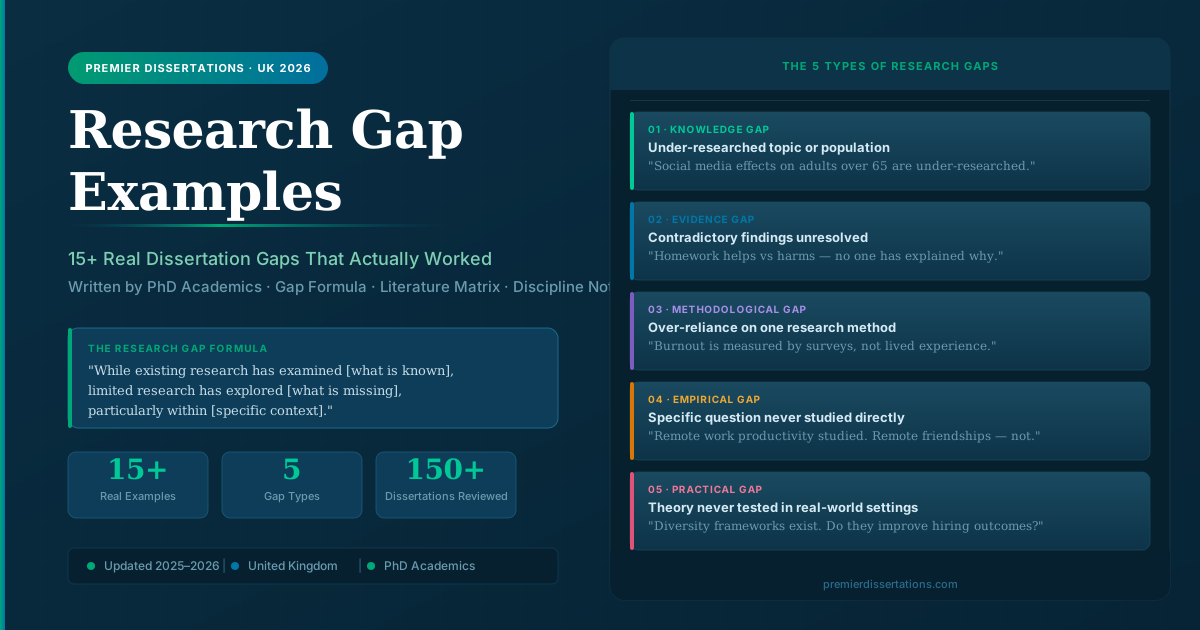
"While existing research has examined [what is known], limited research has explored [what is missing], particularly within [specific context]. This study therefore investigates [your focus]."
Example: "While quantitative research has documented links between social media use and adolescent anxiety, limited qualitative evidence explores how adolescents themselves interpret this relationship. This study therefore investigates the subjective meaning adolescents attach to their social media use in the context of their anxiety experiences."
What Is a Research Gap? (A Definition Students Actually Understand)
Here is the definition I give my students on day one. A research gap is an unanswered question, unresolved contradiction, or underexplored area within existing academic literature that your dissertation is positioned to investigate. Other ways to think about it: a gap in literature, an unexplored area, an under-researched topic, or an unresolved scholarly debate that needs further investigation.
What a Research Gap is NOT
- A topic nobody has ever studied (that almost never exists)
- A personal opinion about what should be researched
- The phrase "more research is needed" (every paper includes this)
- A research problem that has already been solved elsewhere
What a Research Gap IS
- A specific missing population
- An unresolved contradiction between credible studies
- A methodological limitation acknowledged but not corrected
- A theory never tested in a different context
- A question the literature has simply never asked
Specificity matters more than students think. A vague gap produces a vague dissertation. A precise gap produces a clear contribution. For a detailed walkthrough of how to structure your dissertation introduction around a gap statement, see our chapter-by-chapter guide.
At a Glance: The 5 Types of Research Gaps
| Gap Type | Meaning | One-Sentence Example |
|---|---|---|
| Knowledge gap | Under-researched topic or population | "Social media effects on adults over 65 are under-researched compared to adolescents." |
| Evidence gap | Contradictory findings unresolved | "Some studies show homework helps; others show it harms. No one has explained why." |
| Methodological gap | Over-reliance on one method | "Burnout is measured by surveys, but surveys cannot explain lived experience." |
| Empirical gap | Specific question never studied | "Remote work productivity is studied. Remote workplace friendships are not." |
| Practical gap | Theory never tested in real life | "Diversity frameworks exist. Do they actually improve hiring outcomes?" |
Research Gap vs Literature Gap
Students mix these up constantly. They are not the same thing.| Research Gap | Literature Gap |
|---|---|
| Missing contribution in the field's collective knowledge | Missing citation in your bibliography |
| "No longitudinal studies exist in this population" | "I missed Smith (2021)" |
| What examiners ask about during your viva | What happens when you cite poorly |
| Justifies your academic contribution | Just means you need to read more |
Why a Research Gap Shapes Your Entire Dissertation
I want to be direct about the stakes here. Your research gap is not a paragraph in your introduction. It is the logical foundation for everything that follows. Your research question flows from the gap. Your methodology is justified by the gap. Your contribution — which is what examiners are actually marking — is defined by the gap. Across more than 150 dissertations I supervised, the clarity of the gap statement was the single most consistent predictor of the final mark. Not grammar. Not length. Not the number of sources. The gap. Get this right and the rest of the dissertation acquires a logic that makes it much easier to write. Get it wrong and you spend months working around a problem you cannot name.The 5 Types of Research Gaps (Detailed)
Type 01
Knowledge Gap
A topic or population that has not been researched enough. Social media effects on teenagers are well-studied. In adults over 65, the literature is comparatively thin — researchers simply have not asked the same questions of that population.
Type 02
Evidence Gap
Contradictory findings that nobody has resolved. Some studies suggest homework improves primary school performance (Cooper, 1989). Others suggest excessive homework harms wellbeing (Kohn, 2006). Two credible bodies of evidence point in opposite directions.
Type 03
Methodological Gap
Over-reliance on one research method. Burnout has been measured by surveys extensively (Dall'Ora et al., 2020). The subjective experience of burnout — what it actually feels like — has been explored qualitatively much less.
Type 04
Empirical Gap
A specific question has never been studied directly. Remote work productivity has been studied extensively (Bloom et al., 2015). Remote workplace friendships? That specific angle appears rarely, if at all.
Type 05
Practical Gap
Theories or frameworks exist but have never been tested in real-world settings. Organisational psychology has produced numerous diversity frameworks (Roberson, 2019). But do those frameworks actually improve hiring outcomes inside real organisations?
Not sure which gap type fits your dissertation? Our team of UK-qualified academics can review your research question and help you identify the most defensible gap position before you submit your proposal.Get Proposal Help
15+ Real Research Gap Examples From Actual Dissertations
These are adapted from dissertations supervised or examined between 2018 and 2025. Names and identifying details have been changed.At a Glance: All 15 Examples
| # | Discipline | Gap Type | One-Sentence Summary |
|---|---|---|---|
| 1 | Psychology | Methodological | Limited qualitative research on how adolescents interpret social media-anxiety links |
| 2 | Psychology | Methodological / Knowledge | Insufficient longitudinal CBT research in adults over 65 |
| 3 | Business | Empirical | Remote work literature focuses on quantity, not collaborative creativity |
| 4 | Business | Explanatory / Conceptual | Leadership diversity correlates with performance, but mechanisms are unexplored |
| 5 | Education | Knowledge | Lecturer responses to generative AI are under-researched |
| 6 | Education | Conceptual | Engagement measured behaviourally, not through lived experience |
| 7 | Nursing | Methodological | Burnout documented cross-sectionally, rarely longitudinally |
| 8 | Sociology | Conceptual / Knowledge | Digital divide researched as access, not digital literacy skills |
| 9 | Health Sciences | Methodological / Empirical | Patient-perceived barriers to medication adherence unexplored qualitatively |
| 10 | Sociology | Empirical | Care leavers' ongoing university experience under-researched |
| 11 | Business | Conceptual / Practical | SME sustainability adoption mechanisms (not just barriers) unknown |
| 12 | Education | Knowledge / Empirical | First-gen students' feedback interpretation in clinical contexts unstudied |
| 13 | Psychology | Empirical | Cross-cultural anxiety intervention applicability underexplored |
| 14 | Health Sciences | Evidence | Telehealth diagnostic consultation evidence thinner than follow-up care |
| 15 | Sociology | Practical | Housing improvement → health outcome causal evidence limited |
Psychology — Social Media and Adolescent Anxiety
Large quantitative studies through the early 2020s consistently found statistical links between heavy social media use and anxiety symptoms in adolescents (Twenge & Campbell, 2019; Keles et al., 2020; Valkenburg et al., 2022). The research was thorough in terms of what it measured. What it could not do was explain how adolescents themselves understood that relationship. Three separate systematic reviews — Schonning et al. (2020), Popat & Tarrant (2023), and Valkenburg et al. (2022) — called explicitly for qualitative research on this question.
Gap Statement · Psychology
"While quantitative research has established a relationship between social media use and adolescent anxiety, limited qualitative evidence explores how adolescents themselves interpret this relationship."
Result: High 2:1
Psychology — CBT Effectiveness in Older Adults
Most CBT research focuses on adults aged 18 to 65. Existing studies on older adults had very small samples — typically 15 to 25 participants — and follow-up periods of four to eight weeks (Laidlaw, 2020; Gould et al., 2021). Long-term effectiveness in this population had essentially never been measured.
Gap Statement · Psychology
"Despite substantial evidence supporting CBT effectiveness in younger adults, insufficient longitudinal research examines long-term outcomes among adults aged over 65."
Result: Proposal approved at first submission
Business — Remote Work and Collaborative Creativity
Between 2020 and 2022, remote work research multiplied rapidly — most measuring productivity: hours worked, tasks completed, email volume (Bloom et al., 2015; Barrero et al., 2021). What had not been explored properly was whether collaboration suffered in quieter, less measurable ways. The topic was crowded. But the angle was not.
Gap Statement · Business
"Existing remote work literature focuses largely on productivity quantity rather than collaborative creativity or innovation quality."
Result: Approved — niche angle within crowded field
Business — The Mechanisms Behind Leadership Diversity
Research was excellent at documenting that diverse leadership teams correlated with better organisational outcomes (Hunt et al., 2018). But almost none of it explained why. One supervisor might consider this gap too small. Another might see it as appropriately focused — in this case, the proposal was approved on the first submission.
Gap Statement · Business
"While correlational evidence links leadership diversity with organisational performance, limited qualitative research explores the mechanisms underlying this relationship."
Result: Approved — first submission
Education — Lecturer Responses to Generative AI
When ChatGPT became widely accessible, the first wave of academic research focused almost entirely on students. A lecturer completing a part-time master's dissertation asked: how are the people setting the assessments actually responding?
Gap Statement · Education
"Although emerging studies examine student AI usage, limited research explores how lecturers and institutions are adapting assessment practices in response to generative AI tools."
Result: Timely, emerging gap — strong originality claim
Education — Online Learning Engagement
The dominant metrics for online engagement were login frequency, time on platform, and discussion posts. As one student observed: "Someone can log in ten times a day and learn nothing. That is not engagement. That is clicking." She used reflective diaries and interviews — and examiners called the result "refreshingly thoughtful."
Gap Statement · Education
"Existing online learning research relies heavily on behavioural analytics while offering limited insight into how students personally experience and understand engagement."
Result: Described as "refreshingly thoughtful" by examiners
Nursing — Burnout Trajectories After COVID-19
Nurse burnout became one of the most researched topics in health sciences after 2020. Yet almost all of those studies had one thing in common: they were cross-sectional — one survey, one moment in time. Nobody had followed the same nurses across months or years.
Gap Statement · Nursing
"Although burnout prevalence among nurses is extensively documented, longitudinal evidence examining how burnout develops and changes over time remains limited."
Result: Distinction — later cited in an NHS workforce planning document
Sociology — Digital Divide and Educational Inequality
Most digital divide research focuses on internet access and device ownership (van Dijk, 2020; Ragnedda & Mutsvairo, 2018). One student argued that access alone was an incomplete picture — a student with a laptop but poor digital literacy skills would still be disadvantaged.
Gap Statement · Sociology
"Research on educational digital inequality focuses primarily on access to technology while students' digital literacy skills remain comparatively underexplored."
Result: Strong conceptual reframe of well-established field
Health Sciences — Patient-Perceived Barriers to Medication Adherence
Quantitative studies had measured adherence rates extensively. Researchers knew what percentage of patients took their medication as prescribed (World Health Organisation, 2023). They had much less understanding of why non-adherent patients made the choices they made.
Gap Statement · Health Sciences
"While quantitative studies document medication non-adherence rates, limited qualitative research explores patient-perceived barriers from the perspective of those who have chosen not to follow prescribed regimens."
Result: Clear methodological gap, well-evidenced
Sociology — Care Leavers in Higher Education
A reasonable body of literature existed on care leavers' access to university (Jackson & Cameron, 2012; Sebba et al., 2015). Much less had been written about the ongoing experience once students arrived.
Gap Statement · Sociology
"While research addresses care leavers' transition into higher education, limited work explores their ongoing lived experience within university — including how they navigate belonging, academic identity, and institutional support."
Result: Approved — original angle on established access literature
Business — SME Adoption of Sustainability Practices
Sustainability in business had been studied extensively in large corporations. SME literature focused largely on barriers to adoption (Hillary, 2004; Aragón-Correa et al., 2020). The mechanisms of successful adoption remained poorly understood.
Gap Statement · Business
"Although barriers to SME sustainability adoption are documented, the internal mechanisms facilitating successful adoption in resource-constrained organisations remain underexplored."
Result: Practical focus distinguished from barrier-heavy literature
Education — First-Generation Students and Academic Feedback
This was the smallest, most focused study supervised in eleven years — and one of the best outcomes. The study examined how first-year nursing students interpreted written feedback on their first clinical placement assessment. Small scope, sharp focus, clear contribution.
Gap Statement · Education
"While feedback literacy research has examined undergraduate students broadly, limited work explores how first-year nursing students interpret and respond to written feedback on clinical placement assessments."
Result: Distinction — later cited in a journal article
Need help finding your research gap? Our academic team reviews your draft research question and identifies the strongest gap position for your field — drawing on familiarity with UK examiner expectations across disciplines.Get a Topic and Outline
What Examiners Are Actually Looking For
After sitting on more than 50 examination panels, examiners ask three questions — usually without saying them aloud.1Has this gap already been studied? If yes, your originality marks are immediately compromised. The UK Research Integrity Office provides useful guidance on original contribution.
2Can this student realistically investigate this gap? If the study would require ten years of data or 5,000 participants, your methodology section will face hard questions. Project scoping matters as much as originality.
3Has the student proved the gap exists? Assertion is not evidence. You need citations — papers establishing what is known, identifying the limitation, and ideally calling for more research in your direction.
Gap statements that fail in viva almost always fail on one of these three questions. Most students focus on #1. They neglect #3 entirely — and that is the most fixable problem of the three.
Can a Small Research Gap Still Get a Distinction?
Yes. Emphatically. In my experience, small, focused gaps score better than large, ambitious ones — consistently.
✓ Small, Focused Gap
- Feasible to complete within your timeline
- Clean methodology flows naturally from it
- Clear, defensible contribution statement
- Examiners trust your judgment and scope
✗ Large, Ambitious Gap
- Unlikely to finish adequately in time
- Overcomplicated methodology chapter
- Vague or unachievable contribution claim
- Examiners worry about your project scope
How Many Sources Do You Need to Prove a Gap Exists?
| Requirement | Minimum Sources |
|---|---|
| Establish what is already known | 10–15 recent papers |
| Show the limitation your gap addresses | 3–5 papers explicitly stating it |
| Demonstrate the field recognises this gap | 2–3 papers calling for more research |
How to Find Your Research Gap: A Literature Matrix Template
This is the exact process taught to every dissertation student. Follow it in order.1Read the right parts of papers. Most students read abstracts and introductions. The parts most useful for gap-finding are discussion sections and limitations paragraphs. That is where authors admit what their study could not do.
2Build a literature matrix. For each paper record: citation, year, methods, population, key finding, stated limitation, and future research call. After 20 papers, patterns emerge.
3Look for repeated limitations. If multiple papers flag the same missing element, that is strong evidence the gap is real — not a personal observation, but a field-level acknowledgement.
4Narrow the scope aggressively. "Limited research on social media" is weak. "Limited qualitative research on TikTok use and academic concentration among first-year UK university students" is strong.
5Validate with your supervisor. This conversation takes 20 minutes. Skipping it can cost weeks. Supervisors can tell you within minutes whether a gap is original or already covered by a paper you have not found yet.
Literature Matrix: Example Format
| Paper | Year | Methods | Population | Key Finding | Stated Limitation | Future Research Call |
|---|---|---|---|---|---|---|
| Twenge & Campbell | 2019 | Survey | US adolescents | Screen time linked to lower well-being | Cross-sectional; cannot infer causality | Longitudinal and qualitative research needed |
| Keles et al. | 2020 | Systematic review | Adolescents | Small but significant effect size | High heterogeneity; mechanisms unclear | Qualitative studies on individual experiences |
| Valkenburg et al. | 2022 | Longitudinal survey | Dutch adolescents | Person-specific effects vary widely | Surveys alone cannot explain why | Mixed-methods designs |
How to Write a Literature Review That Reveals a Gap
Here is how to weave a gap analysis into an actual literature review. Notice how it moves from what is known → what the limitation is → who agrees the gap exists → what this study will do.
Literature Review Extract — Example
"Several large-scale studies have established a correlation between heavy social media use and anxiety symptoms in adolescents (Primack et al., 2017; Twenge & Campbell, 2019; Keles et al., 2020). However, the mechanisms underlying this relationship remain unclear. Most existing research relies on surveys and quantitative scales, which measure correlation but cannot explain subjective experience. Three recent systematic reviews have called for qualitative research exploring how adolescents themselves interpret this relationship (Schonning et al., 2020; Vahedi & Zannella, 2021; Popat & Tarrant, 2023). This study addresses that gap by conducting semi-structured interviews with adolescents aged 14–16."
Pattern: Known → Limitation → Field agreement → Your response
For examples of how this structure appears across full chapters, see our dissertation proposal examples.
Turning a Gap Into a Research Question
If your gap is specific and well-formed, the research question almost writes itself. If you cannot translate your gap into a research question in one sentence, the gap is not focused enough yet.| Research Gap | Research Question |
|---|---|
| Limited qualitative evidence on how adolescents interpret social media-anxiety links | "How do adolescents experience and interpret the relationship between their social media use and their anxiety?" |
| Limited research on how lecturers adapt assessments for generative AI | "How are lecturers at UK universities adapting assessment design and practice in response to student access to generative AI?" |
| Limited longitudinal evidence on nurse burnout development | "How does occupational burnout among NHS nurses change over a 12-month period following return from COVID-19 redeployment?" |
How Recent Should Your Sources Be?
This matters more than students realise. Examiners look at publication dates. A gap built on ten-year-old evidence is vulnerable to the question: "Has this actually been addressed since then?"| Dissertation Level | Recommended Source Age | Notes |
|---|---|---|
| Undergraduate | Last 5–8 years | Seminal older papers remain citable regardless of age |
| Master's | Last 5 years | Plus foundational papers where necessary |
| PhD | Last 3–5 years | Cutting-edge recency expected — examiners are specialists |
Frequently Asked Questions
A research gap is an unanswered question, unresolved issue, or underexplored area in existing academic literature that a dissertation investigates. It is the justification for why your study was necessary and what original contribution it makes to the field.
Knowledge gap (under-researched area or population), evidence gap (contradictory findings no one has resolved), methodological gap (over-reliance on one research method), empirical gap (a specific question never studied directly), and practical gap (a theory or framework never tested in real-world conditions).
A methodological gap occurs when existing studies have relied too heavily on one method — for example, measuring burnout only through surveys when qualitative interviews are needed to understand the lived experience. It is one of the most common and most defensible types of gap at master's level.
Yes — emphatically. Small, focused gaps consistently score better than broad, ambitious ones. They produce cleaner methodologies, more achievable studies, and clearer contribution statements. The best dissertation supervised in eleven years studied something genuinely narrow, and the student received a distinction. Clarity beats size every time.
For establishing what is already known: 10–15 recent papers. For showing the specific limitation your gap addresses: 3–5 papers explicitly stating it. For demonstrating the field recognises the gap: 2–3 papers calling for more research in your direction. Quality and precision matter far more than volume.
A research gap is missing knowledge in the academic field — it is what examiners ask about during your viva. A literature gap is a citation you omitted — it means you need to read more. Supervisors asking "what is missing from this area?" mean the former. Do not confuse them.
Yes. Many good dissertations begin exactly there. If a credible, peer-reviewed paper explicitly calls for research in a direction you are proposing, that is not a weakness — it is a citation. But you must adapt the gap to your specific context, population, and methodology. Direct replication without adaptation is not original research.
For undergraduate dissertations: last 5–8 years. For master's: last 5 years, plus seminal older papers where necessary. For PhD: last 3–5 years, with examiners who are field specialists expecting cutting-edge recency. Foundational papers remain citable at all levels regardless of age. Examiners will notice if your gap argument rests on evidence from a decade ago when more recent papers may have addressed it.
Checklist Before You Finalise Your Gap
Run through this before you submit your proposal or finalize your introduction chapter. If you cannot tick all ten, your gap statement needs more work.✓Have you read at least 15–20 recent papers in your area?
✓Is your gap specific — defined by population, context, method, or timeframe?
✓Is it realistic for your available timeframe and resources?
✓Does your supervisor agree it is original enough for your level?
✓Can your chosen methodology actually investigate it?
✓Does your research question directly and specifically address the gap?
✓Does your literature review build toward the gap rather than just describing topics?
✓Can you explain your contribution in one clear sentence?
✓Have you cited evidence that the gap exists — not just asserted it?
✓Are your sources recent enough for your level of study?
Final Thought
Finding a research gap rarely feels like a revelation. It is quieter than that. You read a limitations section and something catches your attention. You notice three unrelated papers calling for the same type of follow-up. You see a population that is conspicuously absent. That is how most good dissertations begin. Not through genius. Through careful reading and a willingness to ask what the existing research has not yet answered. It is a skill. It improves with practice. Good luck.
Need Help Identifying or Writing Your Research Gap?
Whether you need a gap identified, a proposal written from scratch, or your literature review chapter strengthened — our team of UK-qualified PhD academics is here to help.
PhD academics · Human-written · Turnitin and AI report · Trusted by 15,000+ UK students
Last reviewed: May 2026 · This guide reflects dissertation supervision practice across UK universities. Always follow your supervisor's guidance for department-specific requirements.
Get 3+ Free Wildlife Dissertation Topics within 24 hours?