

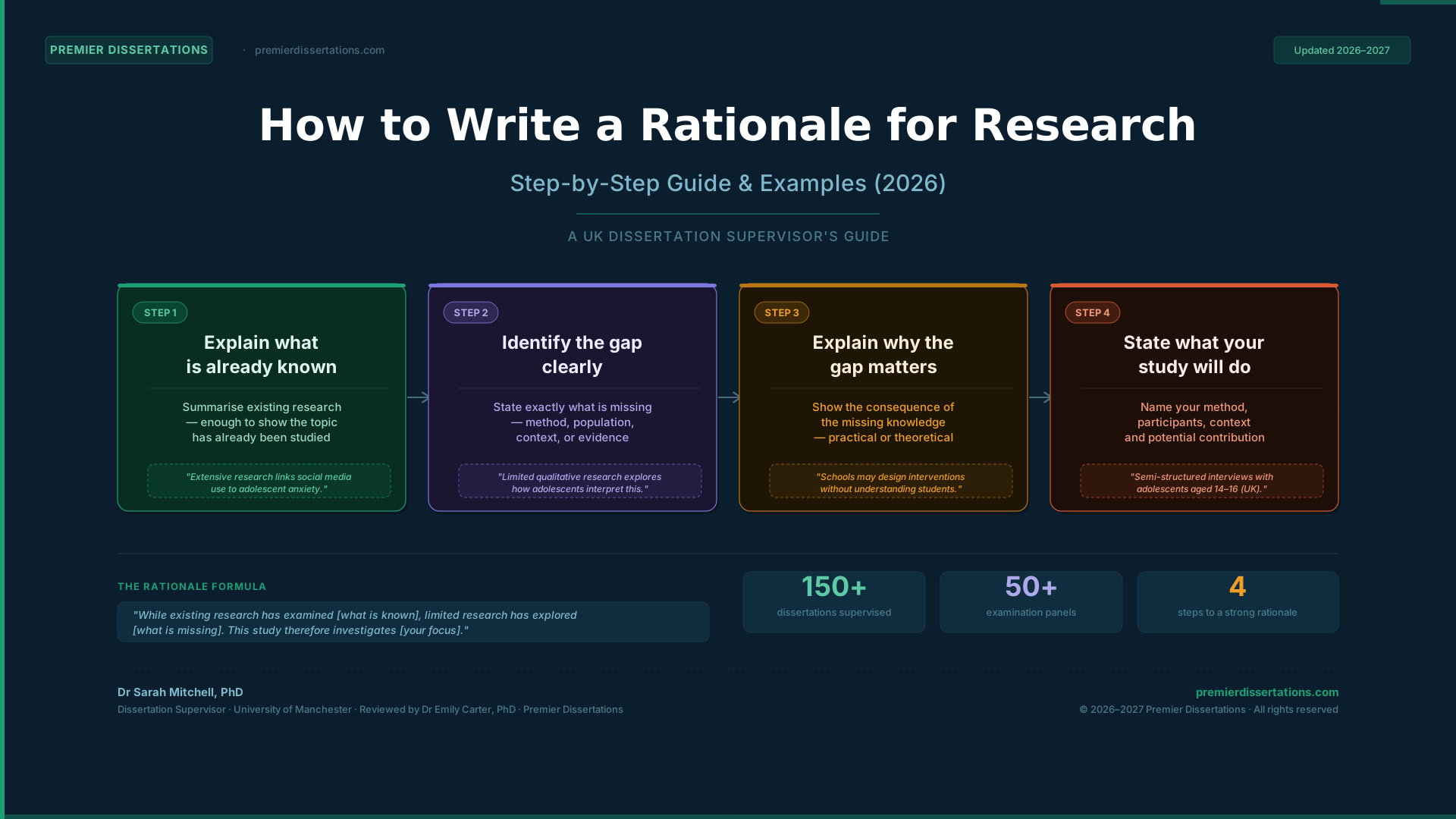
How to Write a Rationale for Research: Step‑by‑Step Guide & Examples (2026)
June 17, 2026
Turnitin False Positive AI Detection: Why It Happens and What To Do (2026-2027)
June 29, 2026
During dissertation supervision meetings, I noticed something strange. Students rarely struggled to collect data. They struggled to collect the right data.
One student distributed a 40-question survey before realising that none of the questions actually answered her research question. Another conducted twelve interviews and only later discovered she needed numerical comparisons instead of experiences.
Data collection problems usually begin long before the first survey link or interview. They begin when the method and the research question stop aligning.
I have supervised over 150 dissertations across psychology, business, education, and health sciences. The single most common mistake? Choosing a method that cannot answer the question. This guide will help you avoid that.
Why Data Collection Methods Matter More Than You Think
After supervising over 150 dissertations, I have seen the same mistake again and again. Students collect data, sometimes lots of it, but then realise they cannot actually answer their research question.
Why? Because they chose the wrong method.
She collected data. But she couldn't answer her question.
If she had used semi-structured interviews instead, those "whys" would have surfaced naturally.
So before you choose a method, ask yourself: "What kind of answer do I need?"
For a deep dive on aligning your method with your research question and sampling strategy, see our dissertation methodology chapter guide.
Primary vs Secondary Data Collection (A Crucial First Distinction)
Most textbooks present this as a simple either/or. It is not. Many strong dissertations use both.
| Primary Data | Secondary Data |
|---|---|
| Data you collect yourself, fresh, for your specific study | Data already collected by someone else |
| Examples: surveys you send out, interviews you conduct | Examples: government statistics, company annual reports, previous research datasets |
| Time-consuming, but tailored to your exact question | Faster and cheaper, but may not fit perfectly |
| You control quality and bias | You inherit the original collector's biases |
A realistic approach: Use secondary data to build your literature review and contextualise your study. Then collect primary data to fill the specific gap you identified.
For more on this, explore our dissertation data collection help page.
Quantitative vs Qualitative Data Collection — A Quick Comparison
I used to teach these as separate worlds. They are not. Many research questions benefit from both.
| Aspect | Quantitative | Qualitative |
|---|---|---|
| Data type | Numbers, scores, categories | Words, images, observations |
| Typical methods | Surveys, experiments, structured observations | Interviews, focus groups, participant observation |
| Sample size | Larger (statistical power) | Smaller (depth over breadth) |
| Analysis | Statistical (SPSS, R, Excel) | Thematic, narrative, discourse |
| Strength | Generalisable, precise | Rich, contextual, exploratory |
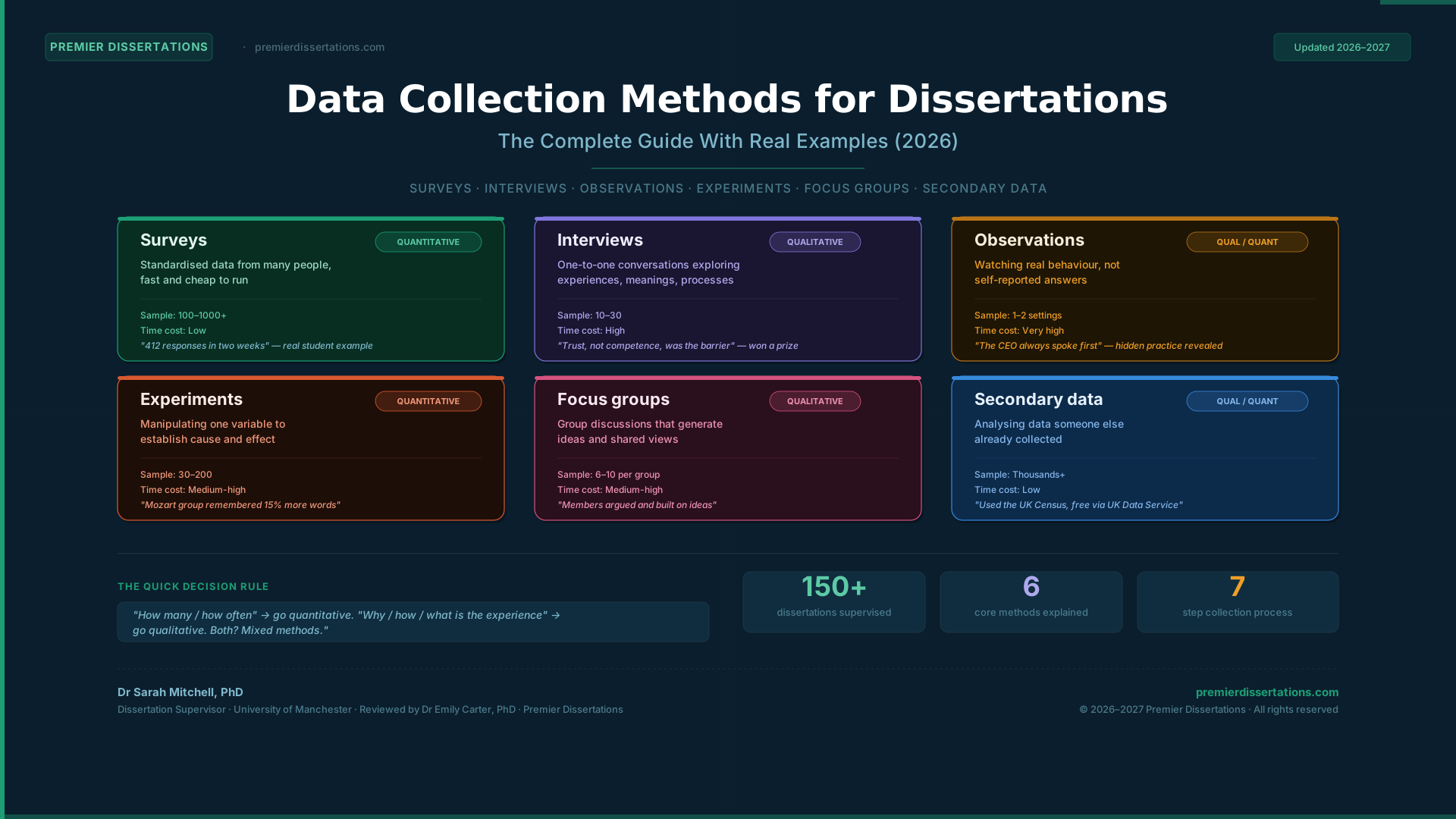
Here is a trick I learned the hard way: If your research question asks "how many / how much / how often", go quantitative. If it asks "why / how / what is the experience of", go qualitative. And if it asks both? Mixed methods.
For help analysing quantitative data, learn how to analyse quantitative dissertation data using SPSS.
The Main Data Collection Methods — Explained With Real Examples
What they are: A set of written questions (paper or online) answered by participants.
When to use them:
Tools: Google Forms, SurveyMonkey, Qualtrics, Jisc Online Surveys.
What they are: One-to-one conversations with participants, guided by questions.
When to use them:
Structured interviews — fixed questions, same order, like a spoken survey.
Semi-structured interviews — a guide with open questions, but you can probe and follow tangents. (Most common in social science dissertations.)
Unstructured interviews — a few broad topics, conversation flows naturally. (Advanced — usually for PhDs.)
What they are: Watching and recording behaviour in natural settings.
When to use them:
Participant observation: You join the group and take part. (Common in ethnography.)
Non-participant observation: You watch from the outside, like a fly on the wall.
What they are: Manipulating one variable to see its effect on another, under controlled conditions.
When to use them:
What they are: Group discussions (6–10 participants) guided by a moderator.
When to use them:
What it is: Analysing data that someone else collected, often for a different purpose.
When to use it:
Sources: Government statistics (ONS, World Bank), company reports, academic datasets (UK Data Service, ICPSR), social media data.
For guidance on finding and interpreting secondary data, see our dissertation data collection help.
At a Glance: Data Collection Methods Comparison Table
| Method | Data Type | Best For | Typical Sample Size | Time Cost |
|---|---|---|---|---|
| Survey | Quantitative | Measuring attitudes, behaviours | 100–1000+ | Low |
| Structured interview | Quantitative (or closed qual) | Standardised responses | 30–100 | Medium |
| Semi-structured interview | Qualitative | Exploring experiences, meanings | 10–30 | High |
| Participant observation | Qualitative | Understanding culture, practices | 1–2 settings | Very high |
| Non-participant observation | Qualitative/Quant | Counting behaviours | 20–100 events | Medium-high |
| Experiment | Quantitative | Cause and effect | 30–200 | Medium-high |
| Focus group | Qualitative | Generating ideas, shared views | 6–10 per group | Medium-high |
| Secondary data analysis | Quantitative/Qual | Large-scale, longitudinal | Thousands+ | Low |
How to Choose the Right Data Collection Method (A Decision Matrix)
File name:
data-collection-decision-tree.webp
I use this decision process with every student who comes to me confused.
Start with your research question.
Is it quantitative or qualitative?
Consider your resources.
| Constraint | What it pushes you towards |
|---|---|
| Very limited time (e.g., 4–6 weeks) | Secondary data, small survey, a few interviews |
| Very limited budget | Secondary data, online survey (free tools), existing dataset |
| Difficult to access participants | Secondary data, public observations, document analysis |
| Need rich, deep data | Interviews, participant observation, focus groups |
| Need statistical generalisability | Survey, secondary dataset, structured observation |
Real student dilemmas — and how they resolved them.
Moral: Do not let perfect be the enemy of good. Your dissertation does not need a randomised controlled trial. It needs a method that answers your question with the resources you have.
For more detailed guidance on designing your methodology chapter and ensuring data validity and reliability, see our dissertation proposal examples.
What Examiners Actually Look For in Data Collection
Across dissertation marking panels, I noticed that examiners rarely criticised students for choosing small samples. What they criticised was poor alignment between the research question and the method.
A modest study with 10 strong interviews often performs better than a rushed survey with 400 weak responses.
Examiners usually look for five things:
Students sometimes assume they need complicated methods to impress markers. In practice, clarity usually scores higher than complexity.
Data Collection Methods: Students Commonly Regret Choosing
Over the years, I have seen students choose methods that looked good on paper but caused real problems later. Here is what they wished they had known.
Surveys look easy at first. Then response rates arrive.
I once supervised a dissertation where a student expected 300 responses and received 17. The survey itself was not terrible. The problem was distribution. Students often underestimate how difficult participant recruitment becomes without institutional support.
Interviews produce rich data, but transcription surprises almost everyone. One hour of audio can easily take four to six hours to transcribe properly.
Group discussions sound efficient until one participant dominates the conversation while everyone else stays quiet.
Observation studies often create more notes than students can realistically analyse within dissertation deadlines.
How Many Participants Do You Need?
This is one of the most common questions I hear. There is no magic number, but here are realistic guidelines based on dissertation level and method.
Surveys (Quantitative)
A small, well-justified survey with a clean dataset is better than a large, messy one with low response rates.
Interviews (Qualitative)
Focus Groups
Experiments
There is no magical number that guarantees a strong dissertation. Examiners care more about justification than sheer size.
For a deeper discussion of sample size and power, see our statistical analysis services.
Can ChatGPT Help With Data Collection?
AI tools like ChatGPT are increasingly used by students, and it is worth being honest about what they can and cannot do.
Refining survey wording to reduce ambiguity
Organising coding categories or suggesting potential themes from transcripts (with caution)
Identifying unclear phrasing in a questionnaire design draft
Participant recruitment — AI cannot recruit people or manage relationships.
Critical interpretation — AI may generate plausible-sounding findings that are entirely wrong (hallucination).
Transcription of sensitive interviews — do not upload confidential data to public AI tools.
Most universities now expect students to disclose significant AI assistance within the methodology or acknowledgements sections. Check your institution's policy before using AI for any part of your data collection or analysis.
Step-by-Step Data Collection Process
File name:
dissertation-data-timeline.webp
Once you have chosen your method, follow this process. I have used it with every student — it works.
- What variables or themes do you need to measure?
- What population will you sample from?
- What comparison groups are necessary?
- For surveys: write clear, unbiased questions. Pilot study with 5-10 people.
- For interviews: create a topic guide (a research instrument). Practice on a friend.
- For observations: define what behaviours you will record (and what you will ignore).
- Complete your university's ethics form.
- Prepare participant information sheets and consent forms (informed consent).
- If you collect primary data, you almost always need approval.
- Use purposive sampling for qualitative studies (choose participants who can best answer your question).
- Use random or stratified sampling for quantitative studies (if possible).
- Be realistic — aim for a sample you can actually reach.
- For surveys: test the link on different devices. Send reminders (many responses come after the first reminder).
- For interviews: record with permission, take notes, transcribe as soon as possible.
- For observations: use a structured observation schedule, write field notes immediately.
- Use folders, clear file names (Survey_Data_2026-05-08.sav).
- Back up to cloud and local drive.
- Anonymise data (remove names, replace with IDs).
- For quantitative: clean the data, check for errors, code open-ended responses.
- For qualitative: transcribe interviews, read through everything, start initial coding framework.
For a detailed walkthrough of how to analyse the data you collect, see our statistical analysis services.
Common Mistakes in Data Collection (And How to Avoid Them)
| Mistake | Why It Hurts | How to Avoid |
|---|---|---|
| Method does not match question | You collect data but cannot answer your RQ | Write your RQ on a sticky note. Every time you design an instrument, ask: "Does this help answer the RQ?" |
| Too few participants | Cannot generalise (quant) or no saturation (qual) | Plan for dropouts. For surveys, double your target. For interviews, aim for 10-20% extras. |
| Poor question wording | Bias, confusion, missing data | Pre-test everything. Ask a colleague to identify ambiguous questions. |
| Low response rate | Small sample, non-response bias | Personalise invitations, offer incentives (e.g., £5 voucher), send up to 3 reminders. |
| Recording errors | Lost data, transcription mistakes | Test your recorder. Backup audio files immediately. Transcribe soon after each interview. |
| Ethical shortcuts | Study rejected or retracted | Get approval before collecting data. Do not start early to "save time". |
I once supervised a student who skipped ethics approval because she "only needed five interviews." The department found out. Her proposal was rejected, and she had to start over. Do not be that student.
The Most Practical Advice I Give Students About Data Collection
Choose the simplest method that can still answer your research question well.
Students often assume complex methods look more academic. Usually the opposite happens. Complex methods create messy data, rushed analysis, and confused conclusions.
A clean survey with a clear variable structure will outperform an over-ambitious mixed-methods project every time. Especially at undergraduate and master's level.
One student wanted to use focus groups, interviews, surveys, and secondary data all in one dissertation. I asked him: "Do you have two years?" He said no. So we dropped two methods. His dissertation was simpler, clearer, and he finished on time.
Simplifying is not dumbing down. It is focusing.
Need help choosing or designing your data collection method? Our team can review your research question and recommend the strongest approach for your timeline and resources.
Get Data Collection HelpFrequently Asked Questions (People Also Ask)
Final Checklist Before You Start Collecting Data
Use this checklist to avoid the most common pitfalls:
File name:
data-collection-mistakes-checklist.webp
Download a printable PDF of this checklist from our Academic Library.
Final Thought (Grounded, Not Perfect)
Most dissertations collect imperfect data.
Participants cancel interviews. Survey response rates drop unexpectedly. Ethics approval takes longer than expected. Sometimes an entire method needs adjusting halfway through the project.
That is normal research.
What usually separates strong dissertations from weak ones is not perfection. It is whether the student explains decisions clearly, adapts intelligently, and stays honest about limitations.
Plan carefully. But when things go wrong — and they will — adapt. Document the changes. Explain them in your methodology chapter.
That transparency is what examiners actually respect.
Good luck with your data collection.
Need Help With Your Data Collection?
Whether you need help choosing a method, designing your instrument, or writing your methodology chapter — our team of UK-qualified PhD academics is here to help.
PhD academics · Human-written · Turnitin and AI report · Trusted by 15,000+ UK studentsGet 3+ Free Wildlife Dissertation Topics within 24 hours?