

How to Present Findings in Qualitative Research: A Step-by-Step Guide for UK Dissertations (2026)
June 12, 2026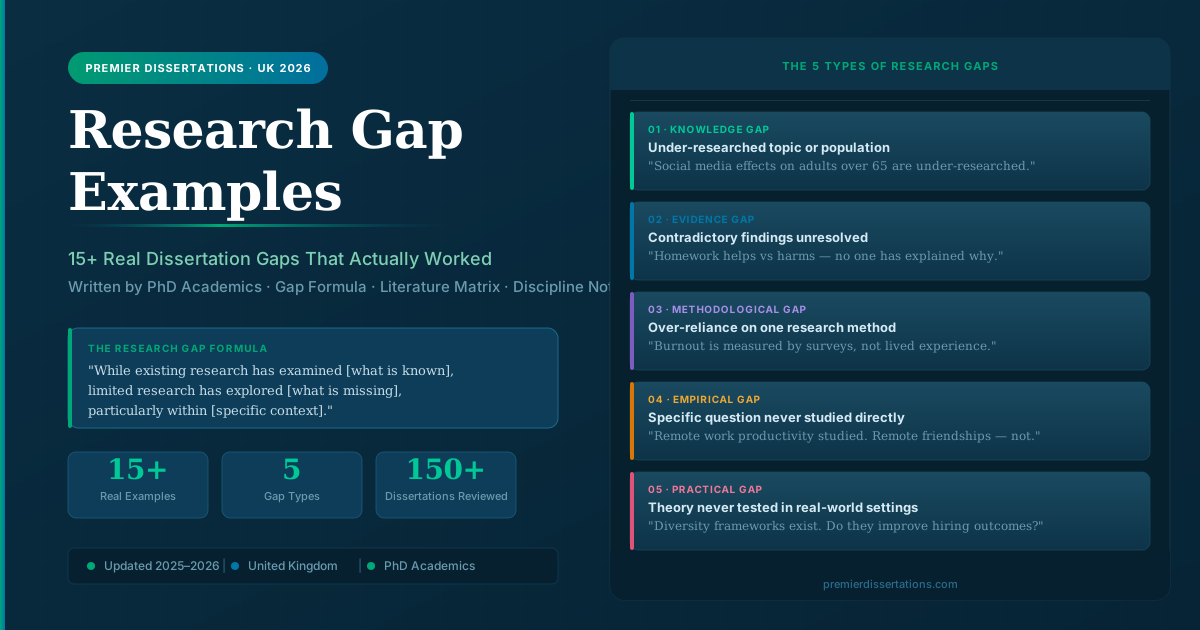
Research Gap Examples: 15+ Real Dissertation Gaps That Actually Worked (UK, 2026)
June 16, 2026
Research Writing Guides Australia
In this guide
The literature review is the foundation of every research project at Australian universities. Whether you are writing an Honours thesis, a Masters by Research dissertation, a PhD thesis, or even an HDR research proposal — the quality of your literature review determines how seriously the rest of your work is taken.
A weak literature review summarises what others have said. A strong one synthesises the field, identifies a genuine gap, and positions your research as the answer. This guide walks you through the entire process — from your first database search to your final draft — with strategies that work at every Australian university.
Need help with your literature review? Premier Dissertations AU writes and edits literature reviews for Australian Honours, Masters, and PhD students — every chapter written by PhD-qualified academics in your discipline. Human-written, AI-free. From AUD $37/page.
Get a free quote →What Is a Literature Review?
A literature review is a critical, structured synthesis of existing scholarly work on your research topic. It is not a list of summaries — it is an argument about the state of the field, organised to demonstrate what is known, what is contested, and what remains unknown.
At Australian universities, a good literature review accomplishes three things simultaneously:
Types of Literature Reviews
Not all literature reviews are the same. The type expected depends on your discipline and the kind of research you are conducting:
| Type | Purpose | Common Disciplines |
|---|---|---|
| Narrative review | Traditional critical synthesis of relevant literature | Most Honours theses, humanities, social sciences |
| Systematic review | Comprehensive, transparent search following PRISMA guidelines | Health sciences, nursing, evidence-based medicine |
| Scoping review | Maps the extent and nature of evidence on a broad topic | Health, education, emerging fields |
| Integrative review | Combines empirical and theoretical literature | Nursing, education, social work |
| Meta-analysis | Statistically combines findings from multiple studies | Psychology, medicine, biomedical sciences |
| Critical review | Evaluative analysis of conflicting perspectives | Law, philosophy, political science |
Unless your supervisor specifies otherwise, most Australian Honours and Masters by Coursework theses use a narrative literature review. PhD candidates in health and biomedical sciences are increasingly expected to use systematic or scoping review methodologies.
Literature Review Word Count by Degree Level
The expected length of your literature review depends on the total length of your thesis and your discipline. As a general guide:
| Degree Level | Total Thesis Length | Lit Review Length | Sources Cited |
|---|---|---|---|
| Honours | 15,000 – 20,000 words | 3,000 – 5,000 words | 30 – 50 sources |
| Masters by Coursework | 10,000 – 15,000 words | 2,500 – 4,000 words | 25 – 40 sources |
| Masters by Research | 30,000 – 60,000 words | 6,000 – 12,000 words | 60 – 100 sources |
| PhD | 70,000 – 100,000 words | 12,000 – 20,000 words | 100 – 250 sources |
The Step-by-Step Process
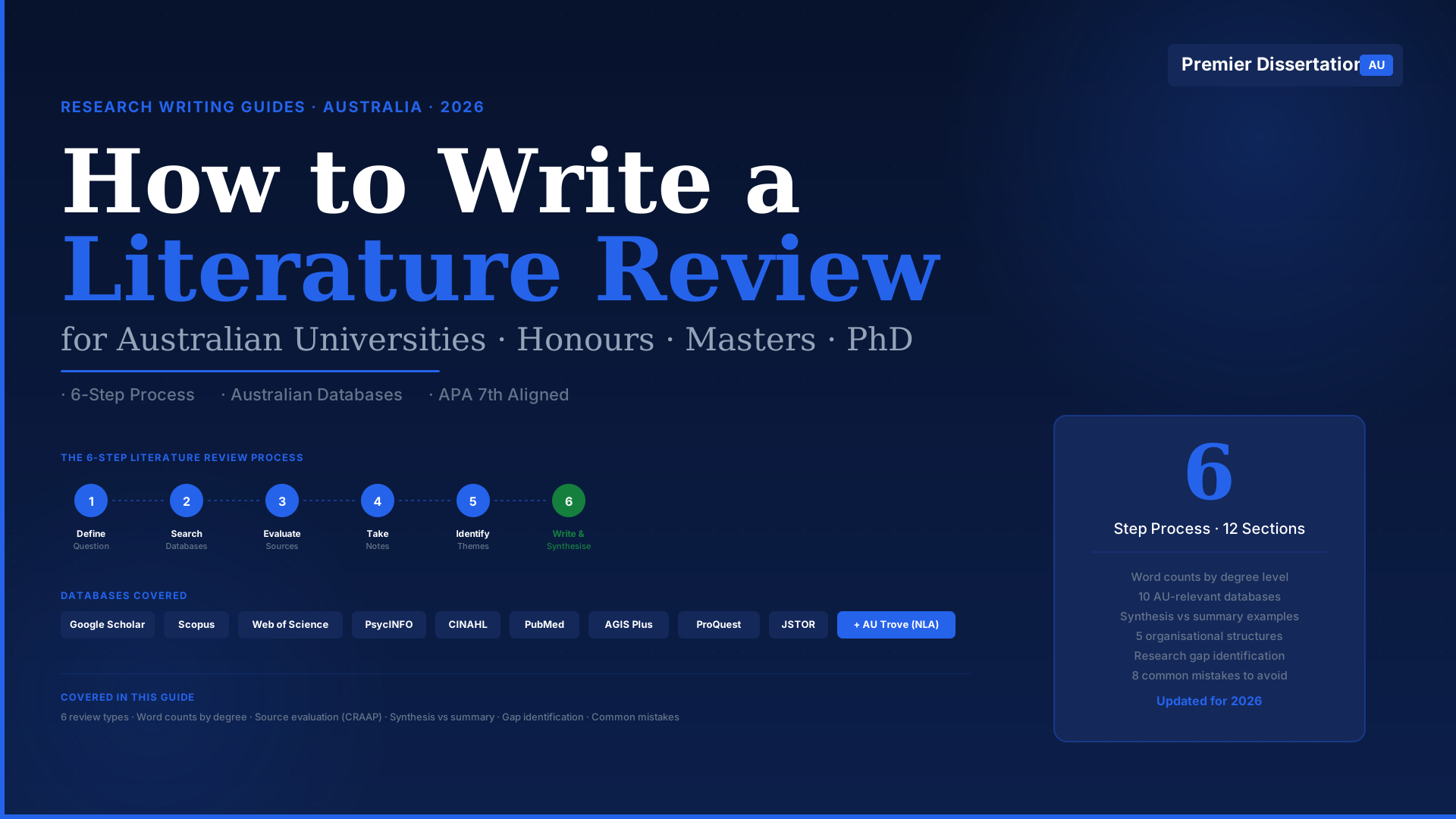
Writing a literature review is not a single task — it is a six-stage process. Skipping or rushing any stage usually shows up in the final draft.
Searching the Literature Effectively
A good literature search is structured, repeatable, and exhaustive. Avoid the trap of using only Google Scholar and stopping after the first ten results.
Build a search strategy
Example search string
("social media" OR "instagram" OR "tiktok") AND ("anxiety" OR "depression") AND ("adolescent*" OR "young people" OR "teenager*") AND ("Australia*")
Note the use of Boolean operators (AND, OR), truncation (adolescent*), and quotation marks for exact phrases.
Apply inclusion and exclusion criteria
Before you start screening sources, define what counts as relevant. Common criteria include date range (e.g., past 10 years), publication type (peer-reviewed only), language (English), study type (empirical, theoretical), and geographic focus (Australian-relevant where appropriate).
Databases Australian Students Should Use
Your university library provides access to academic databases worth thousands of dollars in annual subscriptions. Use them. Here are the most valuable for Australian research:
| Database | Best For |
|---|---|
| Google Scholar | Initial scoping; tracking citations; finding open-access copies |
| Scopus | Comprehensive multi-disciplinary; citation tracking; high-impact journals |
| Web of Science | Sciences, social sciences; bibliometric analysis |
| PsycINFO | Psychology, behavioural sciences, education |
| CINAHL | Nursing, allied health |
| PubMed / MEDLINE | Biomedical, clinical, health sciences |
| AGIS Plus Text | Australian and New Zealand legal databases |
| ProQuest | Business, social sciences, education; theses and dissertations |
| JSTOR | Humanities, history, classical disciplines |
| Trove (NLA) | Australian historical sources, newspapers, government records |
For Australian-specific data, also check ABS, AIHW, AIATSIS, and government department research portals. These contain grey literature that does not appear in academic databases but is highly relevant for Australian-focused research.
Struggling to find quality sources in your field? Our PhD academics know exactly which databases, journals, and grey literature to mine — and can produce a fully sourced literature review chapter for you in days.
Get a free quote →Evaluating Sources Critically
Not every published source is worth citing. Apply the CRAAP test — or its equivalent — to every potential source:
How to Structure Your Literature Review
A literature review should never be organised source-by-source. Choose one of these proven organisational structures based on what best fits your research question:
| Structure | How It Works | Best For |
|---|---|---|
| Thematic | Groups sources by recurring themes or concepts | Most Honours and Masters theses |
| Chronological | Traces the development of ideas over time | History; tracking evolution of a theory |
| Methodological | Groups sources by research design or method | Mixed methodological fields; meta-analysis |
| Theoretical | Organises around competing theoretical frameworks | Philosophy; political theory; sociology |
| Hybrid | Combines two structures (e.g., thematic + chronological) | PhD theses; complex topics |
Whichever structure you choose, your literature review should still have a clear introduction (orientation to the field, scope of the review, structure preview), body (organised by theme/period/etc.), and conclusion (synthesis of what is known, articulation of the gap, transition to your study).
Synthesise, Don't Summarise
The single biggest distinguisher of a HD-level literature review from a Credit-level one is synthesis. Markers can spot a summary-based review within two paragraphs — and they will mark it down.
Summary (weak)
Smith (2022) found that social media use correlates with anxiety in adolescents. Jones (2023) also found a relationship between Instagram and depression in teenagers. Brown et al. (2024) reported similar findings using TikTok data.
Synthesis (strong)
A consistent association between social media use and adolescent mental health concerns has emerged across multiple platforms, including Instagram (Smith, 2022; Jones, 2023) and TikTok (Brown et al., 2024). However, the direction of causality remains contested — while these studies establish correlation, longitudinal designs that could clarify whether platform use causes psychological symptoms, or whether psychologically vulnerable adolescents are simply more drawn to these platforms, are still rare.
Notice what the synthesis version does: it groups sources by common finding, identifies what they have in common, names the unresolved question they collectively raise, and points toward where research should go next.
Identifying the Research Gap
The whole point of your literature review is to set up your research gap — the specific question, population, methodology, or context that existing literature has not adequately addressed. This is where your literature review connects to your own research.
Common types of research gaps:
The closing paragraphs of your literature review should name your gap clearly and explain why filling it matters — both for the academic field and, where applicable, for Australian society, policy, or practice.
Common Literature Review Mistakes
These errors appear repeatedly in Australian Honours and HDR submissions:
Want your literature review edited by a PhD academic? Our editors check synthesis quality, source currency, gap identification, and APA 7th edition formatting — and return your chapter with a Turnitin + AI report included.
Get editing help →Need Expert Help with Your Literature Review?
Writing a literature review takes 4–12 weeks for most Honours students and substantially longer at HDR level. It is the single most labour-intensive section of a thesis — and the section that most often determines the overall mark.
Premier Dissertations AU has produced literature reviews for over 15,000 Australian students since 2010. Our PhD-qualified academics work across every discipline and can produce a fully sourced, synthesised, gap-identifying literature review chapter formatted to your university's standards.
Literature review writing and editing from AUD $37/page.
Get Expert Literature Review Support
Full chapter, source synthesis, gap identification, or editing — Premier Dissertations AU is here to help.
PhD academics · Human-written · Turnitin + AI report · UniMelb, UNSW, USyd, Monash, UQ, ANU, UWA & more