

5 Best AI Search Visibility Agencies for Universities
July 28, 2026
7 Best Evening MBA Degrees in San Francisco for Professionals Advancing Their Careers
July 30, 2026
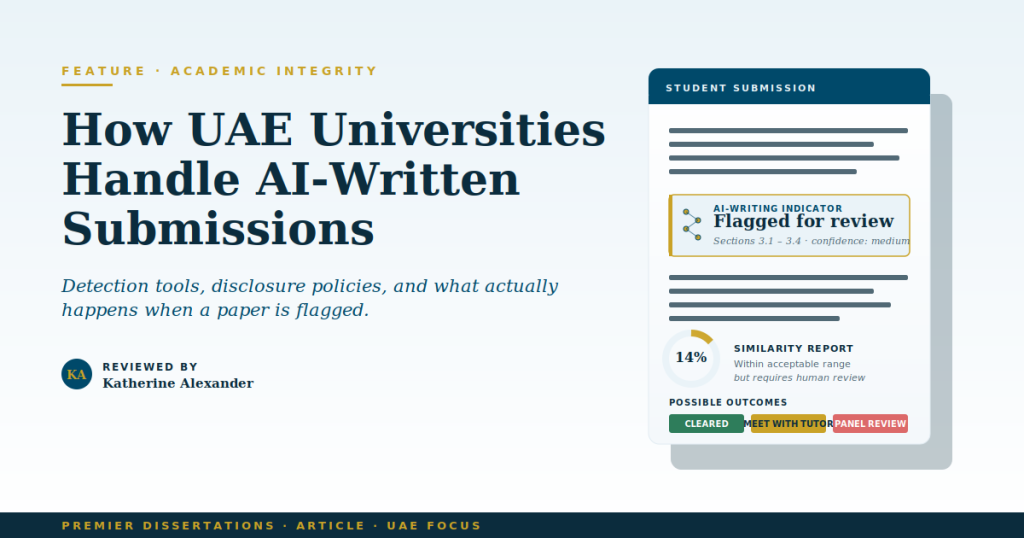
Academic Integrity · UAE
Detection tools, disclosure policies, and what actually happens when a paper is flagged — a plain-English guide for students in Dubai, Abu Dhabi and Sharjah.
In this article
- The landscape has shifted since 2023
- Detection tools UAE universities commonly use
- Why detection alone isn't the whole story
- What UAE academic-integrity policies typically cover
- What actually triggers an integrity review
- What happens if your submission is flagged
- The disclosure-based approach that's growing
- What you should do before submitting
Need a confidential similarity & AI-indicator check before you submit?
See the UAE checker1. The landscape has shifted since 2023
Three years ago, most UAE universities were still writing their first AI-use guidance. Today, most have moved past the panicked first draft. The question is no longer "should we ban AI?" — it's "what counts as legitimate use, how do we detect the illegitimate kind, and how do we handle the false positives?"
That shift matters for students. It means the conversation with your programme, if it happens, is likely to be more nuanced than a simple accept-or-reject. Reviewers are being asked to consider intent, disclosure and the actual quality of the flagged passage — not just the percentage on a screen. If you want the underlying detection mechanics rather than the policy view, our companion piece on how AI detectors work and their limits covers the technical side.
2. Detection tools UAE universities commonly use
Most UAE universities use one or more of the following, often stacked together:
- Turnitin's similarity report — the longstanding standard for text overlap with published sources, web content and other student papers. If you're new to reading one, see our guide to the Turnitin similarity score
- Turnitin's AI-writing indicator — a separate score that tries to estimate the likelihood a passage was AI-generated. It is not the same thing as the similarity index.
- Third-party AI detectors — some programmes cross-check with tools like GPTZero or Copyleaks, especially for suspicious cases.
- Style-consistency checks by the marker — an experienced marker who has seen your earlier work often notices a shift in voice before any tool does.
The important thing to know is that none of these tools return a verdict. They return a score or an indicator, and the human on the other end decides what to do with it.
3. Why detection alone isn't the whole story
AI-writing detectors have well-documented limitations. Multiple published evaluations have found that current detectors produce meaningful rates of both false positives (flagging genuine student writing as AI) and false negatives (missing AI-generated content that has been paraphrased). UAE academic staff are generally aware of this — which is why most universities' policies now explicitly say that an indicator is not, on its own, sufficient evidence of misconduct.
"An indicator is not a verdict. It's the start of a conversation, not the end of one." — A common paraphrase of current UAE university policy language
What this means in practice: a high AI indicator doesn't automatically fail you, and a low one doesn't guarantee you're clear. The report is a starting point.
4. What UAE academic-integrity policies typically cover
Policies vary by institution — you should read your own programme's handbook — but there are recurring themes across the UAE higher-education sector:
- Definition of misconduct. Passing off AI-generated content as your own, without disclosure, is treated as a form of academic misconduct at most UAE universities.
- Permitted AI use with disclosure. A growing number of programmes now allow limited AI use — for brainstorming, outlining, grammar checking or translation — provided you declare it.
- Zero-tolerance zones. Some assessments (final examinations, dissertations, professional-body-mandated work) are held to stricter rules.
- Process rights. If you're accused, you generally have a right to see the evidence, respond in writing, and have the case heard by more than one person.
- Escalating penalties. First-time, low-severity cases are often handled through education and resubmission; repeat or serious cases can lead to grade penalties or programme review.
Read your handbook, not just the tweet
The single most useful thing you can do is find the actual AI-use paragraph in your programme handbook or student integrity policy — and read it before you submit anything. Social-media summaries of "the UAE's AI rules" are almost always oversimplified.
5. What actually triggers an integrity review
Talk to markers at UAE universities and the pattern is fairly consistent. It is rarely a single number that triggers a review. Reviews tend to be triggered when several signals converge:
- An AI-writing indicator that flags a substantial portion of the text.
- A similarity report that shows unusual patterns — either surprisingly low overlap for a topic with a well-established literature, or an unusual concentration of high-similarity matches.
- A noticeable shift in voice, vocabulary or sentence structure compared to your earlier work.
- Content that is technically well-formed but doesn't quite engage with the specific brief.
- Citations that don't exist, are misattributed, or point to sources that don't say what the paper claims.
That last point is worth its own line: fabricated or hallucinated citations are one of the most reliable signs of unsupervised AI use, and one of the fastest ways for a submission to be escalated.
Want to see what your similarity and AI-indicator scores actually look like before submission?
Get a confidential pre-submission review6. What happens if your submission is flagged
Every UAE university has its own process, but a rough sequence is common:
- Initial marker review. The marker looks at the flagged passages in context. Many cases end here — false positive, or a passage that can be reasonably explained.
- Meeting with the module leader or tutor. If concerns remain, you're usually invited to discuss the work. This is not a formal hearing; it's often an opportunity to explain your process.
- Referral to a programme-level panel. Cases that cannot be resolved informally are referred upward — typically to an academic integrity officer or a panel.
- Formal hearing. Serious cases proceed to a hearing where you can present your case, often with representation.
- Decision and appeal. Decisions can range from a warning to a fail grade to programme exclusion, depending on severity. You have a right to appeal.
7. The disclosure-based approach that's growing
A growing number of UAE programmes are moving toward disclosure-based rules. In this model, some AI use is allowed — say, using a language model to check grammar, brainstorm structure or translate a source — provided you declare exactly what you used and how.
The advantage is honesty: instead of pretending AI doesn't exist, universities are asking students to be transparent. The catch is that undisclosed use, even for the same tasks that are permitted with disclosure, is treated more seriously. In a disclosure regime, hiding the fact that you used AI is itself a form of dishonesty.
If your programme has moved this way, the practical implication is simple: err on the side of over-declaring rather than under-declaring.
8. What you should do before submitting
None of the above is a reason to be anxious. It's a reason to be informed. A short checklist before you submit anything meaningful in the UAE:
- Read your programme's specific academic-integrity and AI-use policy. Not a summary — the actual document.
- If your programme permits disclosed AI use, work out exactly what your disclosure statement will say, and include it.
- Run your own similarity check before submission so you're not surprised — see our AI & plagiarism checker for UAE students for a confidential pre-submission review.
- Check every citation in your bibliography actually exists and says what you say it says.
- Save your notes, outlines and earlier drafts. If a question ever comes up, being able to show your working is the single strongest response you can offer.
Final thought
The UAE higher-education sector is not trying to catch students out. Most institutions are genuinely working to draw a fair line between using AI as a tool and letting it write your work for you. If you keep your process transparent, disclose where required, and treat detection reports as feedback rather than sentences, you will almost always be on the right side of that line.
Submit with more confidence, not more guesswork.
A confidential 24-hour similarity and AI-indicator review from a human reviewer — for students across the UAE.