


Best MBA Programs in China for Career Growth in Europe
June 11, 2026
Honours Thesis Topics Australia 2026-27
June 11, 2026
Updated 2025–2026 | United Kingdom | Written by PhD Academics
Quick Navigation
I have seen this mistake ruin more dissertations than I can count. A student picks their analysis method in the first week — sometimes before they have even written a proper research question. They decide "I will do interviews" because it sounds manageable, or "I will do a survey" because it sounds scientific. Then they spend the next three months trying to make their question fit the method they have already committed to.
The choice between quantitative and qualitative data analysis is not really about method at all. It is about what your research question actually needs. Answer that honestly, and the method chooses itself. Get it backwards, and you are rewriting your methodology chapter two weeks before submission. This guide will help you get it right the first time.
If you already know your method but need help running the analysis, our Statistical Analysis Services cover SPSS, R, NVivo, and more — handled by UK-qualified academics.
Quick Answer (If You Are Short on Time)
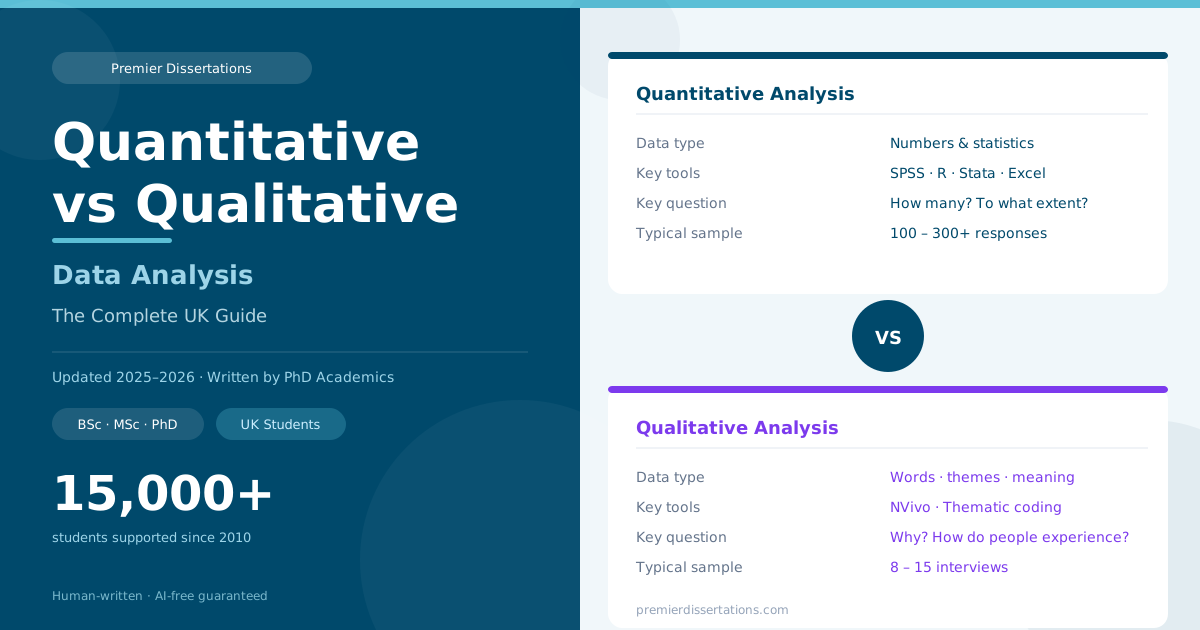
📊 Quantitative Analysis
- Works with numbers, statistics, and SPSS
- Measures things, finds relationships, tests hypotheses
- Use when asking: how many, how often, to what extent?
- Results are generalisable across populations
- Common tools: SPSS, R, Excel, Stata
💬 Qualitative Analysis
- Works with words, themes, and meaning
- Explores experiences, perceptions, and reasoning
- Use when asking: why or how people experience something?
- Results are rich, contextual, and in-depth
- Common tools: NVivo, thematic coding
Mixed methods means both, usually one after the other, where the first set of findings shapes what you do next. It is genuinely useful — but it also doubles your workload. Students frequently underestimate this.
But do not rely on that shortcut alone. The sections below will show you exactly what each approach involves, what mistakes to avoid, and how to make the right choice for your specific dissertation.
Why Getting This Wrong Is So Costly
Two years ago, a student came to me after she had already collected 200 survey responses. Her research question was about how first-generation students experience the transition to university. That is an experience question. It needed interviews, not a survey with Likert scales.
She had the wrong data for her question. She either had to reframe the question around what her data could actually answer — weakening her whole project — or start data collection again with four weeks left before submission. Neither option was good.
This situation is not rare. It happens because students think the choice is about preference or comfort, when it is actually about alignment. Your analysis method has to match your research question, your epistemological position, and — practically — your timeline and skills. All four things matter.
| If your question asks… | You need… | Because… |
|---|---|---|
| How many? How often? To what extent? | Quantitative analysis | You need to measure, count, and test statistical relationships |
| Why? How do people experience this? What does this mean? | Qualitative analysis | You need to explore meaning, perception, and lived experience |
| Both — pattern and explanation | Mixed methods | One approach cannot fully answer the question on its own |
- What is the relationship between study hours and final grade among UK undergraduates?
- Is there a significant difference in employee satisfaction between remote and office-based workers in London?
- To what extent does anxiety predict academic performance in A-level students?
1Design your survey with closed questions and rating scales (Likert, semantic differential, etc.)
2Collect responses — typically 100–300 for a master's dissertation
3Clean the data, checking for incomplete responses, outliers, and data entry errors
4Run descriptive statistics first — means, standard deviations, frequencies
5Run your inferential tests — t-test, ANOVA, correlation, regression, chi-square
6Interpret the output and write up your findings chapter
A business management student was investigating whether perceived manager support predicts employee intention to stay. She surveyed 214 employees using validated scales and ran a multiple regression in SPSS. Her key finding: manager support explained 31% of the variance in intention to stay (R² = .31, p < .001). Every one-unit increase in perceived support was associated with a 0.47-point increase in retention intention. Clean, specific, and defensible.
Common Quantitative Mistakes UK Students Make
Too small a sample. With under 50 responses, most inferential tests cannot run or produce unreliable results. Simple correlations need at least 50; regression with multiple predictors needs 100 minimum; complex SEM models need 200+.
Running the wrong test. The most common version: using a Pearson correlation when one variable is categorical, or running a t-test when you have more than two groups and need ANOVA. Sort this out before you collect data.
Ignoring test assumptions. Most parametric tests assume your data is normally distributed. SPSS can test this. Many students skip this step and then face hard questions from their supervisor about their analysis choices.
Misreading p-values. A p-value below 0.05 means the result is statistically significant — unlikely to have occurred by chance. It does not mean the finding is important, large, or practically meaningful. You also need effect sizes (Cohen's d, eta squared, R²).
Stuck with SPSS output? Our statistical analysts can review your results, explain what each test is showing, and write up your findings chapter correctly — including effect sizes and proper table formatting.
Get Statistical Analysis Help
Qualitative Data Analysis: What It Actually Involves
Qualitative data analysis is interpretive work. You are working with transcripts, field notes, documents, or other non-numerical material. You are not counting — you are reading, thinking, and constructing meaning.
Research Questions That Signal a Qualitative Approach
- How do international students in the UK experience culture shock in their first semester?
- Why do experienced NHS nurses remain in the profession despite high reported burnout?
- What are the lived experiences of first-generation university students navigating academic expectations?
1Design your interview guide with open questions, probes, and follow-ups
2Recruit participants and obtain ethics approval from your university
3Conduct and transcribe the interviews — a 45-minute interview produces around 7,000–9,000 words of transcript
4Read through all transcripts multiple times, making notes and initial observations
5Code the data, assigning labels to meaningful segments
6Group codes into broader themes, then review, refine, and name them
7Write up your findings, using participant quotes as evidence and your own analysis to explain what they mean
Transcription takes longer than most students expect. With 12 interviews, you are looking at 90,000+ words to read, re-read, and code. NVivo helps with the coding process, but it does not do the thinking for you. That is the work.
A Real Example of Qualitative Analysis Done Well
An education student was exploring why secondary school teachers in England were leaving the profession within their first three years. She interviewed 11 teachers who had left, using a semi-structured guide focused on their decision-making process. Through thematic analysis, she identified four themes: unsustainable workload outside classroom hours, lack of genuine mentoring support, the gap between training expectations and classroom reality, and a sense of professional isolation. Her supervisor described the analysis as genuinely illuminating. That is what good qualitative work looks like — not just reporting what people said, but explaining what it means and why it matters.
Common Qualitative Mistakes UK Students Make
Treating quotes as analysis. Presenting a block quote then writing "This shows participants felt overwhelmed" is not analysis — it is a paraphrase. Real analysis explains what the quote means, why it is significant, how it relates to your research question, and what it adds to existing literature.
Too few participants. Three interviews do not give you enough material to claim anything meaningful about themes or patterns. For most master's dissertations, 8–12 participants is the practical minimum.
Coding without a clear approach. There is a difference between inductive coding, deductive coding, and framework analysis. You need to commit to one approach and explain it in your methodology. "I read the transcripts and found themes" is not a coding strategy.
Ignoring data that does not fit. When one participant says the opposite of everyone else, do not leave them out. Negative cases — data that challenge your emerging themes — are analytically important. Address them directly.
Need qualitative analysis support? Our team provides NVivo guidance, thematic analysis coding, and qualitative write-up help — including participant recruitment if you need it.
Get Data Collection Help
The Difference, Side by Side
Quantitative research asks: how much, and does it matter statistically? It works from the outside in, collecting data from many people to find patterns that hold across a population. Its strength is generalisability. Its weakness is that it tells you what is happening without necessarily telling you why.
Qualitative research asks: what does it mean, and how do people make sense of it? It works from the inside out, spending significant time with fewer people to understand their experience in depth. Its strength is richness and context. Its weakness is that findings from 12 interviews in one city cannot be straightforwardly applied to everyone.
| Feature | Quantitative Analysis | Qualitative Analysis |
|---|---|---|
| Data Type | Numerical data | Non-numerical data (words, images, documents) |
| Main Goal | Measure relationships and patterns | Understand experiences and meanings |
| Research Focus | "How many?" or "To what extent?" | "Why?" and "How do people experience this?" |
| Common Methods | Surveys, experiments, secondary datasets | Interviews, focus groups, document analysis |
| Analysis Tools | SPSS, R, Excel, Stata | NVivo, thematic coding, framework analysis |
| Typical Sample Size | 100–300+ participants | 8–15 participants |
| Results | Statistics, p-values, effect sizes | Themes, patterns, interpretations |
| Key Strength | Generalisable results | Rich, detailed, contextual insight |
| Key Limitation | Less depth; tells you what, not why | Findings not directly generalisable |
| Epistemological Position | Positivism or post-positivism | Interpretivism or constructivism |
✓Does your question ask "how much" or "how many"? That points to quantitative.
✓Does your question ask "why" or "how do people experience"? That points to qualitative.
✓What do good dissertations in your department look like? Follow their lead unless you have a strong reason not to.
✓Do you have time and access for your preferred method? Feasibility is not a lesser concern — it is a real one.
Pattern 01
Explanatory Sequential
Quantitative first → qualitative second. Survey finds a pattern; interviews explain why it exists. Most common at master's level in business, education, and health sciences.
Pattern 02
Exploratory Sequential
Qualitative first → quantitative second. Interviews explore a new phenomenon; survey then tests whether findings hold more broadly. Common when little prior research exists.
Pattern 03
Convergent Parallel
Both strands collected simultaneously, then compared. Most complex and time-intensive. Rarely achievable at dissertation level without careful planning and significant time.
The honest caveat: mixed methods is significantly more work than a single-method study. You are running two separate data collection exercises, two analyses, and then a discussion that integrates them meaningfully. Students who underestimate this end up with two thin analyses instead of one solid one. Ask your supervisor whether your research question genuinely requires both strands before you commit.
If you decide mixed methods is right for you, our Dissertation Writing Service can help you manage both strands of analysis and write up the integration chapter.
Discipline-Specific Notes for UK Students
Your discipline shapes methodological expectations more than most students realise. Here is what you need to know about common approaches by subject area.
| Subject Area | Common Approach | Notes for Students |
|---|---|---|
| Psychology | Predominantly quantitative | Qualitative (IPA, thematic analysis) is well-established in health and counselling psychology. Know your department's stance. |
| Business & Management | Both common | Surveys with regression analysis are widely used. Qualitative case studies equally accepted. Mixed methods increasingly popular at master's level. |
| Education | Mixed methods or qualitative | Mixed methods almost standard at postgraduate level. Phenomenology and narrative inquiry also common. Pure quantitative less common. |
| Sociology | Predominantly qualitative | Qualitative approaches strongly represented. Quantitative sociology exists but is less dominant at UG and master's levels in most UK departments. |
| Nursing & Health Sciences | Both accepted | Quantitative dominates outcomes research. Qualitative central to experience-based research. Ethics approval can be slower — build extra time into your timeline. |
| Law | Document-based qualitative | Primarily doctrinal, socio-legal, and comparative analysis. Statistical methods are uncommon except in empirical legal studies. |
| Economics | Almost always quantitative | Secondary data analysis using large datasets is common. Strong statistical skills expected. |
| Social Work | Mixed methods or qualitative | Qualitative approaches dominate, particularly those focusing on lived experience and service user perspectives. |
- Report your descriptive statistics first, then your inferential tests in a logical order
- Format your tables properly — do not paste SPSS output screenshots into your dissertation
- Write an interpretation for each result that explains what it means, not just what the numbers say
- Include effect sizes alongside p-values to say something substantive about magnitude
- Link each finding explicitly back to your research questions or hypotheses
- Explain your coding process clearly — inductive, deductive, or framework analysis
- Present your themes with clear names and paragraph-length descriptions
- Use participant quotes as evidence — then analyse them, do not just restate them
- Your voice as the researcher should be present throughout the findings chapter
- Address negative cases and data that does not fit your main themes
Have your data but struggling with the write-up? Our Dissertation Chapter Writing service can structure and write your findings chapter properly. If your draft exists but needs strengthening, our Editing and Proofreading service covers methodology and analysis chapters specifically.
Get Chapter Writing Help
Frequently Asked Questions
Quantitative analysis focuses on numerical data and statistical testing — you measure relationships, test hypotheses, and produce findings that can be generalised to a broader population. Qualitative analysis focuses on words, experiences, and meanings — you explore how people think, feel, or make sense of something, producing rich, contextual findings. The right choice depends on what your research question is genuinely asking you to do.
Neither is universally easier. Quantitative analysis requires statistical knowledge — understanding which tests to run, interpreting outputs correctly, and meeting the assumptions of each test. Qualitative analysis requires sustained interpretive thinking — reading transcripts deeply, coding carefully, and writing analysis rather than just description. Students who struggle with numbers are not automatically better off with qualitative work. The best choice is the one that fits your question and your skills honestly.
Yes. Mixed methods research combines both approaches and is widely accepted in UK universities, particularly in business, education, health sciences, and social work. The most common pattern is explanatory sequential: a survey followed by interviews. However, mixed methods significantly increases your workload. Before committing, ask your supervisor whether your question genuinely requires both strands, or whether a well-designed single-method study would answer it just as well.
No. SPSS is designed for quantitative statistical analysis. Qualitative researchers commonly use NVivo, which helps organise and manage coding of transcripts, documents, and other text-based data. It is worth noting that NVivo does not do the analytical thinking — it is an organisational tool. The interpretation still comes from you. If you need support with either SPSS or NVivo, our Statistical Analysis Services cover both.
For qualitative interviews at master's level, 8–15 is the typical range. Some methodologies (IPA, phenomenology) can work with fewer, but you need to justify that carefully in your methodology chapter. For quantitative surveys, 100 is a practical minimum for simple analyses such as correlations. If you are running regression with multiple predictors, 150–200 is safer. Complex SEM models typically need 200+. Always check the specific requirements for the statistical test you are planning before you collect your data.
Talk to them — not defensively. Ask them to explain the reasoning. Sometimes supervisors have a genuine methodological concern that is worth hearing. If you have a well-reasoned argument for qualitative research that flows clearly from your research question and epistemological position, most supervisors will engage with it. What they will struggle to accept is "I prefer qualitative because I do not like statistics." Make the argument from your question, not your comfort zone.
This is one of the most common situations students find themselves in. First, go back to your research questions and hypotheses, and match each one to the relevant output table. Check which test was run and confirm it was the right one for your data type and design. If you are still stuck, our Statistical Analysis Services can review your SPSS output, explain what the tests are showing, and help you write up the results section correctly — including effect sizes, significance levels, and proper table formatting.
The most common reason qualitative analysis feels thin is that the coding has stayed too close to the surface — summarising what participants said rather than interpreting what it means. Go back to your codes and ask: what does this tell me about the underlying experience, belief, or social process? Why might this be? What does this reveal that we did not know before? What does this mean for your research question? The difference between shallow and deep analysis is usually the depth of the "so what" question you are asking about each piece of data.
Need Help With Your Data Analysis?
Whether you are stuck on SPSS output, need qualitative coding support, or want your findings chapter written up properly — our team of UK-qualified academics is here to help.
PhD academics · Human-written · Turnitin and AI report · Trusted by 15,000+ UK students
Last reviewed: May 2026 · This guide reflects methods and software commonly used in UK universities. Always follow your supervisor's guidance for department-specific requirements.
Get 3+ Free Wildlife Dissertation Topics within 24 hours?