

Best Survey Tools for Dissertation Research in 2026 (UK Students – Free & Paid)
May 7, 2026
Results to Discussion Dissertation: How to Write a High-Scoring Discussion Section (Step-by-Step Guide + Examples 2026)
May 8, 2026
Thesis Writing Guides Australia
In this guide
Getting the structure of your thesis right is one of the most important things you can do before you write a single word of content. Australian universities — particularly Go8 institutions like the University of Melbourne, UNSW, USyd, ANU, Monash, UQ, UWA, and the University of Adelaide — have clear expectations about how a thesis should be organised, and examiners notice immediately when those expectations are not met.
This guide breaks down the standard five-chapter thesis structure used across Australian universities, explains exactly what belongs in each chapter, and gives you the word count targets and formatting rules you need to submit with confidence.
Need help structuring your thesis? Premier Dissertations AU provides expert thesis writing and editing support for students at all Australian universities. Human-written, AI-free, Turnitin report included. From AUD $27/page.
Get a free quote →The Standard Thesis Structure in Australia
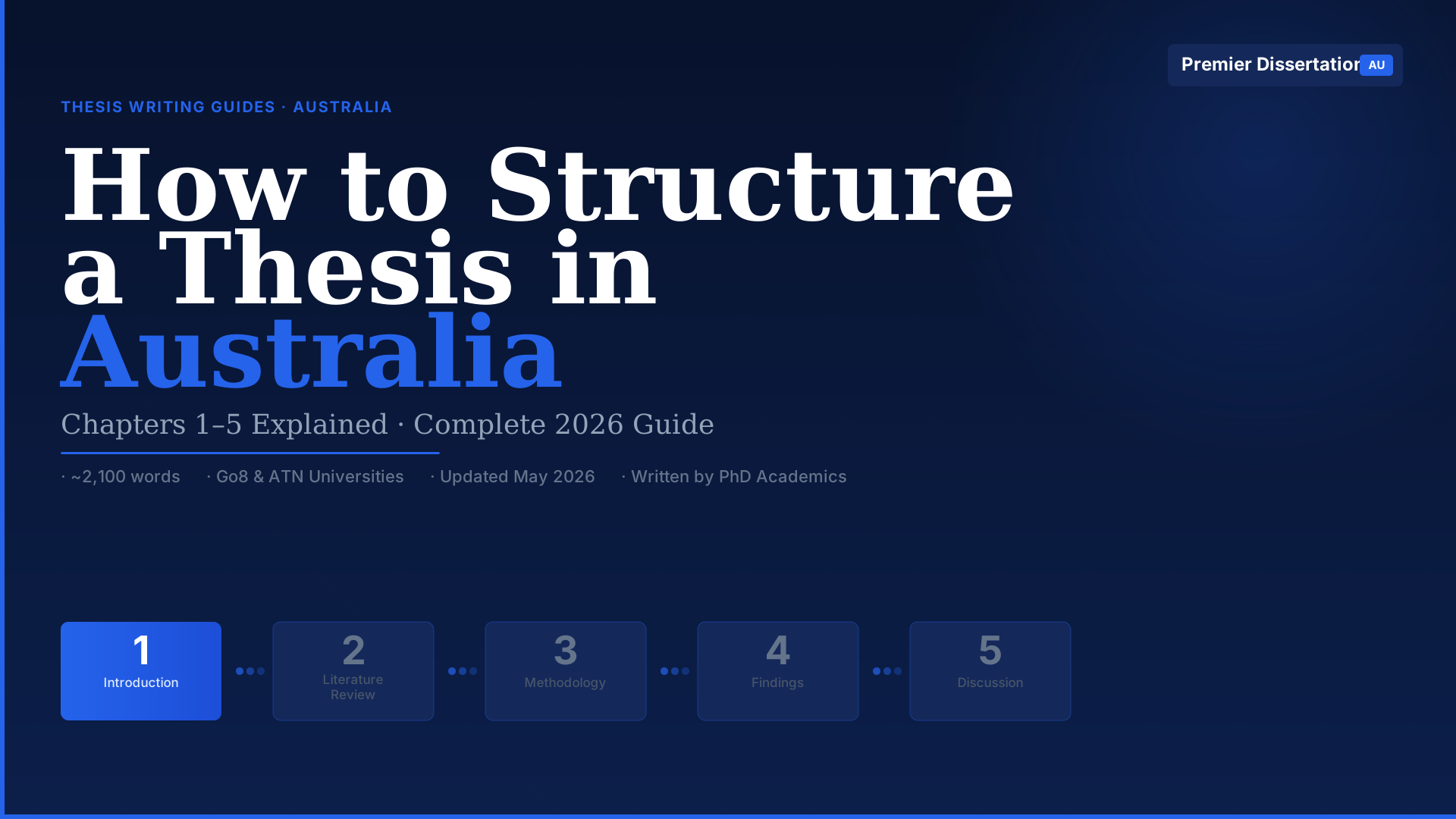
The vast majority of Australian thesis programmes — from Honours and Masters by Research to PhD — follow a five-chapter model. This structure is not arbitrary: each chapter builds logically on the last, taking the reader from the problem you identified all the way to what your research means for the field.
Here is a high-level overview before we go deeper into each chapter:
| Chapter | Title | Core Purpose | Typical Word Count |
|---|---|---|---|
| 1 | Introduction | Establish context, gap, aims, and structure | 1,500 – 2,500 |
| 2 | Literature Review | Critically synthesise existing research | 3,500 – 5,000 |
| 3 | Methodology | Justify research design and methods | 2,500 – 4,000 |
| 4 | Findings / Results | Present data without interpretation | 2,500 – 4,000 |
| 5 | Discussion & Conclusion | Interpret findings, implications, contribution | 3,000 – 4,500 |
Some faculties — particularly in creative arts, science, and engineering — use variations of this structure. Always check your faculty's thesis guidelines and confirm the expected format with your supervisor before you begin writing.
Chapter 1 — Introduction
Chapter 1 is your thesis's first impression — and examiners form their view of your work quickly. A strong introduction does not simply introduce your topic; it builds a compelling case for why your research needed to exist.
Every Australian thesis introduction must cover these four elements:
Chapter 2 — Literature Review
The literature review is the most commonly misunderstood chapter. Students often produce an annotated bibliography — a list of what various authors have said — when what examiners actually want is a critical synthesis: a structured argument about the state of knowledge in your field.
A strong Australian literature review will:
- Group sources thematically, not chronologically or by author
- Identify points of agreement, disagreement, and uncertainty across the literature
- Use primarily peer-reviewed journal articles as sources
- Build to a clear statement of the gap your research fills
- Cite consistently in APA 7th edition throughout (or AGLC4 for law; IEEE for engineering)
Chapter 3 — Methodology
Chapter 3 is where your research design lives. The key word here is justification — you are not just describing what you did, you are explaining why every decision you made was the right one for your research question.
A complete Australian thesis methodology chapter covers:
Need SPSS or NVivo support? Our PhD-qualified data analysts handle regression, ANOVA, chi-square, thematic coding, and full results chapter write-ups for Australian thesis students.
Get data analysis help →Chapter 4 — Findings / Results
Chapter 4 has one job: present your data clearly and objectively, without interpretation. Interpretation is for Chapter 5. Students who blend findings and discussion in Chapter 4 confuse examiners and lose marks for structure.
For quantitative research: organise your results around your research questions or hypotheses. Use tables and figures formatted to APA 7th standard — label every table (above) and figure (below) with a number and descriptive title. Never paste raw SPSS output directly into your thesis; reformat it cleanly.
For qualitative research: organise findings into themes that emerged from your data analysis. Support each theme with direct quotes from participants, properly anonymised using pseudonyms or participant codes (P1, P2, etc.). Each theme should be named descriptively — not "Theme 1" but something like "Barriers to Accessing Mental Health Support."
Chapter 5 — Discussion and Conclusion
Chapter 5 is where your academic voice truly comes through — and where many theses either earn or lose their High Distinction. The discussion is not a recap of Chapter 4. It is your interpretation of what the findings mean, how they relate to the existing literature, and what they contribute to the field.
A HD-worthy discussion chapter will:
Word Count Breakdown by Thesis Type
Word count requirements vary significantly by thesis level and faculty. Use this table as a guide, but always confirm your institution's requirements:
| Thesis Level | Total Word Count | Typical Duration |
|---|---|---|
| Honours Thesis | 15,000 – 25,000 | 1 year (full-time) |
| Masters by Research | 30,000 – 50,000 | 1.5 – 2 years |
| PhD Thesis | 60,000 – 100,000 | 3 – 4 years |
Note that these are excluding appendices, references, and preliminary pages (title page, abstract, acknowledgements, table of contents). Your abstract is typically 250–350 words and does not count toward your thesis total.
Thesis Formatting Requirements in Australia
Beyond chapter structure, Australian universities have specific formatting rules. These vary slightly by institution, but the standards below apply across most Go8 and regional universities:
- Font: Times New Roman or Arial, 12pt body text
- Line spacing: 1.5 or double spacing for body text
- Margins: 2.5 cm on all sides (some universities require 3.5 cm on the left for binding)
- Referencing: APA 7th edition for most disciplines; AGLC4 for law; IEEE for engineering
- Page numbers: bottom centre or bottom right; preliminary pages in Roman numerals (i, ii, iii)
- Headings: consistent hierarchy (Chapter title → H2 → H3) with no more than three heading levels
- Tables and figures: APA 7th format — Table number and title above; Figure number and caption below
- Abstract: 250–350 words; no citations; key terms included for database indexing
Common Structural Mistakes Australian Students Make
These structural errors appear in examiner reports across Australian universities year after year:
Get your thesis professionally edited before submission. Our PhD editors check for structural issues, APA errors, clarity, and argument flow — and return your thesis with a Turnitin + AI report included.
Get thesis editing help →Need Help Structuring or Writing Your Thesis?
Understanding the structure is one thing — executing it under time pressure, with a demanding supervisor and competing commitments, is another. Premier Dissertations AU has supported over 15,000 students at Go8 and non-Go8 Australian universities since 2010.
Whether you need a full thesis, a single chapter, a structural review, or professional editing before submission — our PhD-qualified Australian academics are here to help.
Thesis writing and editing from AUD $27/page.
Get Expert Thesis Support Today
Full thesis, single chapter, structural review, or editing — Premier Dissertations AU is here to help.
PhD academics · Human-written · Turnitin + AI report · UniMelb, UNSW, USyd, Monash, UQ, ANU, UWA & more