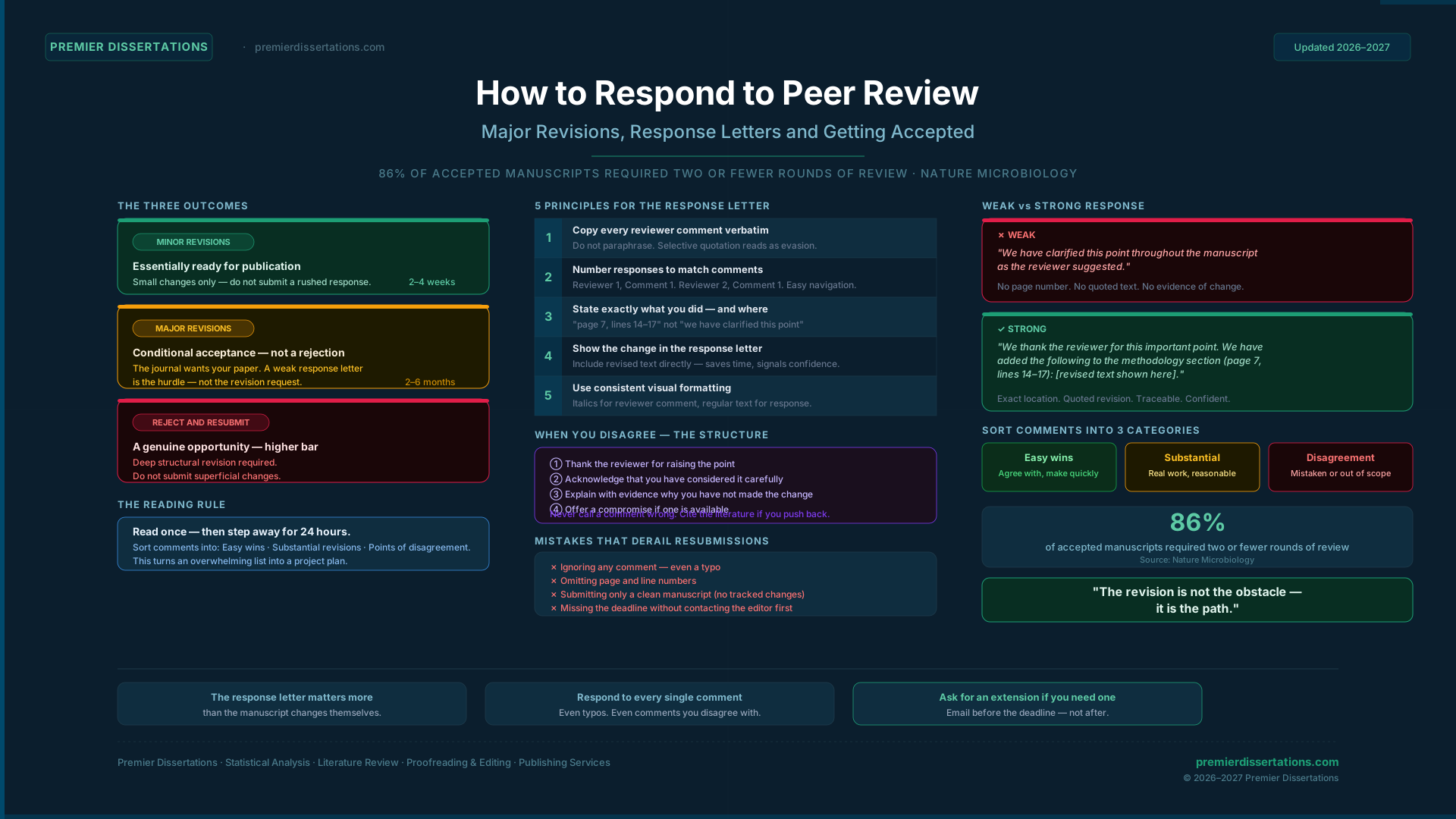



How to Rewrite a Rejected Dissertation: Step-by-Step UK Guide
January 26, 2026
AI in Research Methodology Dissertation Topics (2026)
January 29, 2026

Updated: January 2026 · For Academic Year 2026
Selecting a focused and academically defensible sustainability in business dissertation topic is a critical early decision that shapes the quality, originality, and assessment outcome of your research. Sustainability in business is no longer treated as a peripheral ethical concern. Across UK universities, it is examined as a strategic, financial, and governance issue that influences long-term organisational performance, stakeholder trust, regulatory compliance, and competitive advantage.
In the UK academic context, sustainability-focused business research commonly engages with themes such as environmental, social, and governance (ESG) integration, corporate sustainability strategy, responsible supply chains, ethical leadership, climate risk disclosure, and the measurement of sustainable performance. High-scoring dissertations typically move beyond descriptive discussions of “green practices” and instead demonstrate critical engagement with theory, empirical evidence, and real organisational decision-making. This includes evaluating how firms balance profitability with social responsibility, respond to regulatory pressure, and operationalise sustainability within complex market environments.
This page presents a carefully curated selection of sustainability in business dissertation topics designed for undergraduate, master’s, and PhD-level research. Topics are aligned with the analytical depth, ethical expectations, and methodological standards commonly applied by UK universities in 2026. The list spans core areas such as ESG reporting, sustainable business models, corporate governance, stakeholder theory, circular economy strategies, and sustainability-driven innovation. You may also explore our main Dissertation Topics (All Subjects) hub for related research areas in business management, finance, economics, leadership, and public policy.
If your dissertation involves empirical investigation, such as interviews with sustainability managers, analysis of corporate reports, ESG datasets, case studies of UK firms, or mixed-methods evaluation of sustainability initiatives, our Research Methodology & Data Analysis Guide offers UK-aligned guidance on research design, ethical approval, data analysis techniques, and examiner-focused presentation of findings.
Top Sustainability in Business Dissertation Topics (Editor’s Choice 2026)
Selected by UK academic editors, the following sustainability in business dissertation topics represent high-scoring research directions for 2026. These topics reflect what UK examiners typically reward: a clearly defined business problem, strong engagement with sustainability and management theory, realistic access to organisational data, and a methodology capable of producing robust, ethically sound analysis rather than descriptive commentary.
- Integrating ESG into Corporate Strategy: An examination of how UK firms embed environmental, social, and governance considerations into strategic decision-making, and whether ESG integration delivers measurable financial and reputational outcomes.
- The Impact of Sustainability Reporting on Investor Decision-Making: A critical analysis of how sustainability disclosures influence investor trust, risk perception, and capital allocation in UK-listed companies.
- Sustainable Supply Chain Management and Ethical Risk: Investigating how businesses manage environmental and labour risks across global supply chains, with attention to transparency, supplier monitoring, and accountability mechanisms.
- Corporate Governance and Sustainability Performance: Exploring the role of boards, executive incentives, and governance structures in shaping sustainability outcomes and long-term organisational resilience.
- From CSR to Strategic Sustainability: Evaluating whether corporate social responsibility initiatives function as genuine value-creating strategies or symbolic responses to regulatory and stakeholder pressure.
- Circular Economy Practices in UK Businesses: Assessing how firms adopt circular business models, the operational barriers they face, and the implications for cost efficiency, innovation, and environmental impact.
- Managing Climate Risk as a Business Strategy: Analysing how organisations identify, disclose, and respond to climate-related risks, and how these practices influence strategic planning and performance.
› Planning a sustainability-focused business dissertation involving interviews with managers, analysis of ESG reports, corporate case studies, surveys, or mixed-method research? You may find it useful to consult our Research Methodology & Data Analysis Guide for UK-aligned support with research design, ethics approval, sampling strategies, and examiner-focused analysis. You can also explore our Dissertation Topics hub to refine your focus across business management, finance, economics, and leadership research areas.
Explore This Page
Navigate directly to sustainability in business dissertation topics by level and research focus. Topics are structured to reflect UK university marking criteria and assessment expectations for 2026.
- 🎓 Undergraduate Sustainability in Business Dissertation Topics
- 📘 Masters Sustainability & ESG Dissertation Topics
- 🎯 PhD Sustainability in Business Research Topics
- 🚀 Emerging Sustainability in Business Research Themes (2026)
- ✅ How to Choose a Sustainability in Business Dissertation Topic
- ❓ Sustainability in Business Dissertation FAQs
For broader topic inspiration before finalising your research direction, you may explore our complete dissertation topics library or review subject-specific structures in our dissertation examples. If your study involves sustainability reporting analysis, interviews with managers, ESG datasets, corporate case studies, or mixed-method research, our Research Methodology & Data Analysis Guide provides practical, UK-aligned guidance on research design, ethics approval, and examiner-focused analysis.
Undergraduate Sustainability in Business Dissertation Topics (2026)
These undergraduate-level sustainability in business dissertation topics are designed for students who require a manageable research scope, clear alignment with UK marking criteria, and realistic access to data. Most topics below can be completed through a focused literature review, analysis of company sustainability reports, small-scale surveys, interviews, or document-based case studies without requiring privileged corporate access or complex datasets. For wider inspiration across disciplines, you may also consult our full dissertation topics library.
- Understanding sustainability in business strategy: how UK companies define and prioritise sustainable practices.
- Student perceptions of corporate sustainability: exploring how future employees evaluate sustainable business behaviour.
- Corporate social responsibility in UK SMEs: motivations, challenges, and perceived benefits.
- The role of sustainability reporting in building consumer trust: a document-based analysis of UK firms.
- Environmental sustainability and brand image: examining whether green initiatives influence customer perceptions.
- Ethical sourcing in business supply chains: exploring how companies communicate responsible sourcing commitments.
- Sustainability and employee engagement: investigating whether sustainable values influence job satisfaction and motivation.
- Green marketing strategies: analysing how businesses promote sustainability without misleading consumers.
- Cost versus responsibility: exploring how firms balance sustainability goals with financial constraints.
- Waste reduction practices in retail and hospitality businesses: a case study approach.
- Energy efficiency initiatives in UK businesses: motivations, barriers, and perceived outcomes.
- Sustainability policies in multinational companies operating in the UK: a comparative document analysis.
- Consumer awareness of sustainability claims: examining how well customers understand environmental labels and messages.
- Corporate sustainability and competitive advantage: a literature-based evaluation.
- The role of leadership in promoting sustainable workplace practices.
- Social sustainability in business: exploring diversity, inclusion, and fair labour practices.
- Sustainability training for employees: analysing organisational approaches and effectiveness.
- The impact of sustainability initiatives on organisational reputation.
- Responsible consumption and business response: how firms adapt to changing consumer expectations.
- Sustainability in business decision-making: exploring how managers consider environmental and social factors.
- The use of sustainability metrics in performance evaluation.
- Small business perspectives on sustainability regulation in the UK.
- Corporate sustainability communication on company websites: a content analysis.
- Barriers to implementing sustainable practices in traditional industries.
- The role of innovation in supporting sustainable business practices.
› Tip: Strong undergraduate sustainability dissertations show a clear pathway from research question to method and findings. Keep your data collection proportionate and well-justified. Carefully selected case studies, report analysis, and small surveys can score highly when linked clearly to sustainability theory and business outcomes. For structured guidance on research design, ethics, and analysis, consult our Research Methodology & Data Analysis Guide .
To see how high-scoring undergraduate dissertations are structured, you may explore our dissertation examples. If you are developing a proposal alongside your topic, planning tools and academic guidance are available in our Dissertation Help hub.
Masters Sustainability in Business Dissertation Topics (2026)
These Masters-level sustainability in business dissertation topics are designed for students expected to demonstrate stronger theoretical integration, critical analysis, and a defensible contribution to business sustainability research. UK examiners typically expect clear engagement with sustainability, management, and governance theory, alongside a well-justified methodology. Most topics below are feasible using mixed-methods designs, ESG report analysis, comparative case studies, surveys using validated scales, interviews with managers, or policy and strategy evaluation, without requiring unrestricted access to large organisations. For broader topic mapping across disciplines, you may also explore our Dissertation Topics (All Subjects) hub.
- Evaluating the integration of ESG principles into corporate strategy: a comparative study of UK-listed firms.
- The relationship between sustainability reporting quality and firm performance: evidence from UK annual and ESG reports.
- Corporate governance structures and sustainability outcomes: analysing the role of boards and executive incentives.
- From compliance to strategy: how UK organisations operationalise sustainability beyond regulatory requirements.
- Sustainable supply chain management and ethical risk: a case study analysis of sourcing and accountability practices.
- Investor perceptions of sustainability disclosure: examining how ESG transparency influences trust and risk assessment.
- Leadership commitment and sustainability implementation: exploring how managerial values shape organisational practice.
- Green innovation as a source of competitive advantage: evaluating product, process, and business model innovation.
- Measuring social sustainability in business: challenges of indicators, reporting, and comparability.
- Climate-related risk disclosure and strategic decision-making in UK firms.
- The effectiveness of sustainability performance metrics in managerial evaluation systems.
- Stakeholder engagement in sustainability strategy: examining dialogue, accountability, and power dynamics.
- Circular economy adoption in business operations: drivers, barriers, and organisational outcomes.
- Balancing profitability and responsibility: managerial decision-making under sustainability pressure.
- Sustainability communication and greenwashing risk: analysing corporate narratives and credibility.
- Employee perceptions of organisational sustainability commitment and workplace engagement.
- Public policy influence on corporate sustainability behaviour: a UK-focused analysis.
- Sustainability-oriented corporate culture: exploring how values translate into everyday business practices.
- Digital technologies and sustainability management: evaluating the role of data, analytics, and reporting systems.
- Comparing sustainability strategies across industries: identifying sector-specific challenges and responses.
› Tip: For Masters-level sustainability research, examiners expect (1) a clearly articulated conceptual framework, (2) strong justification of research design and methods, and (3) a credible plan for ethics, data access, and analysis. Clearly explain why your chosen methods suit your research questions and how your findings contribute to sustainability and business theory. For UK-aligned support with research design, sampling, and analysis choices, consult our Research Methodology & Data Analysis Guide .
To see how strong Masters dissertations are structured, including chapter flow, critical literature synthesis, and methodology presentation, you may explore our dissertation examples. For step-by-step proposal development and writing guidance, visit our Dissertation Help hub.
PhD Sustainability in Business Research Topics (2026)
These PhD-level sustainability in business research topics are designed for doctoral candidates expected to make an original, theoretically grounded contribution to knowledge. UK PhD examiners typically look for strong positioning within sustainability, management, governance, and political economy literature, alongside rigorous methodological design such as longitudinal studies, multi-country or multi-industry comparisons, advanced qualitative analysis, or theory-driven empirical modelling. Topics below emphasise conceptual depth, critical analysis, and originality rather than applied implementation alone. For broader disciplinary mapping, you may also consult our Dissertation Topics hub.
- Conceptualising sustainability in business beyond ESG: a theoretical study examining competing definitions, assumptions, and measurement frameworks in management research.
- Corporate sustainability and power: analysing how institutional pressures, investor influence, and regulation shape sustainability strategy adoption in UK firms.
- Greenwashing as organisational practice: a critical investigation into how sustainability narratives are constructed, legitimised, and contested.
- Board governance and sustainability outcomes: a multi-firm study examining how board composition, incentives, and decision-making structures influence long-term sustainability performance.
- Climate risk, uncertainty, and strategic decision-making: a longitudinal study of how firms integrate climate-related risks into investment and planning processes.
- Sustainability reporting regimes and organisational behaviour: evaluating how disclosure requirements reshape internal management practices.
- Political economy of sustainable business: examining the relationship between corporate sustainability strategies and state regulation in the UK context.
- Stakeholder theory revisited: analysing whose interests dominate sustainability governance and whose voices remain marginalised.
- Circular economy transitions in business systems: a multi-level analysis of organisational, sectoral, and institutional barriers to circularity.
- Sustainability metrics and managerial control: investigating how performance indicators shape behaviour, accountability, and unintended consequences.
- Global supply chains and sustainability risk governance: a comparative study of accountability mechanisms across regions and industries.
- Digitalisation and sustainability management: examining how data, analytics, and reporting technologies reshape sustainability governance.
- Corporate culture and sustainability identity: exploring how values, norms, and routines influence long-term sustainability commitment.
- Financialisation and sustainability strategy: analysing tensions between short-term shareholder value and long-term sustainability objectives.
- Intersectionality in business sustainability: examining how social, environmental, and economic inequalities intersect within corporate sustainability practices.
- Policy implementation gaps in business sustainability: a critical analysis of how sustainability regulations translate into organisational practice.
- Responsible innovation and sustainability transitions: developing theory on how firms navigate innovation under environmental and social constraints.
- Employee agency in sustainability initiatives: investigating how worker participation shapes sustainability outcomes.
- Comparative sustainability governance across industries: identifying sector-specific dynamics and institutional constraints.
- Designing integrative models of sustainability governance: developing and testing frameworks that coordinate firms, regulators, investors, and civil society.
› Tip: PhD examiners expect a clearly articulated theoretical stance, rigorous methodological justification, and a demonstrable original contribution. Avoid treating sustainability as a checklist of practices. Instead, examine how power, incentives, institutional constraints, and measurement choices shape sustainability outcomes in business contexts. For advanced support with UK doctoral research design, ethics planning, sampling strategy, and analytical frameworks, consult our Research Methodology & Data Analysis Guide .
To review how successful doctoral dissertations structure theory, methodology, and contribution chapters, you may explore our dissertation examples. Guidance on proposal development, ethics documentation, and chapter planning is also available in our Dissertation Help hub.
Emerging Sustainability in Business Research Themes (2026)
The following emerging sustainability in business research themes reflect areas gaining rapid academic, regulatory, and organisational attention for 2026. These themes are particularly well suited to Masters and PhD-level research, where UK examiners expect topical relevance, strong theoretical positioning, ethical awareness, and critical evaluation of how sustainability is governed and enacted in real business contexts. Many themes below support conceptual analysis, qualitative inquiry, mixed-methods designs, or policy- and governance-focused research aligned with UK university standards.
- Beyond ESG compliance: examining whether sustainability reporting drives substantive organisational change or symbolic legitimacy.
- Climate risk disclosure and strategic adaptation: analysing how firms translate climate-related risk information into investment and planning decisions.
- Greenwashing and credibility risk: investigating how sustainability narratives are constructed, challenged, and regulated.
- Digitalisation and sustainability governance: exploring the role of data analytics, AI, and reporting systems in managing sustainability performance.
- Circular economy transitions in business: analysing organisational, sectoral, and institutional barriers to circular business models.
- Social sustainability and workforce inequality: examining labour practices, wellbeing, and inclusion within sustainability strategies.
- Supply chain transparency and accountability: investigating how firms manage environmental and social risks beyond direct operations.
- Investor activism and sustainability outcomes: exploring how shareholder pressure reshapes corporate priorities and governance.
- Regulatory change and corporate response: analysing how evolving UK and international sustainability regulations influence business behaviour.
- Sustainability metrics and unintended consequences: examining how measurement choices shape managerial action and trade-offs.
- Stakeholder participation in sustainability decision-making: analysing power dynamics and voice within governance structures.
- Net-zero commitments and organisational reality: investigating gaps between public pledges and operational practice.
- Sustainability and innovation tension: exploring how firms balance environmental goals with cost, risk, and competitiveness.
- SMEs and sustainability transitions: examining capacity constraints, support mechanisms, and policy alignment.
- Comparative sustainability governance across industries: identifying sector-specific challenges and institutional pressures.
› Tip: Emerging-theme sustainability research performs best when it is theoretically grounded and critically cautious. Avoid treating sustainability as a checklist of initiatives. Focus instead on trade-offs, incentives, power relations, regulatory context, and unintended consequences. Many of these themes suit policy analysis, ESG report evaluation, interviews with sustainability managers, stakeholder analysis, or mixed-method research designs. For guidance on method selection and ethics planning, consult our Research Methodology & Data Analysis Guide .
To see how emerging sustainability themes are developed into high-scoring dissertations, you may review our dissertation examples or refine your topic selection using our Dissertation Help hub.
How to Choose a Sustainability in Business Dissertation Topic
Choosing a strong sustainability in business dissertation topic involves more than selecting a popular ESG label or a broad “green business” theme. UK examiners assess whether your topic is conceptually grounded, methodologically feasible, ethically appropriate, and clearly linked to business decision-making, governance, or measurable organisational outcomes. The steps below will help you refine a broad sustainability interest into a focused, defensible research project.
- Start with a concrete business problem, not a sustainability slogan. Anchor your topic in a specific organisational challenge, such as sustainability reporting credibility, supply chain risk, climate-related decision-making, governance incentives, or stakeholder pressure. “Sustainability” should be something you can analyse, compare, or evaluate in practice.
- Define what sustainability means in your study. Be explicit about whether you are focusing on environmental sustainability, social sustainability, governance (ESG), circular economy models, or integrated sustainability strategy. Clear definitions strengthen your literature review and prevent vague arguments.
- Check data access and feasibility early. Business sustainability research often relies on corporate reports, ESG datasets, interviews with managers, surveys of employees or consumers, or comparative case studies. Choose a topic that fits the data you can realistically access within your timeframe.
- Be realistic about ethics and organisational sensitivity. While business research rarely involves vulnerable participants, issues such as confidentiality, reputational risk, and commercial sensitivity still require careful ethical planning, anonymisation, and transparent consent procedures.
- Align the scope with your degree level. Undergraduate topics should prioritise clarity and a manageable dataset. Masters topics should integrate theory, evidence, and method more deeply. PhD topics must demonstrate originality, theory development, or a rigorous multi-site or longitudinal design.
- Link your topic to a defensible theoretical framework. High-scoring projects connect to established lenses such as stakeholder theory, institutional theory, legitimacy theory, political economy, or sustainability transitions. This helps justify your research design and strengthens your analysis.
- Frame the topic as a research question or evaluative aim. Examiners respond best to topics that can be expressed clearly, for example: “How do firms…?”, “To what extent does…?”, or “What factors influence…?”. Clear framing improves coherence across your literature review, methodology, and findings.
› Tip: A reliable way to test topic quality is to answer four questions: (1) What specific sustainability issue am I examining? (2) Which organisations or stakeholders are involved? (3) What data can I realistically collect or analyse? (4) Why do the findings matter for business strategy, governance, or policy? For structured support with research design, sampling, and analysis choices, consult our Research Methodology & Data Analysis Guide .
If you would like help refining a broad idea into a supervisor-ready title, or checking whether your topic meets UK assessment expectations, you may explore planning resources in our Dissertation Help hub or review how successful projects frame their research questions in our dissertation examples.
Trusted by 10,000+ students worldwide
What Sustainability & Business Students Say About Us
Verified reviews from UK university students who used our topic refinement, proposal guidance, and academic editing support in sustainability in business, ESG research, corporate governance, sustainable strategy, supply chain ethics, and business management dissertations.













Last reviewed: January 2026 · Reviewed by UK Academic Editor
Ready to Proceed? Get a Custom Sustainability in Business Research Proposal
Our UK-qualified academic editors help turn your chosen topic into a clear, supervisor-ready proposal with research aims, objectives, conceptual framework, methodology, ethics considerations, and key references (within 48 hours). Support covers sustainability strategy, ESG reporting, corporate governance, responsible supply chains, and sustainable business models.
Get Free Proposal Guidance3-Step Dissertation Process
Get an immediate response:
WhatsApp ·
Email ·
Live Chat
24/7 response · UK-qualified academic support · 100% confidential
Explore Free Student Study Tools
Academic integrity and writing-support tools trusted by UK students working on sustainability in business, ESG research, corporate governance, and management dissertations.
Frequently Asked Questions (FAQs)
Need Expert Guidance?
Our UK-qualified academic editors support undergraduate, master’s, and PhD students in developing high-scoring sustainability in business dissertations that meet UK assessment expectations. Whether your project is strategy-led, governance-focused, or empirical, we help you refine a supervisor-ready research direction, position your study within credible sustainability and management literature, and select a defensible methodology that matches your data access, ethics requirements, and timeframe. Support covers ESG reporting, corporate sustainability strategy, responsible supply chains, greenwashing and credibility, climate risk disclosure, circular economy models, stakeholder governance, sustainability performance measurement, and sustainability-driven innovation.
How It Works
From topic shortlisting to proposal drafting — simple, fast, and fully confidential for UK sustainability and business students.
-
01 · Tell Us Your FocusShare your study level, area of interest, and any supervisor notes (e.g., ESG reporting, sustainability strategy, corporate governance, responsible supply chains, circular economy, climate risk, or sustainability measurement).
-
02 · Get 3+ TopicsReceive hand-picked sustainability in business dissertation topics with brief academic rationales within 24 hours.
-
03 · Approve & Order ProposalWe draft a ~1,000-word proposal including aims, key literature positioning, methodology, ethics considerations, and core references aligned with UK expectations.
-
04 · Free Revisions & SupportUnlimited scope and structure revisions, plus guidance on research design, analysis planning, and chapter-wise writing clarity.
100% confidential · UK-qualified academic support · Turnitin-safe
Get 3+ Free Sustainability in Business Dissertation Topics within 24 hours
Share your research interests, study level, and any supervisor notes. We will send carefully matched topics with brief academic rationales tailored to ESG reporting, sustainability strategy, governance and accountability, supply chain ethics, circular economy models, climate risk disclosure, greenwashing and credibility, and sustainability performance measurement.