


How to Read a Turnitin Similarity + AI Report — What Every Number Means (2026)
July 1, 2026
APA Referencing Guide for Australian Students (7th Edition, 2026)
July 14, 2026
The email arrives after weeks of waiting. You open it, scan the first paragraph, and your stomach drops.
We are inviting you to submit a major revision.
I have watched this moment play out dozens of times — with PhD students, early-career researchers, and experienced academics alike. The reaction is almost always the same: a sinking feeling that the work wasn't good enough.
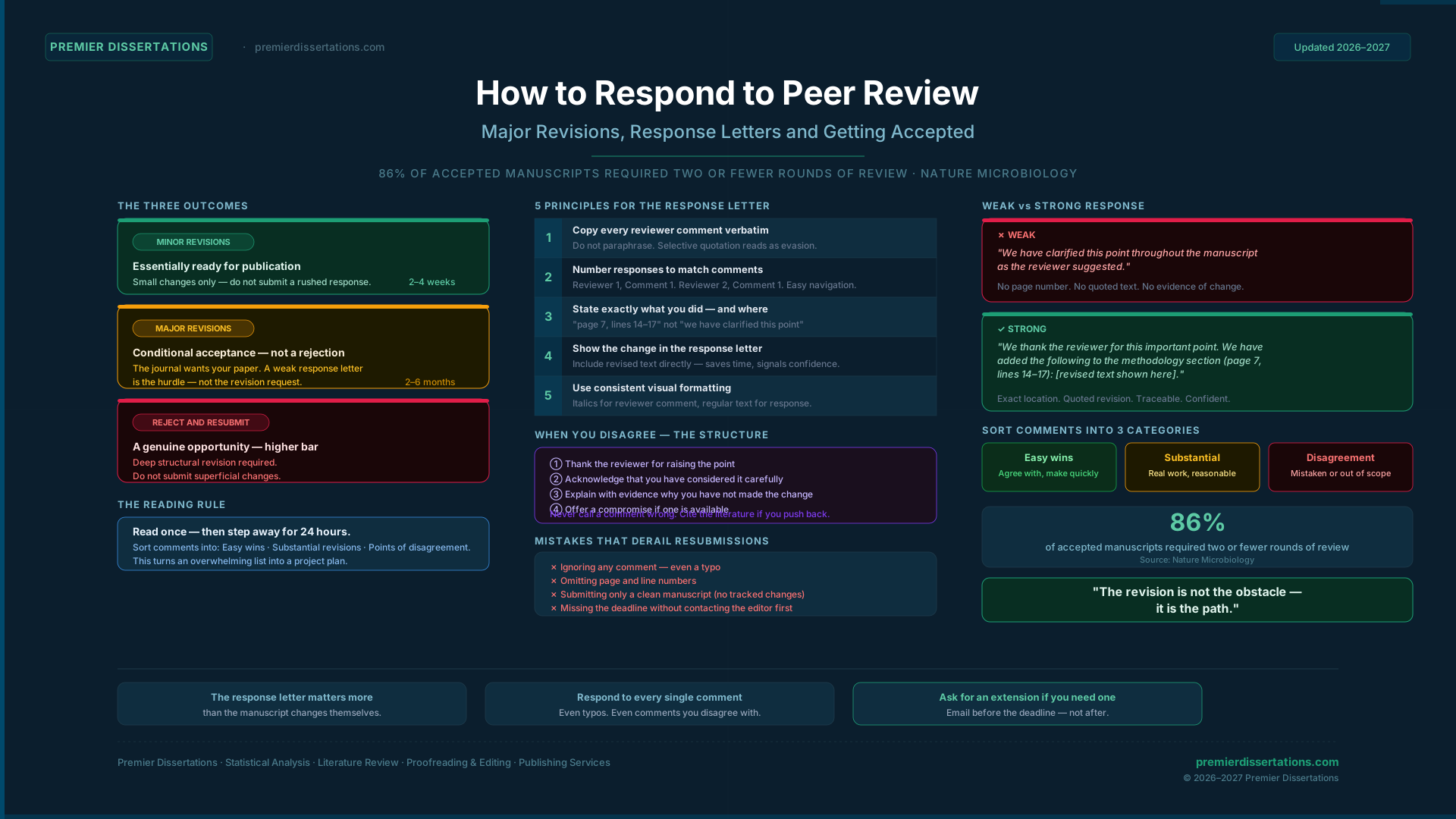
Here is what I tell every one of them: a major revision request is not a rejection. It is the journal saying we want this paper — now help us make it publishable. Data from Nature Microbiology shows that 86% of accepted manuscripts required two or fewer rounds of review. The paper you are holding a decision letter for has almost certainly been through exactly this process.
This guide walks you through every stage of responding — from reading the comments without spiralling, to writing a response letter that gets your paper accepted.
The Three Outcomes — What the Editor Is Actually Telling You
Decision letters use formal language that can obscure their real meaning. Here is what each outcome actually means for your next steps.
The editor and reviewers consider your paper essentially ready for publication. The requested changes are small: a sentence that needs clarifying, a missing reference, a figure that needs a better caption, a grammatical correction. No fundamental restructuring or additional analysis is required.
What researchers often get wrong: They treat minor revisions casually and submit a rushed response. Reviewers notice. A sloppy response letter on minor revisions is a surprisingly common reason for a paper to be sent back for another round.
Realistic timeline: 2–4 weeks. Responding promptly while being thorough is appreciated by editors and signals professionalism.
This is a conditional acceptance, not a rejection. The journal wants your paper — but has identified substantive concerns that must be addressed first. You might need to add a new analysis, restructure your argument, re-run statistical tests, or substantially rewrite a section.
If the reviewers have flagged your methodology or data analysis as a concern, it is worth getting specialist support before resubmitting. Our dissertation statistical analysis service helps researchers re-run, interpret, and write up quantitative findings to the standard reviewers expect.
The important statistic: The majority of major-revision papers that submit a thorough, well-organised response letter are eventually accepted. The revision request is not the hurdle — a weak response letter is.
Realistic timeline: 2–6 months, depending on what is required. If you need more time than the deadline allows, contact the editor before the deadline — extensions are almost always granted to authors who ask proactively.
The journal will not accept your current manuscript. However, the editor is interested enough in the work to invite a complete overhaul submitted as a new manuscript — which will typically be sent to the same reviewers.
This is a genuine opportunity. Treat it as a major revision with a higher bar. The editor is telling you the research has merit but the execution needs fundamental work.
What to do: Do not submit superficial changes and hope the reviewers do not notice. They will. A reject-and-resubmit requires deep, structural revision — not a light polish.
On outright rejection: Even a desk rejection does not mean your research lacks value. Rejection frequently reflects a mismatch of scope or audience rather than a judgment on your findings. Revise your framing and submit elsewhere. Once your paper does get accepted, our dissertation publishing services can help you navigate Scopus indexing, formatting requirements, and journal selection for your next submission.
How to Read Reviewer Comments Without Losing Your Composure
Your first read-through of reviewer comments will almost certainly produce an emotional response. Comments that feel unfair. Suggestions that seem to miss the entire point of your work. Lines that sting.
This is normal, and it does not mean the reviewers are wrong.
The rule: read once, then step away.
Do one quick pass to understand the overall picture — how many reviewers, how many comments, what the general nature of the concerns is. Then close the document. Do not respond. Do not draft a rebuttal. Do not email your co-authors in frustration.
Wait at least 24 hours. Walk, sleep, work on something else.
When you return for your second, careful read, you will notice something: most of the comments that felt harsh or unfair now seem reasonable — or at least addressable. The defensiveness fades when the emotion does.
The reframe that helps most: If a reviewer misunderstood your argument, you did not explain it clearly enough. If they missed your key finding, you did not foreground it prominently enough. If a figure confused them, the caption or labelling needs work. This is a practical principle, not a blame shift. Reviewers read your paper once, often alongside many others. Anything they misunderstood is worth examining, because a general reader may misunderstand it too.
By the end of your second read, sort comments into three categories:
This sorting turns an overwhelming list into a project plan.
Part 3The Response Letter — Structure That Gets Papers Accepted
Your response letter — sometimes called a rebuttal letter or response to reviewers — is submitted alongside your revised manuscript. In my experience supervising researchers through this process, it is the single most important document in the revision. More influential on the final decision than the manuscript changes themselves.
A strong response letter does three things: it thanks the reviewers sincerely, it gives the editor a clear overview of what changed, and it addresses every single comment in specific, traceable detail.
Section A: Cover Letter to the Editor
This is one page, addressed to the editor. It should include:
Section B: Point-by-Point Response to Reviewers
This is where papers are won or lost. Follow these principles without exception:
Nature Computational Science advises authors to begin with a short summary of the main concerns and key changes, then go point-by-point through every comment — copying the full text of each review without omissions, so reviewers do not feel their points were selectively addressed.
Part 4How to Respond — Minor and Major Revisions With Real Examples
Minor Revision Response
Major Revision Response
The difference between minor and major responses is scope, not politeness. For major revisions, you may need to show substantial new text, new references, or entirely new analysis — not just tweaked sentences.
Part 5When to Disagree — and How to Do It Without Damaging Your Chances
You are not required to accept every reviewer comment. Reviewers make factual errors. They occasionally misread your methodology. They sometimes request additions that would take your paper out of scope entirely.
Disagreeing politely and professionally is legitimate — and often respected by editors, who understand that reviewers are not infallible.
The structure for respectful disagreement:
Example:
What to avoid: Never call a comment wrong, ignorant, or poorly considered — even if it is. Never be dismissive of a request, however minor. If you are genuinely uncertain what a reviewer is asking, write to the editor for clarification before responding. Most editors would rather clarify once than receive a response that misses the point entirely.
Part 6Full Response Letter Template
[Cover Letter]
Dear Dr. [Editor's Name],
Thank you for your decision letter regarding our manuscript, "[Title]" (Manuscript ID: [XXXXX]), submitted to [Journal Name]. We are grateful to you and the reviewers for your time and for the thoughtful, constructive feedback provided.
In response to the reviewers' comments, we have made substantial revisions throughout the manuscript. The major changes are as follows:
[Change 1 — one sentence]
[Change 2 — one sentence]
[Change 3 — one sentence]
All revisions are marked using tracked changes in the enclosed revised manuscript. A detailed point-by-point response to every reviewer comment is provided below.
We believe the revised manuscript is considerably stronger as a result of this process and hope it now meets the standards for publication in [Journal Name].
Yours sincerely,
[Your Name], on behalf of all co-authors
[Response to Reviewers]
Summary of Major Changes
[2–3 sentences summarising the headline revisions before the point-by-point section begins.]
Reviewer 1
Comment 1: [Copy reviewer's exact comment here, in italics.]
Response: We thank the reviewer for this observation. We have [describe the change made]. Specifically, [quote the revised text or describe the addition]. This change can be found on page [X], lines [Y–Z].
Comment 2: [Copy reviewer's exact comment here.]
Response: [Your response.]
Reviewer 2
Comment 1: [Copy reviewer's exact comment here.]
Response: [Your response.]
The Principles That Separate Accepted Papers From Rejected Ones
After reviewing hundreds of manuscripts and sitting on editorial boards, these are the habits that consistently distinguish successful resubmissions from ones that go around again.
Common Mistakes That Derail Resubmissions
| Mistake | Why It Matters | Fix |
|---|---|---|
| Ignoring any comment | Reviewers notice immediately | Respond to every point, even minor ones |
| Being defensive in tone | Editors often side with reviewers | Use "we respectfully believe" not "the reviewer is wrong" |
| Omitting page and line numbers | Forces the editor to search for changes | Always specify the exact location of every revision |
| Missing the deadline without notice | Editor may close the submission | Request an extension before the deadline if needed |
| Submitting only a clean manuscript | Editor cannot see what changed | Always submit both tracked-changes and clean versions |
| Paraphrasing reviewer comments | Feels evasive to reviewers | Copy every comment verbatim |
| Submitting without a final proofread | Typos in a resubmission look careless | Get a professional edit before sending — see our dissertation proofreading and editing service |
Frequently Asked Questions
Final Thought
The peer review process is not adversarial. Reviewers are unpaid experts who have given their time to read your work carefully and tell you how to make it better. Most of the time, they are right — or at least raising a concern that other readers would also have.
Approach revision with gratitude, organisation, and genuine engagement with the feedback. Respond to everything. Make your changes easy to find. Be professional even when you disagree.
Do these things, and your paper will almost always move closer to publication. The revision is not the obstacle — it is the path.
Need support before you resubmit? Whether it is re-running your data analysis, expanding your literature review, or getting a final proofread before the manuscript goes back to the journal — our academic team is ready to help. Get a free quote →
Last reviewed: June 2026 · This guide reflects peer review practice across UK and international academic journals. Always follow your target journal's specific author guidelines.Get 3+ Free Dissertation Topics within 24 hours?