

Honours Thesis Topics Australia 2026-27
June 11, 2026
How to Write a Literature Review for Australian Universities (2026 Guide)
June 13, 2026
Updated 2026 | Qualitative Research · Dissertation Writing
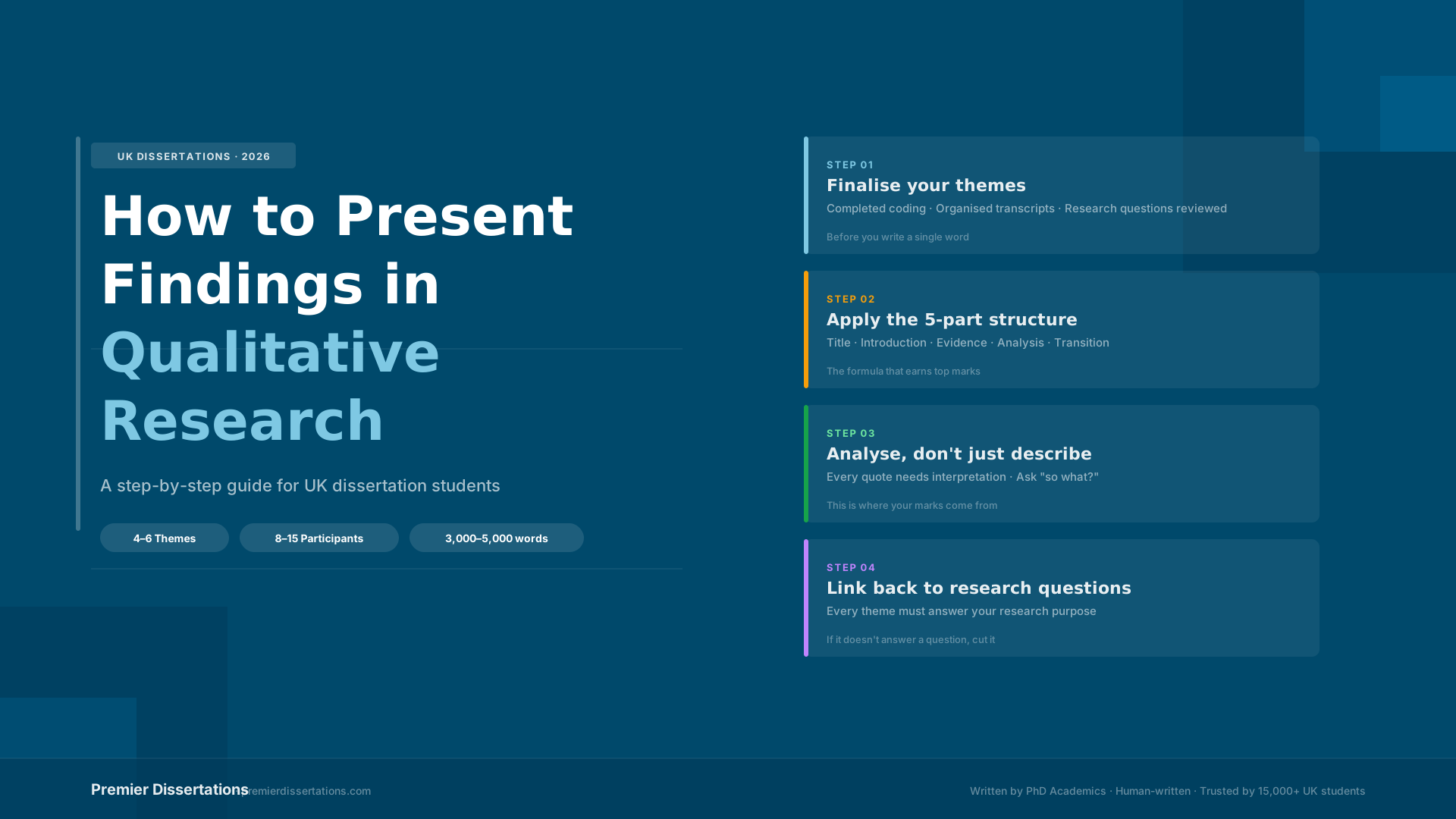
I have seen students collect excellent interview data and still lose marks because their findings chapter lacked structure, interpretation, and clarity. The problem was rarely the research itself. It was the presentation. Let me tell you about a student I worked with at the University of Manchester. She had conducted twelve thoughtful interviews. Her transcripts were rich with insight. She had identified interesting themes. Then she wrote her findings chapter as fifteen pages of participant quotes with two sentences of introduction. No theme names. No analysis. No connection to her research questions. Just quotes. Her supervisor gave her a 2:2 grade for the chapter. She was devastated. We restructured everything using the approach I am about to share with you. Her final dissertation scored a First. The difference was not her data. It was how she presented it. Many students assume qualitative findings simply mean inserting quotes from interviews and briefly describing them. Unfortunately, that approach rarely scores highly at the UK university level. Examiners are not looking for pages of participant quotes. They are looking for interpretation, thematic development, analytical thinking, clear links to research questions, and evidence of critical engagement with your data. A strong qualitative findings chapter shows that you understand not only what participants said, but also why it matters academically. This guide explains exactly how to present qualitative findings in your dissertation. I will show you real examples, structure templates, and the exact approach I have used to help hundreds of UK students improve their marks. For additional guidance from a UK university perspective, Sheffield Hallam University's guide to presenting qualitative data provides useful context on how UK institutions expect findings to be structured. If you are still analysing interview data, coding transcripts, or developing themes, our qualitative analysis help can make the process much easier before you begin writing.
What Examiners Actually Look For Here is what examiners ask themselves while reading qualitative findings. I know because I have been that examiner.
Before You Start Writing I have seen students start writing too early more times than I can count. Do not make this mistake. Before you open a blank document, make sure you already have:
Example of a Strong Theme Presentation
How to Use Participant Quotes Effectively Quotes are evidence. But quotes alone are not analysis. This is the single biggest mistake I see. Weak Quote Usage (What Not To Do)
Why the strong version works: clear theme name, introduction explaining what it means, quotes with participant demographics, substantive analysis explaining what quotes reveal, and a transition linking to the next theme. The difference is night and day. Both examples use similar data. But the second one will get a much higher mark. How to Add Analysis Instead of Description This is where many dissertations lose marks. Let me show you the difference.
Analysis explains why something matters, what patterns reveal, how themes connect, and what underlying meaning exists. Every time you present a quote, ask yourself: "So what? Why does this matter for my research question?" If you cannot answer, you are not analysing yet. Should You Include Literature in Your Findings Chapter? This depends on your university guidelines. Here is the general rule in most UK universities: the findings chapter is where you present your results, and the discussion chapter is where you compare your findings with existing literature. However, some departments allow limited literature references within findings chapters. Always follow your supervisor's guidance. When in doubt, save the literature for Chapter 5. Using Visuals and Thematic Maps Visuals can improve clarity significantly. I encourage students to include at least one visual in their findings chapter.
Example: Theme Summary Table
Themes
Quotes
Analysis
Presentation
Frequently Asked Questions
Final Thought I have supervised more dissertation students than I can count. The ones who succeed with qualitative findings are not the ones with the most interesting data. They are the ones who present their data clearly, analyse it thoughtfully, and connect everything back to their research questions. You have done the hard work of collecting interviews and identifying themes. Do not let poor presentation undo that effort. Take the time to structure your chapter properly. Use the 5-part theme structure I showed you. Analyse your quotes, do not just present them. And please, leave yourself time to revise. The best findings chapters are not written in one sitting. They are written, reviewed, slept on, and rewritten. You can do this. Thousands of students before you have figured it out. And if you get stuck, we are here to help.
Quick Navigation
What Is a Qualitative Findings Chapter? The findings chapter (often Chapter 4) is where you present the results of your qualitative analysis. This chapter explains what themes emerged from your data, what participants revealed, and how patterns appeared across interviews or focus groups. Importantly, the findings chapter is not simply a transcript dump. Its purpose is to organise and interpret your data systematically. Where It Fits in a Dissertation
01What Is a Findings Chapter? 02What Examiners Look For 03Before You Start Writing 04How to Structure Your Chapter 05How to Present Themes 06Using Participant Quotes 07Before and After Example 08Analysis vs Description 09Visuals and Thematic Maps 10Common Mistakes 11Submission Checklist 12Frequently Asked Questions
| Chapter | Purpose |
|---|---|
| Chapter 1 | Introduction |
| Chapter 2 | Literature Review |
| Chapter 3 | Methodology |
| Chapter 4 | Findings / Results |
| Chapter 5 | Discussion |
| Chapter 6 | Conclusion |
Examiner Check 01 Are the themes clear and logically organised? Messy findings chapters immediately weaken credibility. If I cannot follow your structure, I cannot award top marks.
Examiner Check 02 Is there enough evidence? Themes should be supported with participant quotes and examples. One quote per theme is rarely enough.
Examiner Check 03 Is the student analysing the data properly? This is the biggest issue I see. Weak dissertations describe data. Strong dissertations interpret it. The difference is massive.
Examiner Check 04 Does the analysis answer the research questions? Every theme should connect back to the purpose of your study. If a theme does not answer a research question, cut it.
✓Completed coding
✓Finalised themes
✓Organised transcripts
✓Selected strong participant quotes
✓Identified links between themes
✓Reviewed your research questions
If your themes are still vague, your chapter will also feel vague. Take the time to get your analysis right before you write a single word.
If you need help with thematic analysis or coding, our dissertation data collection help can guide you through NVivo and the coding process. How to Structure a Qualitative Findings Chapter There are three common structures used in UK dissertations. Let me walk you through each one.
Structure 01 Theme-by-Theme Structure (Most Recommended) This is the clearest and most examiner-friendly approach. Introduction → Theme 1 (sub-themes) → Theme 2 (sub-themes) → Theme 3 → Summary. Works especially well for thematic analysis, semi-structured interviews, focus groups, and master's dissertations.
Structure 02 Research Question Structure Organise findings according to research questions. Works best when your questions are clearly separated and your themes do not overlap heavily.
Structure 03 Narrative or Chronological Structure Less common. Mainly used in ethnography, narrative inquiry, and longitudinal research. For most students, the theme-by-theme structure is the safest and strongest option.
Struggling to structure your chapter? Our dissertation writing service can help you organise your findings and write a first draft. Get Writing Help
How to Present Themes Properly A strong findings chapter follows a consistent analytical structure. Here is the formula I give all my students. The 5-Part Theme Structure
| Part | Purpose |
|---|---|
| Theme title | Clearly identify the focus |
| Theme introduction | Explain what the theme means |
| Participant evidence | Support findings with quotes |
| Analysis | Interpret what the data reveals |
| Transition | Link to next theme |
Theme 2: Time Pressure and Academic Burnout
Participants consistently described time pressure as one of the main causes of academic stress. Unlike financial stress, which appeared periodically, workload pressure was described as continuous and emotionally exhausting.
"There was never really a point where I felt finished. Even when one deadline ended, another one had already started." (P4)
"I stopped enjoying university completely by the second semester because I constantly felt guilty whenever I took a break." (P9)
These accounts suggest that burnout was not simply linked to the amount of work students received. It was also about the psychological inability to disconnect from academic expectations. Participants described stress as persistent rather than temporary. This sense of ongoing pressure connects directly to the next theme: declining motivation and emotional disengagement.
Why This Structure Works
Participants consistently described time pressure as one of the main causes of academic stress. Unlike financial stress, which appeared periodically, workload pressure was described as continuous and emotionally exhausting.
"There was never really a point where I felt finished. Even when one deadline ended, another one had already started." (P4)
"I stopped enjoying university completely by the second semester because I constantly felt guilty whenever I took a break." (P9)
These accounts suggest that burnout was not simply linked to the amount of work students received. It was also about the psychological inability to disconnect from academic expectations. Participants described stress as persistent rather than temporary. This sense of ongoing pressure connects directly to the next theme: declining motivation and emotional disengagement.
| Element | Why It Matters |
|---|---|
| Clear theme title | Helps readability and signals what is coming |
| Context before quotes | Improves flow and prepares the reader |
| Multiple participant voices | Shows evidence of diversity, not just one person's view |
| Interpretation after quotes | Demonstrates analysis — this is where marks come from |
| Transition sentence | Creates cohesion between themes |
"I felt stressed all the time." (P2) This shows participants experienced stress. ⚠ Weak — this simply repeats what the quote already said. You have added nothing.
Strong Quote Usage (What To Do Instead)
One participant described stress as physically exhausting rather than emotionally temporary: "I felt stressed all the time. Even when I tried to relax, I kept thinking about assignments." (P2)
This reflects how academic pressure extended beyond university tasks and affected participants' ability to disengage mentally from their workload. The participant was not just busy — she was unable to switch off, even during rest time. ✓ Strong — this explains the meaning, significance, and interpretation.
How Many Quotes Should You Use?
This reflects how academic pressure extended beyond university tasks and affected participants' ability to disengage mentally from their workload. The participant was not just busy — she was unable to switch off, even during rest time. ✓ Strong — this explains the meaning, significance, and interpretation.
| Theme Size | Recommended Quotes |
|---|---|
| Small theme | 2–3 quotes |
| Medium theme | 4–6 quotes |
| Large theme | 6–8 quotes |
One powerful quote is often better than five repetitive ones. Choose quotes that best illustrate your point.
Weak vs Strong: A Detailed Before and After Example Let me show you the difference using the same data presented two ways.
✗ Before — Weak (No Analysis, Just Quotes)
Theme: Stress
Many participants mentioned stress. One said, "I felt stressed all the time." Another said: "The pressure was too much." A third participant said: "I could not cope."
This shows that stress was a common experience.
Many participants mentioned stress. One said, "I felt stressed all the time." Another said: "The pressure was too much." A third participant said: "I could not cope."
This shows that stress was a common experience.
✓ After — Strong (Full Analysis)
Theme: The Pervasiveness of Academic Stress
All twelve participants described experiencing academic stress, but the nature of this stress varied significantly between undergraduate and postgraduate students...
"I would lie awake at night thinking about everything I had not done yet. My mind just would not switch off." (P3, Female, Year 2)
These contrasting accounts suggest that stress is not a uniform experience. For undergraduates, stress appeared event-based and acute. For postgraduates, stress felt more like a continuous state.
All twelve participants described experiencing academic stress, but the nature of this stress varied significantly between undergraduate and postgraduate students...
"I would lie awake at night thinking about everything I had not done yet. My mind just would not switch off." (P3, Female, Year 2)
These contrasting accounts suggest that stress is not a uniform experience. For undergraduates, stress appeared event-based and acute. For postgraduates, stress felt more like a continuous state.
✗ Description (Weak)
Participants said they struggled with motivation.
This just tells me what participants said. It does not tell me why it matters.
This just tells me what participants said. It does not tell me why it matters.
✓ Analysis (Strong)
Participants described motivation loss not simply as laziness, but as emotional exhaustion caused by ongoing academic pressure and uncertainty about outcomes. This suggests that interventions focused purely on time management may miss the underlying emotional factors driving disengagement.
| Visual | Purpose |
|---|---|
| Thematic maps | Show relationships between themes |
| Theme summary tables | Simplify complex findings |
| Coding diagrams | Demonstrate analytical process |
| Participant tables | Show demographics |
| Theme | Core Finding |
|---|---|
| Academic Pressure | Students experienced ongoing stress |
| Social Isolation | Participants struggled with belonging |
| Motivation Decline | Emotional exhaustion reduced engagement |
Visuals should support your analysis, not replace it. Always explain what the visual shows in your text.
Common Mistakes Students Make I have marked hundreds of findings chapters. These are the mistakes I see most often.
Presenting quotes without analysis. Quotes are evidence, not findings by themselves. Always explain what each quote reveals.
Creating themes that are too broad. A theme called "Stress" is too vague. A theme called "Persistent Academic Pressure and Emotional Exhaustion" tells me something specific.
Ignoring contradictory data. Not all participants will agree. Strong qualitative analysis acknowledges differences. If one person said the opposite of everyone else, address it. It shows academic honesty.
Writing a descriptive summary instead of analysis. Your role is to interpret meaning, not simply repeat responses. If you find yourself writing "This shows that..." and then restating the quote, stop. Dig deeper.
Using the same participants repeatedly. Use quotes from a broad range of participants where possible. If all your quotes come from Participant 3 and Participant 7, your findings look biased.
Have you made one of these mistakes? Our proofreading and editing service can help you restructure and strengthen your analysis. Get Editing Help
Dissertation Findings Chapter Checklist Use this checklist before you submit. Structure
✓Clear introduction (restating research questions)
✓Logical theme order
✓Smooth transitions between themes
✓Short conclusion or summary at the end
✓4–6 main themes
✓Clear, descriptive theme names (not one-word labels)
✓Each theme connects to a research question
✓Context provided before each quote
✓Quotes from multiple participants (not just one or two)
✓Quotes formatted correctly (short quotes in text, long quotes as block quotes)
✓Interpretation follows each quote (not just restatement)
✓Explanation of why each quote matters
✓Links between themes are clear
✓Contradictory data addressed (if present)
✓Consistent formatting throughout
✓Correct tense used (past tense for what participants said)
✓Clear headings and subheadings
✓Academic tone maintained
For most UK master's dissertations, qualitative findings chapters are typically between 3,000 and 5,000 words. Undergraduate dissertations are usually shorter. Check your department's guidelines.
Most dissertations contain between 4 and 6 main themes. Too many themes can make the analysis feel unfocused. Too few can feel shallow.
Some universities allow limited literature references, while others prefer all comparisons with literature to remain in the discussion chapter. Ask your supervisor.
Most themes use between 2 and 6 participant quotes, depending on complexity and your word count. Quality matters more than quantity.
The findings chapter presents what participants revealed. The discussion chapter explains how those findings relate to existing literature and theory.
A strong findings chapter includes clear themes, analytical interpretation, strong participant evidence, logical structure, and clear links to your research questions.
No. Each quote should be used once, under the theme it best supports. Using the same quote twice makes your analysis look repetitive.
Need Help With Your Findings Chapter? Whether you need NVivo support, a full findings chapter write-up, or expert editing — our team of UK-qualified academics is ready to help.
PhD academics · Human-written · Turnitin and AI report · Trusted by 15,000+ UK students
Last reviewed: May 2026 · This guide reflects best practices for presenting qualitative findings in UK dissertations. Always follow your department's specific guidelines.
Get 3+ Free Wildlife Dissertation Topics within 24 hours?