

Journal Impact Factor Explained: What Counts as Good? (2026-2027)
November 24, 2025
How to Choose the Best Journal for Your Dissertation (2026-2027)
November 24, 2025
🤔 Not sure which journal fits your research? Find your journal, free and instant →
If you're a student, researcher, or academic enthusiast, you've probably wondered whether to access or publish research through open access (OA) journals or subscription-based journals. Both models are widely used in academia, and your choice can affect your research's visibility, citations, funding, and even career trajectory.
This guide explains what open access and subscription journals actually are, the key differences between them, the pros and cons of each, and practical tips for choosing the right route for your research.
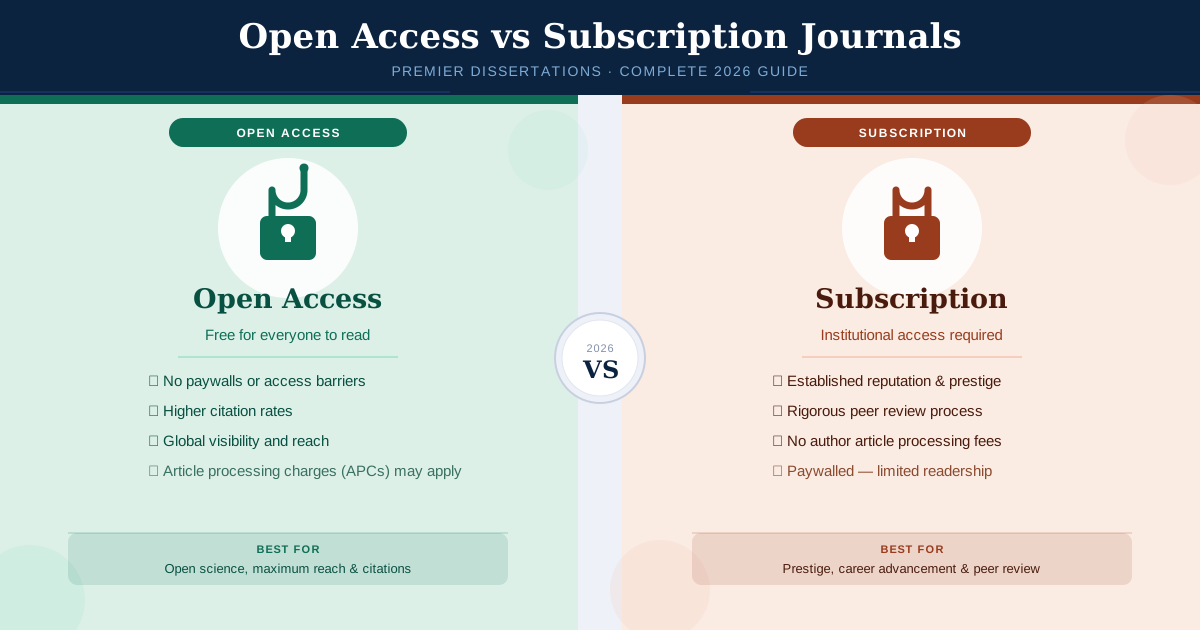
Quick insight: Open access journals make articles free for everyone to read, while subscription journals restrict access to paying institutions and subscribers. OA often boosts visibility and citations, whereas subscription titles may carry more prestige and longer-established reputations. The best choice depends on your goals, field, and funding.
What Are Open Access Journals?
Open access journals make all their articles freely available online. Anyone can read the content without a subscription, login, or pay-per-view fee.
- Free to read for everyone, including students, independent researchers, and the public.
- Often funded through article processing charges (APCs) paid by authors, institutions, or funders.
- Typically faster dissemination, with no paywalls limiting who can find and cite the work.
Students often rely on OA journals for literature reviews, since full articles are accessible instantly without inter-library loan delays. You can check reputable OA sources directly, including the Directory of Open Access Journals, Springer Open, and Wiley Open Access.
Also worth knowing, authors publishing OA typically retain copyright over their work under a Creative Commons licence, whereas subscription journals often require authors to transfer copyright to the publisher.
What Are Subscription Journals?
Subscription journals require payment or institutional access to read articles. Universities and libraries typically pay annual fees so students and staff can access the content.
- Paywalls mean only subscribers or affiliated institutions can read full articles.
- Many carry long-standing reputations within their fields.
- They frequently report higher impact factors, depending on the discipline and journal tier.
You can check journal metrics directly via Scopus or PubMed before deciding where to submit or which sources to cite.
Open Access vs Subscription: Key Differences
| Feature | Open Access | Subscription |
|---|---|---|
| Accessibility | Free for everyone to read | Requires subscription or institutional access |
| Cost for authors | Usually charges APCs | Typically no APCs, costs covered by subscriptions |
| Copyright | Authors usually retain copyright (CC licence) | Often transferred to the publisher |
| Visibility | Shared and accessed widely, instantly | Limited to subscribers and affiliated institutions |
| Impact and reputation | Variable, some top-tier, others newer or niche | Often long-established, higher impact factors in some fields |
Research published in BMC Medicine (Björk & Solomon, 2012) found that open-access journals indexed in Web of Science and Scopus are "approaching the same scientific impact and quality as subscription journals," particularly in biomedicine and for APC-funded OA journals. The historical citation gap has largely closed for indexed OA titles.
Pros and Cons of Each Model
Open Access Journals
Pros: wider audience and potentially higher citation rates, easy access for students and the public, encourages transparency and knowledge sharing.
Cons: APCs can be expensive without funding support, some OA journals carry less prestige in certain fields, and predatory OA journals exist, so quality and indexing need checking carefully.
Subscription Journals
Pros: prestigious and well established in many disciplines, often higher impact factors and rigorous peer review, stable long-term archives.
Cons: access is limited without a subscription, dissemination is slower for readers outside subscribing institutions, and it can be genuinely costly for independent researchers or students without access.
A lower-ranked OA journal can still contain valuable niche insight for your specific topic. The real skill is balancing visibility (OA) against credibility and fit, which subscription titles are often associated with.
Gold OA, Green OA, and Bronze OA
Within open access publishing, you'll see three distinct categories, and mixing them up is a common source of confusion:
| Type | Description | Accessibility |
|---|---|---|
| Gold OA | The final published article is immediately free on the journal website, usually supported by an APC | Instant, for all readers |
| Green OA | The author self-archives a pre-print or post-print in an institutional or subject repository, sometimes after an embargo | Free later, often after the embargo ends |
| Bronze OA | Freely readable on the publisher's site but without any formal open licence | Free to read now, but access and reuse rights aren't guaranteed long term |
Bronze OA is worth knowing about specifically because it can look identical to Gold OA on the page, freely readable right now, but without a formal licence, that access can be withdrawn or changed later, and you don't have the same reuse rights. If you're relying on an article for your dissertation, check its actual licence, not just whether it currently appears free.
Subscribe-to-Open: A Newer Model
Subscribe-to-Open (S2O) is a growing alternative model where a publisher makes a journal fully open access for the year if its existing subscribers keep paying at the usual rate, no author fees, no reader paywalls. Several established publishers have adopted it, including the Royal Society, De Gruyter, Annual Reviews, and the American Physiological Society.
It's not universally successful, though, and it's worth being realistic about that. AIP Publishing concluded its own S2O pilot in 2025 after finding it didn't provide a clear path to scale, even though it had met its funding targets. S2O is a genuine, growing option, but it's one model among several, not a settled industry standard yet.
Funder Mandates and Who Pays for Open Access
If APCs are a barrier, it's worth checking whether your funding source already covers them. Major research funders, including the NIH, the Wellcome Trust, and the European Research Council, have provisions to cover open access publication costs as part of research grants. In Europe, Plan S requires immediate open access for publicly funded research, which has accelerated institutional support for APC payments.
Many UK universities also have read-and-publish agreements with major publishers that cover or discount APCs for their researchers and students, worth checking with your library before assuming you'll need to pay out of pocket.
📋 Before You Submit to Any Journal
Journals desk reject papers for plagiarism and AI generated content before they even reach peer review. Check your manuscript is clean before you submit.
Free Plagiarism Check Free AI DetectorHow to Choose Between Open Access and Subscription Journals
- Research visibility: OA journals make your work accessible worldwide, including to researchers without institutional access.
- Prestige and career goals: some subscription titles carry more weight for tenure, promotion, or competitive grants.
- Funding availability: check whether your institution, supervisor, or grant covers APCs before ruling OA out.
- Field norms: life sciences and health research increasingly favour OA, while humanities and some social sciences still rely heavily on subscription models.
- As a student: combining OA for accessibility with subscription journals for credibility is a reasonable default approach for most literature reviews.
If you need help preparing your manuscript for either model, our Scopus manuscript preparation service ensures your paper meets the formatting and quality standards reputable journals expect. Or try our free journal matcher to get a realistic starting point.
Ready to Submit, But Not Sure Your Manuscript Is?
Most journal rejections happen at desk review, not peer review. Poor formatting, a weak abstract, or language issues get you rejected before anyone reads your research.
WhatsApp Us for Manuscript Support →Or visit: Scopus Publication Support → · Find Your Journal →
Tell Us Where You Want to Publish. We Handle Everything Else.
You don't need to become an expert in access models and licensing. That's what our team is here for.
Journal selection →
We help you weigh OA versus subscription based on your field, budget, and career goals.
Thesis-to-journal conversion →
Condensing and reformatting your dissertation into a submission-ready manuscript.
Pre-submission review →
A second, expert pair of eyes before you submit.
Plagiarism and AI screening →
A full integrity report before submission, from £2.99.
Submission support →
Cover letters, portal formatting, and tracking through to a decision.
Journal acceptance can never be guaranteed by any service. The decision belongs to the journal's editors and reviewers.
Trusted by 15,000+ UK and international students/researchers
What Students Say About Our Journal and Access Support
Verified feedback from students who used our journal guidance and manuscript preparation services.













Last reviewed: August 2026 · Reviewed by Katherine Alexander, PhD, UK Academic Editor at Premier Dissertations
Get a Free Journal and Source Check
Share your reading list or draft chapter for a brief review of journal quality, access model, and credibility. Response within 24 to 48 hours.
Ethical support · Turnitin-safe · COPE-aligned · No ghostwriting
Frequently Asked Questions
⭐ Trusted by UK students · Since 2010 · Reviewed by UK Academic Editors
Request Free Review
Get a quick check of your appendices (labels, cross-references, anonymisation, layout).
Turnitin-safe · GDPR compliant · Ethical academic editing only. Need a fast reply? Chat on WhatsApp