


Climate Justice & Law Dissertation Topics for 2026
November 24, 2025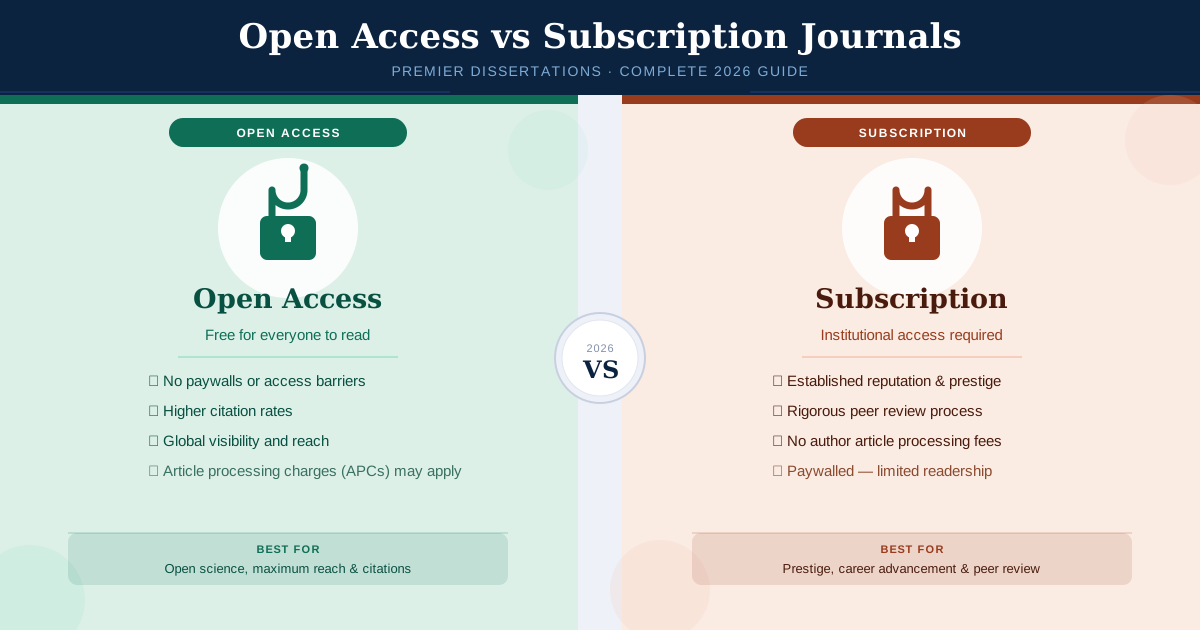
Open Access vs Subscription Journals: Which Should You Choose? (2026-2027)
November 24, 2025

Short answer: a good impact factor is one that fits your field and career stage.
In some disciplines, an impact factor of 3 is excellent. In others, 10 is the baseline. The number only means something when compared to journals in the same subject area.
I am Katherine Alexander, PhD, UK Academic Editor at Premier Dissertations. I have helped thousands of students and researchers understand journal metrics so they can make smarter publishing decisions. This guide explains what a journal impact factor actually measures, what counts as "good" in 2026-2027, and how to avoid the common confusions around platform-level names like ScienceDirect and SAGE.
If you already have a target journal in mind, use our journal matching tool to check its fit for your research.
What is a Journal Impact Factor?
The Journal Impact Factor (JIF) is a metric calculated by Clarivate Analytics for journals indexed in the Web of Science. It measures the average number of citations received in a given year by articles published in the journal during the previous two years.
In simple terms, a journal with an impact factor of 5 means that, on average, articles published in that journal two years ago were cited five times last year.
The impact factor is widely used as a proxy for journal influence, but it is not a perfect measure. It does not tell you whether an individual article will be cited, and it varies significantly between disciplines.
How is the Impact Factor Calculated?
The formula is straightforward:
Impact Factor = Citations in Year 3 to articles published in Years 1 and 2 ÷ Total citable articles published in Years 1 and 2
For example, the 2025 impact factor for a journal is calculated using citations received in 2025 to articles published in 2023 and 2024.
Only citable items such as research articles, reviews, and conference papers are counted. Editorials, letters, and news items are usually excluded from the denominator, which is one reason the metric can be manipulated.
What Counts as a Good Impact Factor in 2026-2027?
There is no single number that is universally good. The answer depends entirely on your field.
Arts, Humanities, and Social Sciences
An impact factor between 1 and 3 is often considered respectable. Many leading journals in these fields do not have impact factors above 5. Review articles and highly specialised journals can push higher, but a score of 2 to 4 is generally strong.
Science, Technology, Engineering, and Medicine
Impact factors tend to be higher. A score of 5 to 10 is solid in many biological and physical science fields. Top multidisciplinary journals like Nature and Science regularly exceed 30, and medical journals like The Lancet can reach above 50.
Business and Management
A score of 3 to 6 is typical for well-regarded journals. The very top journals, such as the Academy of Management Journal, can exceed 10, but those are outliers. Most good, credible journals in this field sit between 2 and 5.
The best approach is to compare a journal's impact factor against others in the same subject category using the Journal Citation Reports (JCR) quartile ranking. A Q1 journal is in the top 25% of its category, and that is a stronger signal of quality than a raw number alone.
Impact Factors by Major Publisher (2026-2027)
Publishers do not have a single impact factor. Each journal they publish has its own score. However, the following ranges give a realistic sense of where journals from major publishers typically sit in 2026-2027.
| Publisher | Typical Journal Impact Factor Range |
|---|---|
| Elsevier | Varies widely, from under 1 in specialist titles to over 50 in flagship journals like The Lancet. |
| Springer Nature | Varies widely, from under 1 in specialist titles to over 50 in journals like Nature. |
| Wiley | Varies widely, from under 1 in niche journals to over 25 in top materials and medical titles. |
| SAGE Publications | Varies widely, from under 1 in some social science titles to over 10 in leading management journals. |
| Taylor & Francis | Varies widely, from under 1 in humanities titles to over 15 in select science and medical journals. |
Always check the specific journal's current impact factor in JCR or on the journal's official website. These ranges shift annually.
Does ScienceDirect Have an Impact Factor?
No, ScienceDirect does not have its own impact factor. ScienceDirect is Elsevier's platform for hosting and accessing journal articles and book chapters. It is not a single journal, so it cannot have one impact factor.
Each individual journal hosted on ScienceDirect has its own impact factor. For example, The Lancet, published by Elsevier and available on ScienceDirect, is one of the highest-impact journals in medicine, with an impact factor that has recently ranged from roughly 88 to over 100 depending on the JCR release year. Journal of Business Research, also Elsevier and on ScienceDirect, usually sits between 8 and 12. The platform itself has no score.
If you see a search result asking for "ScienceDirect impact factor," what the user actually needs is the impact factor of a specific journal they found on ScienceDirect. Always check the journal title, not the platform name.
Does SAGE / SAGE Publications Have an Impact Factor?
No, SAGE Publications does not have a single impact factor. SAGE is a major academic publisher that produces hundreds of journals across the social sciences, humanities, health, and business. Each of those journals has its own impact factor.
For example, Journal of Management, published by SAGE, has an impact factor typically around 9 to 11. Sage Open, also from SAGE, is a broad open-access journal with an impact factor usually between 2.0 and 2.5, depending on the release year.
The correct question is not "What is SAGE's impact factor?" but "What is the impact factor of the specific SAGE journal I am considering?"
Frequently Asked Questions
What is a good impact factor for a journal?
A good impact factor depends on the field. In social sciences, 2 to 4 is often strong. In biomedical fields, 5 to 10 may be expected. Always compare against journals in the same subject category.
Does ScienceDirect have an impact factor?
No. ScienceDirect is a hosting platform, not a journal. Individual journals on ScienceDirect each have their own impact factor.
Does SAGE have an impact factor?
No. SAGE is a publisher. Its individual journals, such as Journal of Management or Sage Open, each have their own impact factor.
Is an impact factor of 5 good?
In many social science and humanities fields, yes. In some biomedical and physical science fields, 5 may be average or below average. Context matters.
How often is the impact factor updated?
Clarivate releases the Journal Citation Reports annually, usually in June. The 2026 release covers 2025 data.
Where can I find a journal's current impact factor?
Use Clarivate's Journal Citation Reports, the journal's official website, or the publisher's journal page. Avoid third-party aggregator sites that may show outdated or conflicting numbers.
Tell Us Where You Want to Publish
If you are ready to move forward, my team and I can help you choose the right journal and prepare your dissertation for submission.
We support you at every stage:
Journal selection →
A free, personalised shortlist based on your field and priorities.
Manuscript restructuring →
Condensing and reformatting your dissertation into a submission-ready manuscript.
Full publishing support →
Formatting, citation accuracy, and submission guidance.
This is not a guarantee of acceptance. No ethical service can promise that. What we offer is honest, expert support that improves your chances and reduces stress.
To get started, tell us where you want to publish or ask for a journal recommendation. You can reach us via WhatsApp or our order form.
Trusted by 15,000+ UK and international students/researchers
What Students Say About Our Publishing Support
Feedback from students who have used our editing and journal preparation support.
Last reviewed: August 2026 · Reviewed by Katherine Alexander, PhD, UK Academic Editor
⭐ Trusted by UK students · Since 2010 · Reviewed by UK Academic Editors
Request Free Review
Get a quick check of your appendices (labels, cross-references, anonymisation, layout).
Turnitin-safe · GDPR compliant · Ethical academic editing only. Need a fast reply? Chat on WhatsApp