


Elsevier vs Taylor and Francis: Which Publisher Is Better for Your Research
November 17, 2025
Complete Guide For Students To Achieve Academic Success
November 17, 2025

🤔 Not sure which journal fits your dissertation? Find your journal, free and instant →
You have completed your dissertation. Now comes the real challenge: getting it published. If you have searched for Elsevier journal acceptance rates or Scopus-indexed journals for dissertations, you have probably noticed how confusing the advice can get. Everyone says submit to Scopus journals, but few explain which ones are actually suitable for dissertation-based research right now. This guide breaks down the facts, realistic timelines, and the reasoning behind them, so you can make an informed decision between Elsevier, MDPI, Springer, and other Scopus-indexed publishers.
Written by Katherine Alexander, PhD, UK Academic Editor at Premier Dissertations. Updated August 2026. 15,000+ researchers served.
Quick insight: For dissertation-based papers, aim for Scopus-indexed journals with realistic acceptance rates and transparent peer review. Elsevier, MDPI, and Springer all publish suitable outlets. The right choice depends on your field, timeline, and credibility goals, not just the publisher's name.
See also: how to publish in a Scopus journal · professional Scopus manuscript preparation · what it costs to publish
What Is the Acceptance Rate for Results in Engineering?
Results in Engineering is a gold open-access engineering journal published by Elsevier. It is indexed in Scopus and Web of Science, and many researchers place it in Q1 or Q2 depending on the specific ranking source and engineering subfield. Its impact factor has recently ranged from roughly 9 to 10.6.
Elsevier does not publish an official acceptance rate for this specific journal. Third-party websites often show conflicting figures, which is why I do not quote a single number here. If you want the most current information, check the journal's official page on ScienceDirect or search for it directly on Scopus. Those two sources are far more reliable than aggregator sites.
The Article Processing Charge (APC) for Results in Engineering is currently around $2,160, but always confirm on the journal's own author guidelines page before submitting, because APC figures change.
What Journal Acceptance Rates Actually Show
Before comparing specific journals, it helps to understand what an acceptance rate actually tells you. It is simply the percentage of submitted papers that are accepted after peer review, and it varies enormously by field, journal age, and reputation.
For a full breakdown of typical acceptance rate ranges and what they mean for your publishing strategy, see my separate guide on journal acceptance rates. This page stays focused on the question that matters most for dissertation-based papers: which tier and publisher gives your work the best realistic chance.
When weighing Elsevier against other Scopus-indexed publishers, focus less on prestige alone and more on acceptance trends in your specific field, indexing status across Scopus, Web of Science, or PubMed, and peer review quality and turnaround time. A well-matched Q2 journal in your exact subfield will usually serve your dissertation better than a prestigious but poorly-fitted Q1 journal that rejects you six months later.
Elsevier: Broad Coverage, Established Reputation
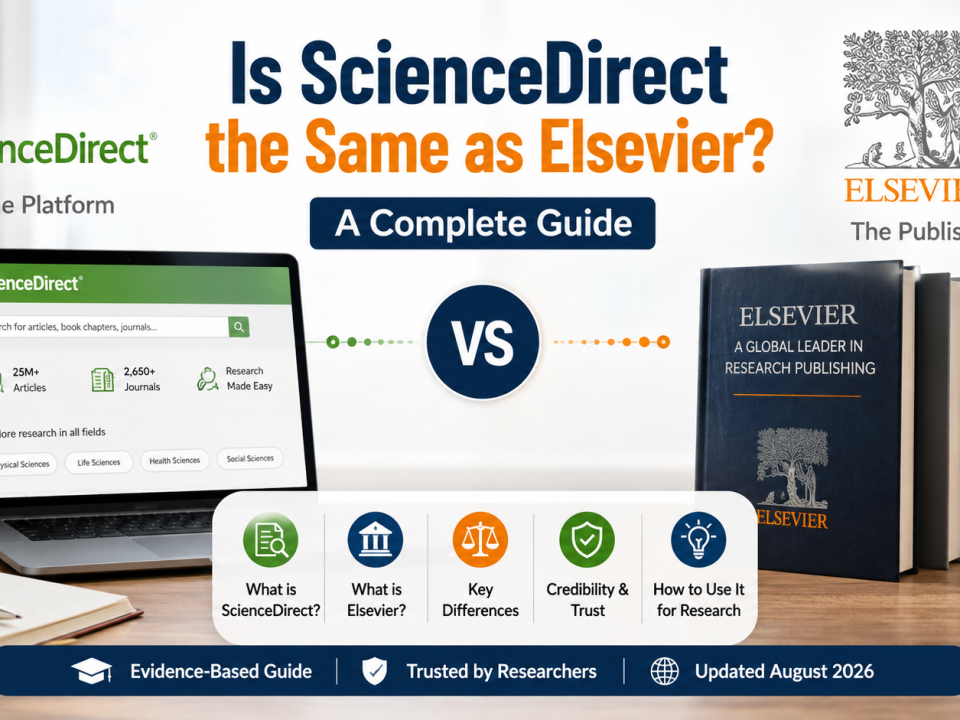
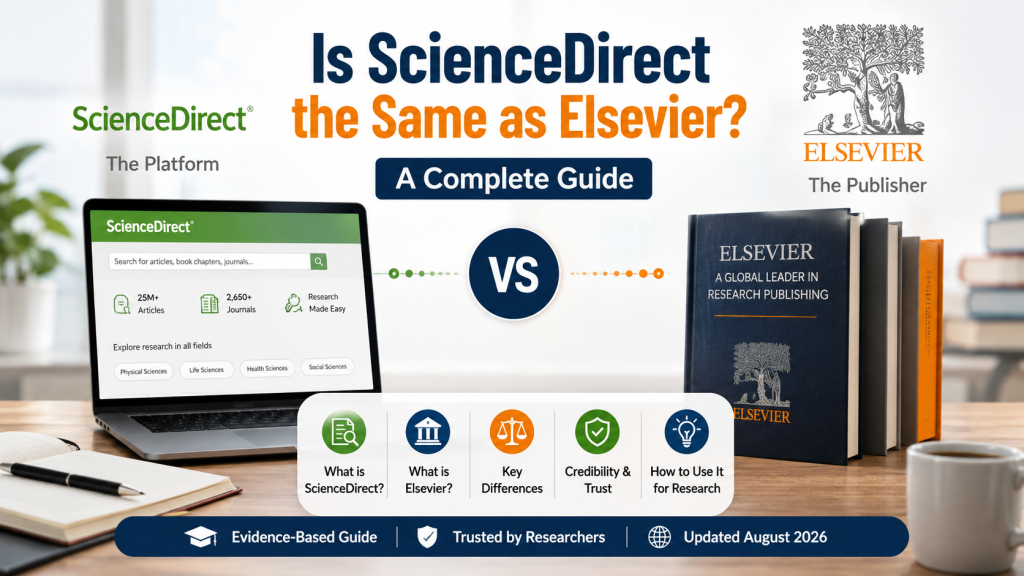
Elsevier publishes thousands of journals across nearly every discipline, all indexed through ScienceDirect and Scopus, which it also owns. For dissertation-based work, Elsevier's mid-tier and specialist journals tend to be more realistic first targets than its flagship titles, which are highly competitive.
For a detailed comparison against other publishers, see my guides on Elsevier vs MDPI and Elsevier vs Springer.
MDPI: Faster Review, Open Access
MDPI journals are fully open access and known for comparatively fast peer review, often appealing to students working against a graduation or funding deadline. Quality varies genuinely by individual journal rather than by MDPI as a whole, so check each specific title's indexing and editorial board before submitting. My full evidence-based assessment of MDPI's reliability covers this in detail.
Springer: Strong for STEM and Social Sciences
Springer Nature covers a wide range of fields, with particularly strong coverage in STEM and social sciences. Review timelines tend to run longer than MDPI's, but its journals often carry more established reputations within specific academic communities. For a side-by-side comparison, see my guide on MDPI vs Springer.
Choosing the Right Tier for a Dissertation-Based Paper
First-time authors converting a dissertation into a journal article most often see success with Q2 to Q3 journals. This is not a compromise, it is a strategic choice. A well-matched mid-tier journal with genuine readership in your field will usually get your work seen, cited, and built upon faster than an extremely selective journal that rejects you after a long wait.
A quick self-check before you commit to a journal:
- Does the journal's stated scope genuinely match your research topic?
- Is it currently indexed in Scopus? Verify directly on the official Scopus Source List, not the journal's own claim.
- Does your paper match its formatting and submission guidelines?
- Is the typical review timeline compatible with your deadline?
If your answer is yes to most of these, you have likely found a suitable journal. If you want a faster, more personalised starting point, our free journal matcher asks a few quick questions and gives you a realistic tier and publisher shortlist based on your actual field and priorities.
Common Mistakes That Cause Delays
Many students face unnecessary delays because of avoidable errors. Watch out for the following:
- Submitting to predatory journals
- Journals promising fast publication within 24 to 48 hours, a reliable warning sign, not a genuine benefit
- Submitting without following the journal's formatting guidelines
- Choosing a journal unrelated to your actual field
- Ignoring APC costs or hidden fees until after acceptance
- Picking a low-quality publication purely to publish quickly
If a journal guarantees acceptance without genuine peer review, that is not a shortcut worth taking. My guide to guaranteed journal publication scams explains exactly why, and how to spot the warning signs before you submit anything.
Tell Us Where You Want to Publish. We Handle Everything Else.
You do not need to become an expert in academic publishing. That is what my team is here for. Every step above, from journal selection to final submission, is something we can take off your plate.
Journal selection →
We match your dissertation to a genuinely suitable Scopus-indexed journal, not just the biggest name.
Thesis-to-journal conversion →
Condensing, restructuring, and reformatting your dissertation into a submission-ready manuscript.
Pre-submission review →
A second, expert pair of eyes before you submit, catching what causes most desk rejections.
Plagiarism and AI screening →
A full integrity report before submission, from £2.99, so there are no surprises later.
Submission support →
Cover letters, portal formatting, and tracking your submission through to a decision.
Reviewer response and resubmission →
If revisions are requested, we help you build a clear, professional response.
Journal acceptance can never be guaranteed by any service. The decision belongs to the journal's editors and reviewers. What we guarantee is that your submission is prepared to the highest standard possible.
Trusted by 15,000+ UK and international researchers
What Researchers Say About Our Scopus Support
Verified feedback from researchers who used our journal selection, manuscript preparation, and Scopus submission support.
Last reviewed: August 2026 · Reviewed by Katherine Alexander, PhD, UK Academic Editor
Get a Free Manuscript Review
Share your draft or thesis chapter for a brief review of journal fit, structure, and submission readiness. Response within 24 to 48 hours from our academic editorial team.
Ethical support · Turnitin-safe · COPE-aligned · No ghostwriting
Frequently Asked Questions
Final Thought
Finding the right Scopus journal for your dissertation is not just a technical step, it is a strategic decision that shapes how your research is seen, cited, and built upon. Take the time to match your work properly rather than chasing the biggest publisher name, and verify every claim about a journal directly rather than trusting the journal's own marketing.
If you would like help getting this right the first time, my team works with researchers through the full process, from journal selection to submission and beyond.
⭐ Trusted by UK students · Since 2010 · Reviewed by UK Academic Editors
Request Free Review
Get a quick check of your appendices (labels, cross-references, anonymisation, layout).
Turnitin-safe · GDPR compliant · Ethical academic editing only. Need a fast reply? Chat on WhatsApp