

Experimental Research Dissertation: Experimental vs Quasi-Experimental Methods Explained (2026 Guide)
April 27, 2026
How to Get Survey Responses for Your Thesis (15 Proven Ways + Real Examples) – 2026 Guide
April 30, 2026
Last Updated: September 2026 · Academic Year 2026-2027
Every week, thousands of UK students ask the same question: what AI score is safe for a dissertation? And every week, dozens of websites answer with a number, "keep it under 20%," and leave it there.
The problem is that answer is incomplete. For many students, acting on it alone has led to failed submissions and academic misconduct hearings they never expected.
This guide explains what Turnitin's AI score actually means, what the thresholds really are, why the same score can be safe at one university and a serious problem at another. And most importantly, how to know exactly where you stand before your supervisor sees your report.
What Is a Turnitin AI Score, Actually?
Before we talk about safe percentages, it is important to understand what the number is measuring, because most students get this wrong.
Turnitin's AI score is not a verdict. It is a probability.
When Turnitin scans your dissertation, it runs a statistical analysis of your writing patterns — sentence construction, rhythm, predictability of word choices, syntactic regularity. It then produces a score representing how likely it is that the flagged segments were written by an AI tool rather than a human.
A score of 40%, for example, does not mean 40% of your dissertation was written by AI. It means Turnitin's algorithm detected patterns in that proportion of your writing that it classifies as statistically AI-like.
This distinction matters enormously because human writers, especially non-native English speakers, students writing in a formal academic register, or those working in highly structured disciplines like law or the sciences, can produce writing that triggers AI flags without ever having used an AI tool.
⚠️ Turnitin itself acknowledges a false positive rate of approximately 4%. That means for every 100 completely human-written dissertations scanned, roughly four will receive an AI flag. This is not a flaw that will be patched — it is an inherent limitation of probabilistic detection.
What AI Score Is Considered Safe for a Dissertation?
Here is a general framework used across UK universities, based on how most academic integrity policies are applied in practice.
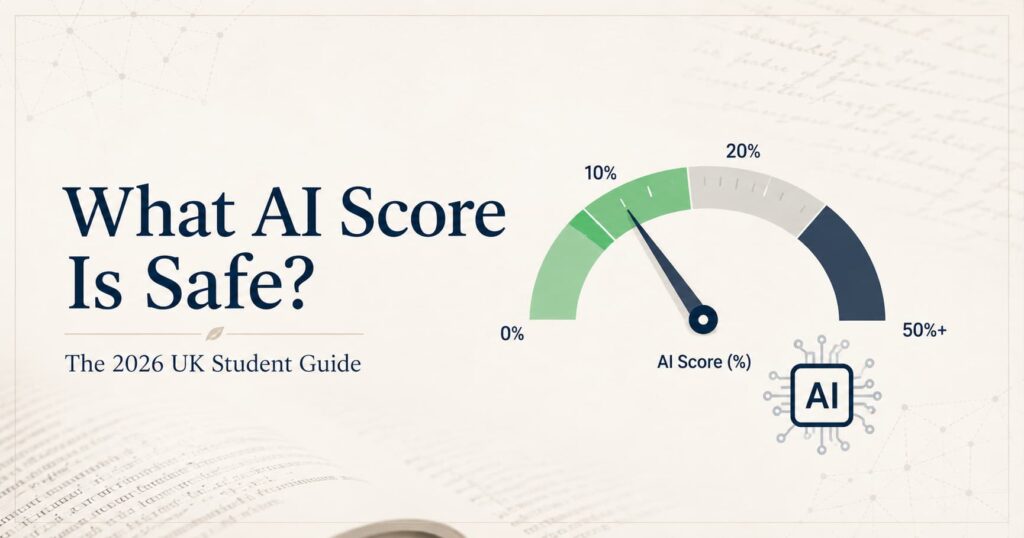
Under 10%
Very low risk: passes without issue at almost all universities.
10-20%
Low to moderate risk: acceptable at most institutions; check your policy.
20-40%
Moderate risk: review likely, depends on context and department.
Above 40%
High risk: formal review triggered at most UK universities.
Above 60%
Very high risk: formal process almost certain, evidence required.
Why the "Safe Number" Varies by University
Here is what most guides do not tell you: there is no single universal threshold. In fact, universities themselves cannot agree on how to handle AI detection scores.
🏛️ Imperial College London
Imperial has a Turnitin site license but does not use AI detection university-wide. Each department decides independently — meaning your experience can vary by faculty.
📜 UCL
UCL has shifted from prohibiting AI to encouraging "responsible use" with transparency and disclosure — but maintains zero tolerance for undeclared AI use.
🇦🇺 Curtin University (Australia)
Disabling Turnitin AI detection entirely from January 2026, citing it as "a trust-building step" with students.
🏫 Russell Group Universities
Some have zero-tolerance policies where any score above 10% warrants investigation. Others rely on tutor discretion.
Postgraduate and PhD submissions are typically held to a stricter standard than undergraduate work. This variability is why the question "what percentage is safe?" does not have a clean answer — it depends on your specific university, your department, your degree level, and how your submission is reviewed.
What Makes the Same Score More or Less Dangerous
📍 Where the AI flags appear
A 25% score concentrated in your literature review is less serious than the same score spread across your methodology and conclusions.
📚 Your subject area
Technical disciplines like medicine, engineering, and law use formal language that detectors misinterpret as AI-generated.
📝 Your declared AI use
If you honestly declared AI use for drafting, your position is very different from a student who declared none.
🌍 Your first language
Non-native English speakers are disproportionately flagged. 64% of students report stress after being falsely accused of AI use. Some students now intentionally add errors to avoid flags — a system where competent writing is treated as suspicious.
The One Thing Most Students Do Not Know
🚨 You cannot see your own Turnitin AI score.
Students do not have access to Turnitin's AI detection results. The AI score is visible only to your tutor or academic integrity team. Students report finding out about a misconduct investigation without being told which report or percentage triggered it — leaving them to defend their work without knowing what they're defending it against. This is the gap that leaves students exposed: you submit, you wait, and only then do you find out if your writing triggered a flag that could affect your entire degree.
What to Expect in 2027
AI detection is evolving rapidly. Here is what the data suggests will matter most by 2027:
📋 Documenting your writing process
Turnitin is shifting from pure detection to process visibility. By 2027, students will be expected to show draft histories as proof of original work.
🔍 AI bypasser detection
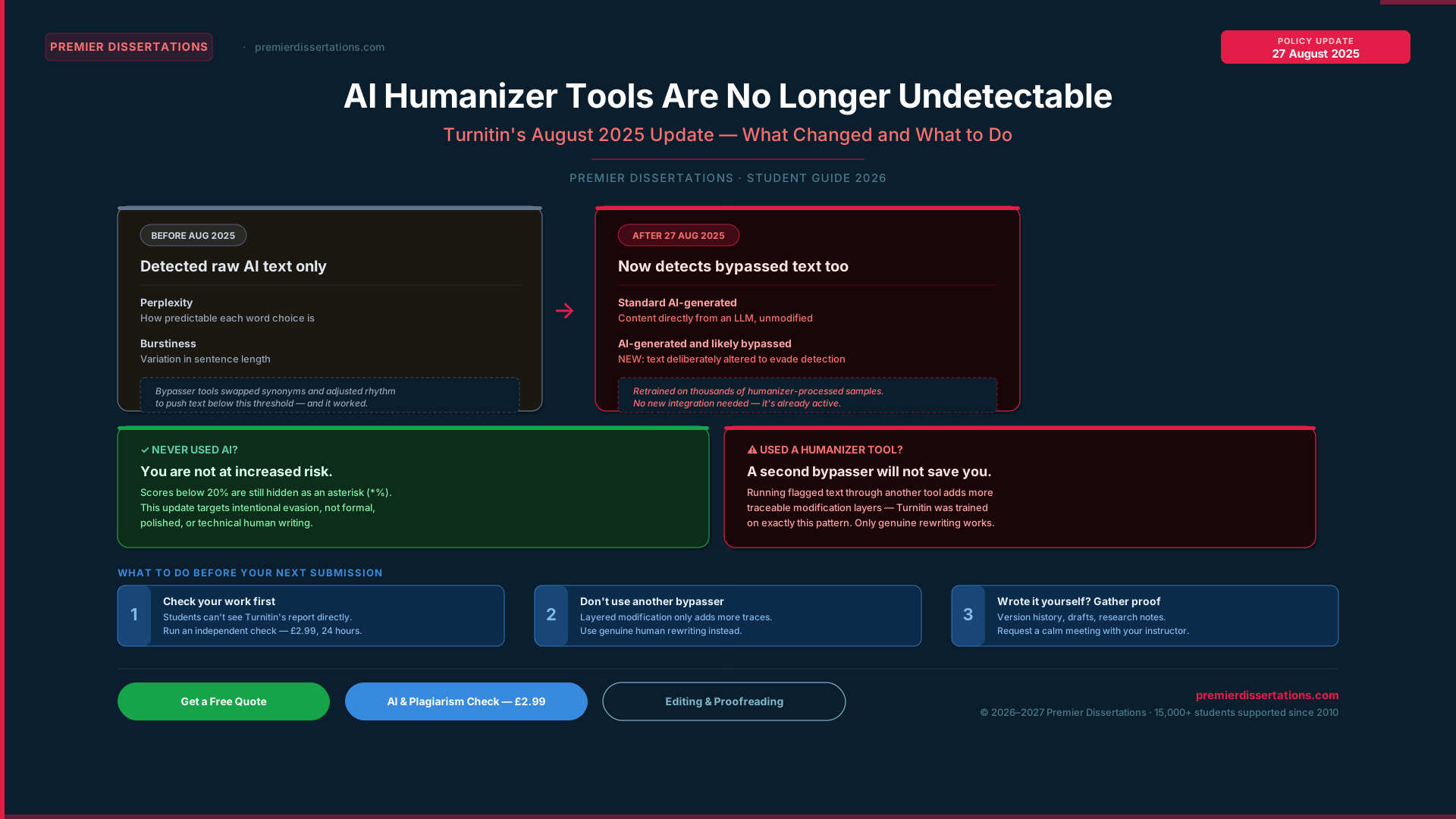
Turnitin launched bypasser detection in August 2025 specifically to catch AI-humanised text. Automated humanisers will become increasingly unreliable.
🏛️ Split university policies
With Curtin already disabling AI detection, more institutions may follow. Knowing your specific university's stance will be essential.
📝 AI declaration requirements
With HEPI's 2025 survey showing 92% of UK university students now using AI tools, declaration requirements will be standard by 2027. How you declare AI use will matter as much as your score.
The direction is clear: universities are moving away from relying solely on automated scores and toward a more holistic assessment of academic integrity. Knowing your score before submitting — and having evidence of your writing process — will give you the strongest possible position.
How to Check Your AI Score Before Submitting
Independent AI-detection and similarity-checking services now exist that mirror the same scanning technology universities use, allowing students to review their AI and similarity scores privately, before their official submission is reviewed.
These tools typically break results down section-by-section rather than giving a single overall score, which matters because where a flag appears in your dissertation often affects the outcome as much as the number itself.
Premier Dissertations' Premier Check (£2.99) delivers a full Turnitin-style AI and similarity report, broken down section by section, without uploading the document to any student repository.
✅ AI detection score, by section
✅ Similarity % with matched sources
✅ Segment-by-segment breakdown
✅ Same format your university sees
If a check comes back higher than expected, the flagged sections can usually be addressed through careful manual rewriting, rather than relying on automated "humanising" tools, which recent Turnitin updates have specifically started detecting.
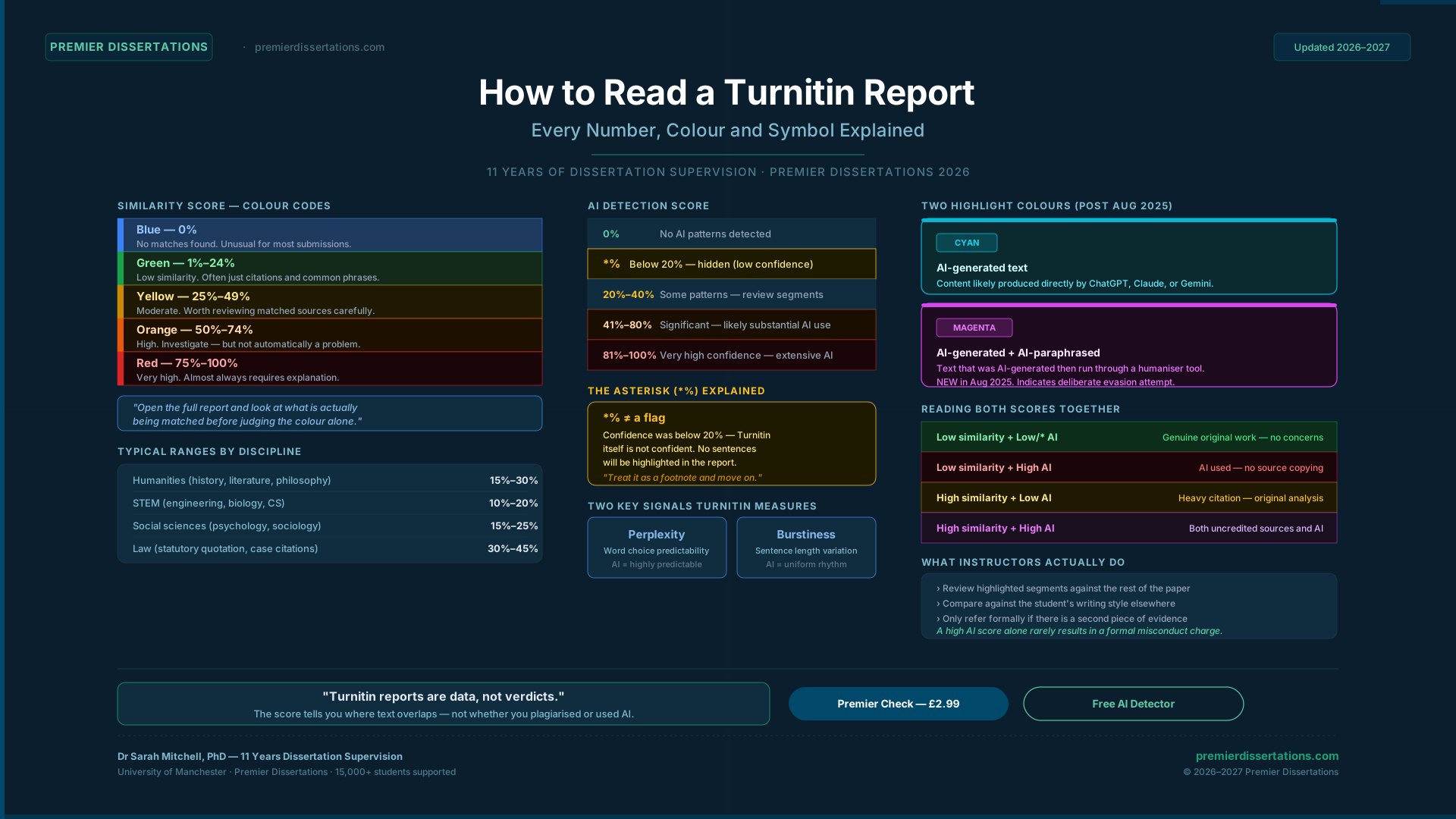
Quick Reference: AI Score Guide for UK Dissertations
Frequently Asked Questions
What is a safe AI score for a dissertation UK? +
Is a 20% AI score bad for a dissertation? +
Can Turnitin's AI detection be wrong? +
What happens if my dissertation has a high AI score? +
How can I check my AI score privately before submitting? +
We Can Help
If your dissertation has already been flagged, or you want to check before you submit, our UK academic editors can review the affected sections and rewrite them properly by hand, rather than running another automated pass. Every check includes a full report, similarity score, AI detection score, and a section-by-section breakdown — the same information your university sees.
We aim to reduce your AI score to a level your university will accept. While we don't guarantee a specific percentage — because Turnitin's algorithm is beyond our control — our editors have a proven track record of significantly reducing AI flags. Every rewrite is backed by our quality-assured or money-back guarantee.
Our UK academic editors can also provide full dissertation proofreading and editing, or start with a free dissertation review if you're not sure what level of help you need.
Close to a deadline and need this sorted fast? Message our team on WhatsApp and we'll tell you honestly what's possible before you pay for anything.
⭐ Rated Excellent by UK Students · Reviewed by UK Academic Editors · Established 2010
Request a Free Plagiarism Removal Review
Upload your flagged document or describe your concerns, and a UK academic editor will review your work and explain how we can reduce your similarity score. (Typically responds within an hour.)
💬 Need urgent help? Chat on WhatsApp (replies in seconds).
UK-reviewed · 100% confidential · Ethical academic editing only · No ghostwriting
🕒 Average response time: under 60 minutes · Feedback tailored to your study level (Undergraduate, Masters, PhD)
What Our Students Say
"Premier Dissertations helped me get my Turnitin score down to a level I was comfortable submitting. The editor didn't just swap words — they clearly read my research and rewrote the flagged sections properly. Submitted with confidence."
Ali H. — MBA Student ✓ WhatsApp Verified
"They provided a full dissertation package, including a Turnitin report. The plagiarism score was 3%, and all references were properly cited. I could submit with full confidence knowing nothing was flagged."
Tom S. — Verified Student ✓ WhatsApp Verified
📋 Read 57+ verified reviews on Trustindex →
Summary
A safe AI score depends on your university, your department, your subject area, and where the flags appear, not just the number itself. Under 20% is low risk at most UK institutions, but that figure is not universal.
Do not guess. The only way to know where you stand is to see the same report your university will see — before they see it.
Check your dissertation before your university does.
📄 Get Premier Check — £2.99 →Delivered in minutes · Never stored in any database · Reviewed by UK editors
Related reading: Free AI Plagiarism Checker · How Plagiarism Checkers Work · Why Does My Own Writing Get Flagged as AI? · Can Turnitin Detect AI Humanizers? · How to Read a Turnitin Similarity & AI Report · Can Turnitin Detect ChatGPT?
Reviewed by Katherine Alexander, PhD, UK Academic Editor at Premier Dissertations · Updated September 2026 · Trusted by 15,000+ UK and international students/researchers