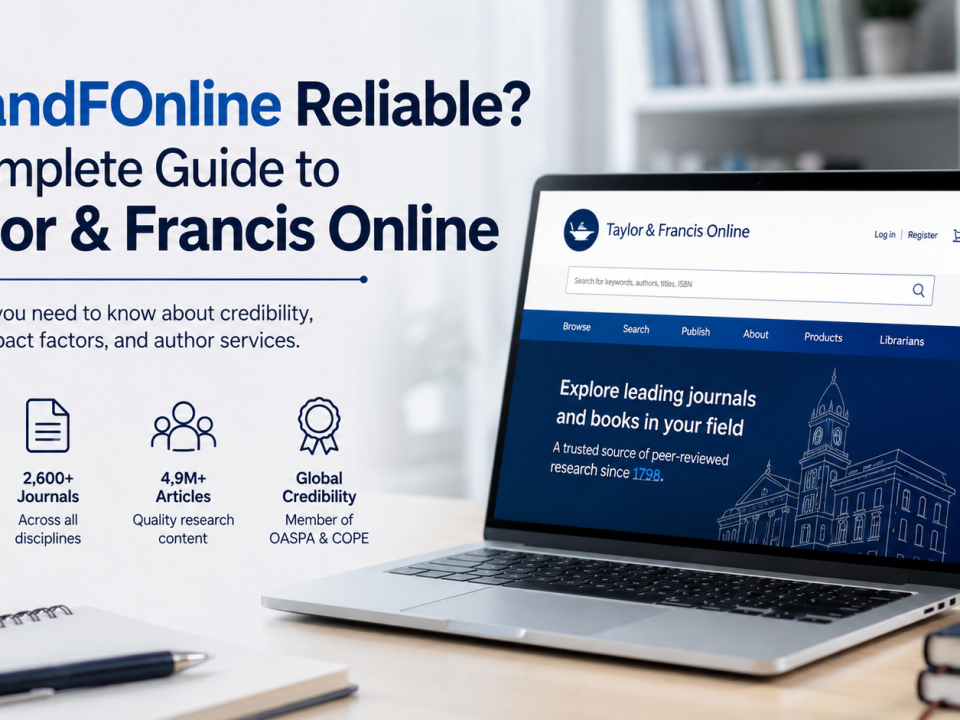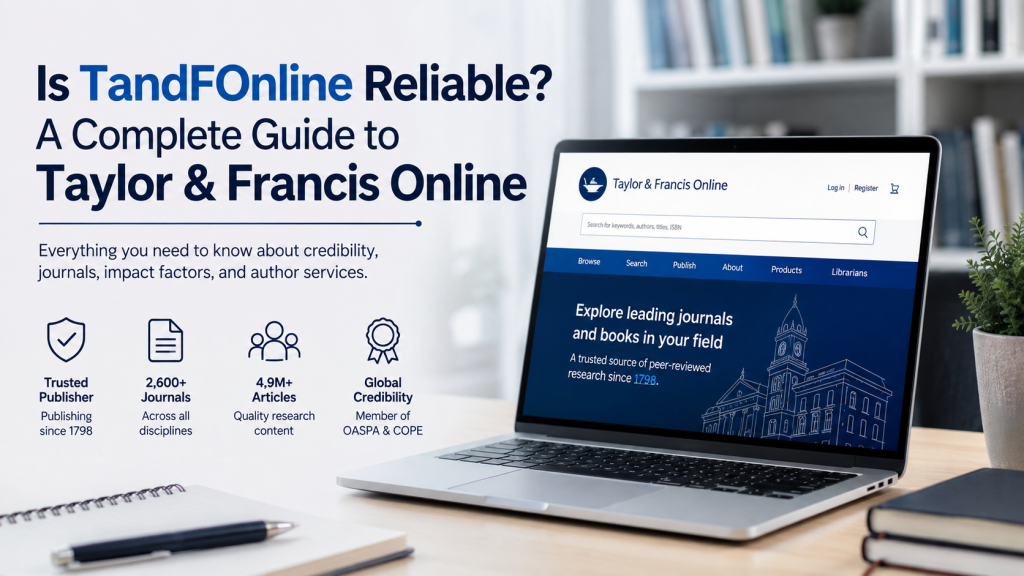



Is TandFOnline Reliable? A Complete Guide to Taylor & Francis Online
August 13, 2026
How to Write a Literature Review — Kuwaiti Standards
August 17, 2026
🤔 Not sure which journal fits your research? Find your journal – free, instant match →
Is ScienceDirect the Same as Elsevier?
I have been asked this question by more students than I can count. "Katherine, is ScienceDirect the same as Elsevier?"
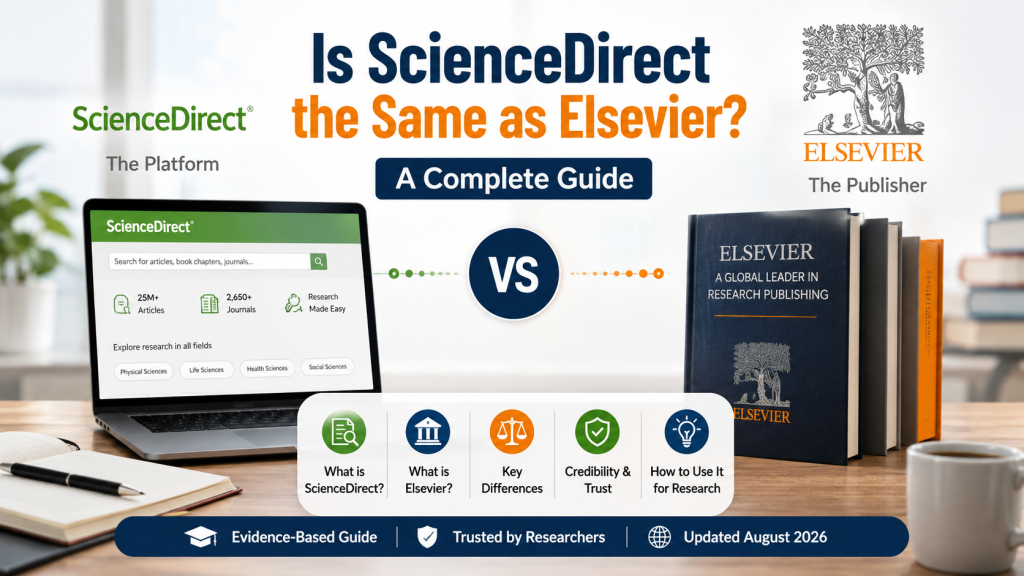
The short answer is no. ScienceDirect is not the same as Elsevier. Elsevier is the publisher. ScienceDirect is the platform where Elsevier hosts its journals, articles, and book chapters. ScienceDirect is to Elsevier what TandFOnline is to Taylor and Francis.
If you are submitting a paper to an Elsevier journal, you will use Elsevier's editorial system. Once your paper is published, it appears on ScienceDirect. That is where researchers, students, and institutions go to access millions of articles.
Here is everything you need to know about ScienceDirect. I will explain its credibility, how it differs from Elsevier, what impact factors mean, and how to use it for your research. And if you need help preparing your manuscript for an Elsevier journal, we can help with that too.
Written by Katherine Alexander, PhD · UK Academic Editor · Updated August 2026
Quick Answer: No. ScienceDirect is not the same as Elsevier. Elsevier is the publisher. ScienceDirect is Elsevier's platform for hosting peer-reviewed journals, articles, and book chapters. ScienceDirect has been active since 1997 and hosts over 25 million articles and more than 2,650 journals.
📌 We can help you get published in Elsevier journals or any journal on ScienceDirect
Our UK qualified academic editors help with journal selection, manuscript preparation, pre-submission review, and submission support. We have helped 15,000+ students get their work published.
Free consultation · No obligation · PhD qualified editors
What Is ScienceDirect?
ScienceDirect is Elsevier's primary platform for peer-reviewed academic literature. It is a scientific database operated by Elsevier, launched in March 1997. It has been running for over 25 years.
Elsevier celebrated 25 years of ScienceDirect in 2024. The platform was commercially launched as www.sciencedirect.com in 1999.
ScienceDirect is divided into four main sections:
- Physical Sciences and Engineering
- Life Sciences
- Health Sciences
- Social Sciences and Humanities
It hosts prestigious journals like Cell and The Lancet, along with thousands of other peer-reviewed titles covering scientific, technical, medical, and social science research.
Key fact: ScienceDirect hosts over 25 million articles and book chapters across 2,650+ peer-reviewed journals. It is one of the largest academic databases in the world.
Is ScienceDirect the Same as Elsevier?
No. ScienceDirect is not the same as Elsevier. Elsevier is the publisher (the company). ScienceDirect is the platform (the website) where Elsevier hosts its journals, articles, and book chapters. ScienceDirect is to Elsevier what TandFOnline is to Taylor and Francis.
| Elsevier | ScienceDirect |
| The publisher (the company) | The platform (the website) |
| Owns and manages thousands of journals | Hosts the journals, articles, and book chapters |
| Headquartered in the Netherlands | Elsevier's digital delivery platform |
| Publishes The Lancet, Cell, and 2,650+ journals | Hosts 25M+ articles from those journals |
If you submit a paper to an Elsevier journal, you will use Elsevier's editorial system. Once your paper is published, it appears on ScienceDirect. That is where researchers, students, and institutions can access and read it.
For a broader comparison of publishers and their platforms, see our Elsevier vs Springer comparison and Is TandFOnline reliable?
ScienceDirect Scale and Scope
ScienceDirect is one of the largest academic databases in the world. It hosts over 25 million articles and book chapters across more than 2,650 peer-reviewed journals.
- 25+ million articles and book chapters
- 2,650 to 3,000+ peer-reviewed journals
- 4 main subject areas: Physical Sciences, Life Sciences, Health Sciences, Social Sciences
- Open access articles: 3.8M+
- Launched: March 1997 (over 25 years ago)
Source: Elsevier's official data confirms over 25 million articles and more than 2,650 journals hosted on ScienceDirect.
Is ScienceDirect Credible?
Yes. ScienceDirect is a legitimate, credible, and professionally managed academic platform. It is the official platform of Elsevier, one of the most established academic publishers in the world.
- Member of COPE. Elsevier, the publisher behind ScienceDirect, is a member of the Committee on Publication Ethics. [Source: COPE official directory]
- Member of OASPA. Elsevier is a member of the Open Access Scholarly Publishers Association.
- Indexed in Scopus and Web of Science. ScienceDirect journals are indexed in Scopus, Web of Science, and PubMed Central. [Source: Elsevier]
- Platform since 1997. ScienceDirect has been active for over 25 years.
- 25M+ articles. A vast, professionally curated archive of research content.
- Media Bias/Fact Check rating. Media Bias/Fact Check rates ScienceDirect "Pro-Science" with a "High" factual reporting rating, based on its publication of low-bias, evidence-based scientific research. [Source: Media Bias/Fact Check]
What Is the ScienceDirect Impact Factor?
ScienceDirect itself does not have an impact factor. Impact factors belong to individual journals, not the platform that hosts them. This is the same pattern as TandFOnline and SpringerLink.
Elsevier publishes journals across Q1, Q2, Q3, and Q4 categories. Some ScienceDirect-hosted journals have high impact factors:
- Polymer: Impact Factor around 4.5 (Q1)
- Inorganic Chemistry Communications: Impact Factor around 5.9 (Q1)
- Chemical Physics Impact: Impact Factor around 4.5
- Chemical Engineering Journal Advances: Impact Factor around 5.5
- The Lancet and Cell: Top-tier, highly cited journals
What matters is the individual journal you choose to submit to, not the platform itself.
Practical tip: Before submitting to any journal on ScienceDirect, check its Scopus or Web of Science indexing, impact factor, and quartile ranking. You can find this information on the journal's page on ScienceDirect.
How to Use ScienceDirect
Is ScienceDirect free to access?
ScienceDirect is mixed in its access model. Abstracts and bibliographic metadata are free. Full-text articles generally require a subscription, institutional access, or payment of an Article Processing Charge for open-access articles.
- Free: Article abstracts and bibliographic metadata
- Subscription required: Full-text access requires a subscription or pay-per-view purchase
- Open access: Papers published under open access licenses are available without cost
- 50-day free access: Authors who publish with Elsevier receive a shareable link providing 50 days of free access
How do I find journals on ScienceDirect?
ScienceDirect has a search bar at the top of every page. You can search by keywords, article titles, author names, or DOI. You can also filter results by subject, date, or other criteria.
- Search by keywords, article titles, author names, or DOI
- Browse by journal title or subject category
- Filter results by date, subject, or other criteria
- Use the advanced search function for more precise filtering
Is there a ScienceDirect author dashboard?
Yes. Elsevier has an author dashboard for tracking submissions and published work. Authors can track the status of submitted papers, view all published articles, access sharing links, and manage their author profiles and preferences.
The dashboard is accessed via the Elsevier Publishing System, not directly through ScienceDirect's search interface.
Practical tip: If you are unsure which journal is right for your research, use our free journal matcher. We will recommend journals that fit your field, timeline, and budget.
Frequently Asked Questions: ScienceDirect
Ready to Submit but Not Sure Your Manuscript Is?
Most journal rejections happen at desk review, not peer review. Poor formatting, a weak abstract, or language issues get you rejected before anyone reads your research.
WhatsApp Us for Manuscript Support →