


Gig Economy & Platform Economy Dissertation Topics (2026-27)
November 26, 2025
100+ Data Privacy & Surveillance Studies Dissertation Topics 2026-27
November 28, 2025
Finding the right journal for your research in 2026-2027 sounds simple, but anyone who has tried knows how stressful it can get. Students spend weeks polishing every chapter, only to receive a rejection, or worse, realise the journal is not properly indexed. Deadlines get tighter, supervisors ask for revisions, and the whole process becomes overwhelming.
That is why understanding journal indexing databases has become just as important as the research itself. A well-indexed journal boosts your credibility, visibility, and the overall strength of your dissertation.
Updated for 2026-2027 · Written by Katherine Alexander, PhD, UK Academic Editor at Premier Dissertations
Quick insight: Using journals indexed in Scopus, Web of Science, and DOAJ in 2026-2027 is one of the simplest ways to strengthen your dissertation, improve credibility, and avoid predatory publishers.
🤔 Not sure which journal fits your research? Find your journal, free and instant →
📘 Explore This Page
Jump to the section you need:
- Why does Good Indexing Actually Matter?
- Scopus: The Most Trusted Index in 2026-2027
- Web of Science (WoS): The Gold Standard for High-Impact Research
- DOAJ: The Best Free Open-Access Index
- Is DOAJ Scopus Indexed?
- Scopus vs Web of Science vs DOAJ (2026-2027 Comparison)
- Indexing Sites for Journals and Directory of Research Journals
- How Students Should Pick the Right Journal
- Real Student Tip
- Frequently Asked Questions (FAQ)
- Final Thoughts
Why does Good Indexing Actually Matter?
Using properly indexed journals helps you:
- Make your dissertation more credible
- Avoid low-quality or fake studies
- Strengthen your literature review
- Follow academic standards
- Ensure examiners trust your sources
Skipping indexing checks often leads to weak references. Many students now confirm indexing before submission or get help from professional dissertation editing and publishing support to avoid mistakes.
1. Scopus: The Most Trusted Index in 2026-2027
Scopus remains the largest and most widely accepted database for peer-reviewed journals. Most universities recommend it, and supervisors expect citations from Scopus-indexed articles.
Why do Students Prefer Scopus?
- Covers journals across all major subjects
- Provides metrics like SJR, SNIP, and CiteScore
- Helps compare journals before submitting
- Recognised worldwide
How do Students Usually Use Scopus?
Students typically search by:
- Keywords
- Subject area
- Author name
- Topic relevance
After finding a journal, they review the SJR ranking, publisher details, and peer-review clarity to avoid predatory journals.
Going through dissertation examples also helps students understand how Scopus sources are cited in real academic writing.
2. Web of Science (WoS): The Gold Standard for High-Impact Research
Web of Science is more selective than Scopus. Only journals meeting strict editorial and ethical standards make it into WoS collections.
Why WoS Is Trusted?
- High-impact journals only
- Excellent citation tracking
- Includes SCIE, SSCI, AHCI, ESCI
- Favoured for PhD-level work and academic career applications
Best For:
- Master's dissertations
- PhD publications
- High-impact research
- Scholarship and academic job applications
Many departments treat WoS-indexed journals as mandatory for serious research.
3. DOAJ: The Best Free Open-Access Index
DOAJ (Directory of Open Access Journals) is a strong option for students who do not have paid database access. It includes over 20,000 journals (as of August 2026) that follow transparent review processes.
Why Students Use DOAJ?
- Completely free
- Full-text access with no login
- Ethical and quality-checked journals
- Strong in social sciences, business, humanities, and education
Best For:
- Undergraduate dissertations
- Students avoiding publication fees (no APC)
- Quick access to reliable open-access papers
Free does not mean low-quality. DOAJ has many strong journals, but students should still check the editorial board and review policy.
For technical researchers, note that DOAJ offers a public API to query its database programmatically. You can find details on the DOAJ API documentation. This is useful if you are building a reference tool or doing a large-scale literature review.
Is DOAJ Scopus Indexed?
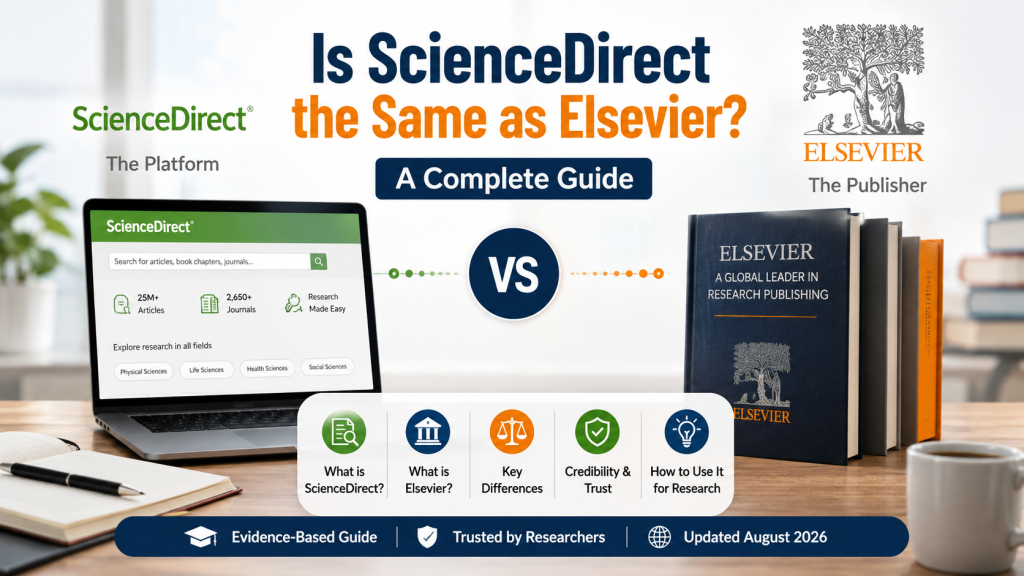
No. DOAJ is not Scopus indexed. DOAJ and Scopus are entirely separate, independently operated databases. DOAJ is a directory that verifies open-access editorial transparency. Scopus is a commercial citation database owned by Elsevier. Being listed in DOAJ says nothing about whether a journal is in Scopus or Web of Science, and the reverse is also true. Always verify each database separately.
Key distinction: DOAJ does not calculate impact factors, CiteScore, or any citation metric. It only evaluates whether a journal meets open-access quality standards. Scopus and Web of Science measure citation performance, which is a completely different job.
Scopus vs Web of Science vs DOAJ (2026-2027 Comparison)
| Feature | Scopus | Web of Science | DOAJ |
|---|---|---|---|
| Governing body | Elsevier | Clarivate | Independent non-profit |
| What it measures | Citation impact, journal quartiles, CiteScore | Citation impact, Journal Impact Factor | Open-access quality and transparency only |
| Cost to access | Paid subscription | Paid subscription | Free |
| Typical use case | Broad literature search, journal comparison | High-impact research, tenure, grant applications | Finding verified open-access journals, no-fee publishing |
| Journal count (approx.) | 25,000+ | 21,000+ | 20,000+ |
If you want maximum credibility, choose Scopus or Web of Science. If you want free access and verified open-access journals, DOAJ is ideal.
Indexing Sites for Journals and Directory of Research Journals
Students often search for "indexing sites for journals" or "directory of research journals indexing." The three databases above are the core ones you need. Additionally, these free tools can help you confirm indexing and avoid predatory journals:
- Scopus Source List — search by journal name or ISSN
- Web of Science Master Journal List — search by title or ISSN
- DOAJ Search — browse verified open-access journals
- Think.Check.Submit — checklist to avoid predatory outlets
If you are looking for a broader directory of journals across all subjects, start with Scopus and DOAJ together. That combination covers both paid and open-access titles comprehensively.
How Students Should Pick the Right Journal
- Check Journal Credibility
Impact Factor or SJR
Publisher reputation
Editorial board
Peer-review method - Compare Scopus and WoS
Some fields prefer Scopus; others require WoS. Compare both to avoid mistakes. - Avoid Predatory Journals
Verify indexing through official websites
Do not trust what the journal claims
Review APC fees and review duration - Look at Real Examples
Checking real dissertations helps students understand correct citation styles and source structure. - Review Acceptance Rates
Some journals reject 80 to 90% of submissions. Knowing this early prevents delays. - Get Professional Support
If unsure, use academic editing and proofreading to ensure everything is correct before submission.
For a faster route, use our free journal matching tool to get a shortlist based on your field.
Real Student Tip
"I always start with SJR. Then I check the last few published papers. If they look rushed or poorly structured, I avoid the journal, no matter how popular it seems."
Frequently Asked Questions (FAQ)
Final Thoughts
Choosing the right journal index is not just a technical step. It directly affects your dissertation's credibility, visibility, and academic value. Using trusted databases like Scopus, Web of Science, and DOAJ helps you avoid predatory publishers and ensures your research stands on a strong foundation.
Whether you are working on your first research paper or completing your PhD, selecting the right indexed journal shapes how examiners and future readers see your work.
If you are unsure at any stage, our dissertation editing and publishing support can guide you through journal selection, citation accuracy, and research structure so you submit confidently.
Need help checking indexing and choosing the right journal?
Get ethical journal selection support, indexing verification, and citation guidance from UK academic editors so your dissertation is built on credible, well-indexed sources.
Turnitin-safe · Supervisor-friendly · COPE-aligned support · No ghostwriting
Trusted by 15,000+ UK and international students/researchers
What Students Say About Our Indexing and Journal Support
Verified feedback from students who used our journal-selection guidance and editing services to choose well-indexed journals and avoid predatory publishers.













Last reviewed: August 2026 · Reviewed by Katherine Alexander, PhD, UK Academic Editor at Premier Dissertations
Get a Free Indexing and Source Check
Share your reading list or draft chapter for a brief review of journal indexing, credibility, and citation structure. Receive a response within 24 to 48 hours from our academic editorial team.
Ethical support · Turnitin-safe · COPE-aligned · No ghostwriting
Reviewed August 2026 · Katherine Alexander, PhD, UK Academic Editor at Premier Dissertations
⭐ Trusted by UK students · Since 2010 · Reviewed by UK Academic Editors
Request Free Review
Get a quick check of your appendices (labels, cross-references, anonymisation, layout).
Turnitin-safe · GDPR compliant · Ethical academic editing only. Need a fast reply? Chat on WhatsApp